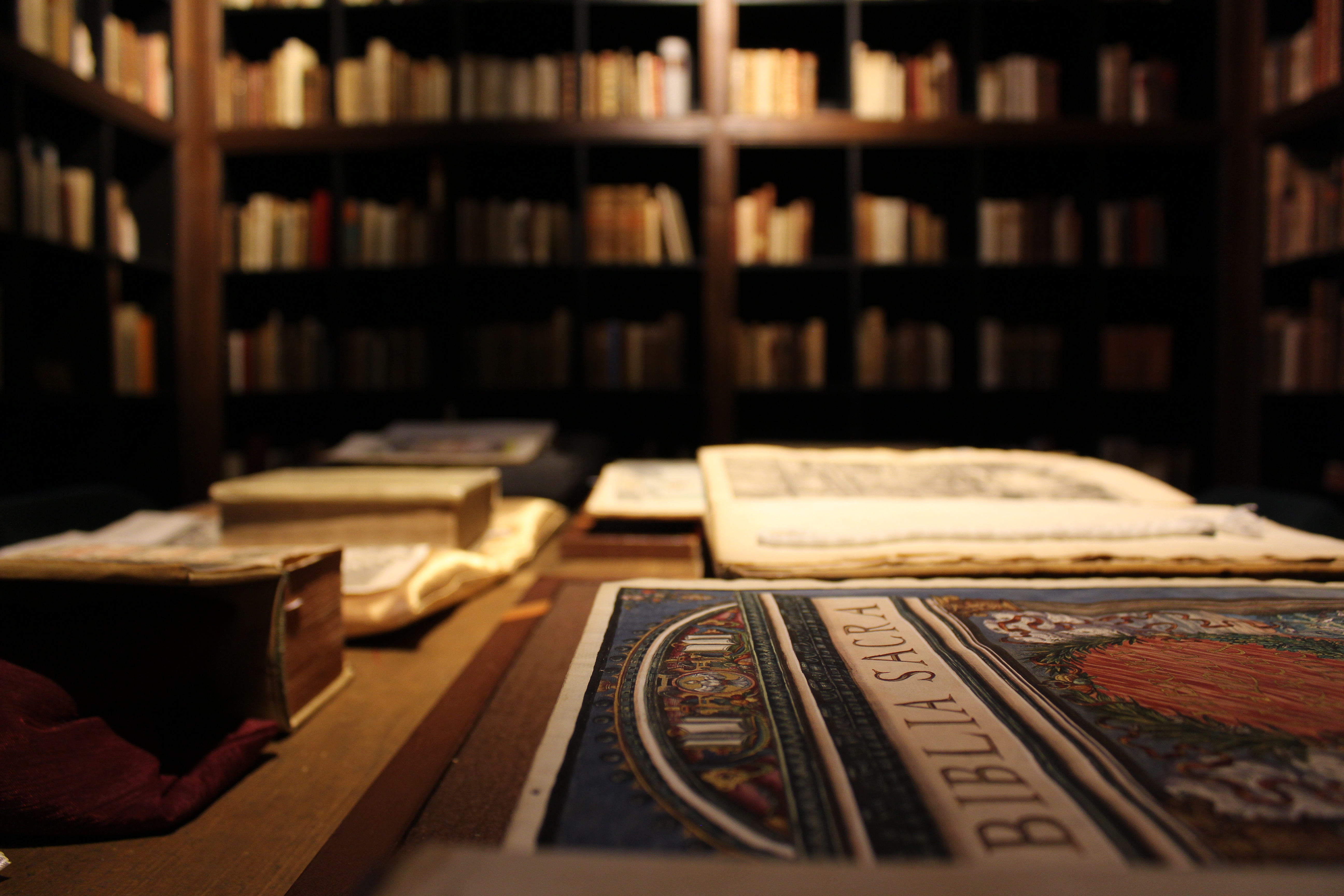
Bibliotheca Philosophica Hermetica
The mother handed her son a book and changed his life. It was a seventeenth-century edition of Aurora by the German mystic Jacob Bohme, a treatise on the divine fire that animates all matter, and Joost Ritman was still a teenager when he opened it. Most kids who get handed a four-hundred-year-old book of Christian mysticism do not become billionaires who spend the next sixty years assembling the largest private library of Hermetic texts on earth. Ritman did. The library now occupies the Huis met de Hoofden - the House with the Heads - on the Keizersgracht, a Dutch Golden Age mansion whose facade is studded with six carved stone heads of Roman gods staring blankly into the canal.
The Collector
Ritman built his fortune in packaging - specifically, in plastic cutlery and tableware - through a company called De Ster, which he turned into one of Europe's largest disposable goods firms. He poured the profits into manuscripts. He was hunting a specific intellectual tradition: the Christian-Hermetic line that runs from the Corpus Hermeticum through Renaissance Florence, through Jacob Bohme in Silesia, through the Rosicrucian manifestos of the early 1600s. This is the strand of Western thought that holds that nature is alive, that knowledge is a form of remembering, that the world is woven through with hidden correspondences. Most universities ignore it. Ritman, by the 1980s, owned more of its primary sources than anyone alive.
Treasures on the Shelves
The numbers are unusual for a private library. Around 28,000 books total. Roughly 7,500 printed before 1800. Seventy incunables - that is, books printed in the first decades after Gutenberg, before 1501. Twenty-five manuscripts written before 1550. Among the highlights: a 1471 edition of the Corpus Hermeticum in Marsilio Ficino's Latin translation, the foundational text of Renaissance Hermeticism; the first illustrated Divine Comedy from 1481; a 1465 Cicero. Many items are unique. The collection covers alchemy, Kabbalah, Rosicrucianism, Sufism, theosophy, the Grail tradition, and what the library's own catalogue cautiously labels comparative religion. To a librarian, it is a dream. To a scholar, it is an indispensable resource. To Joost Ritman, it was a private cathedral.
When the Creditors Came
Then it nearly all vanished. In the late 1990s and early 2000s, De Ster ran into financial trouble. The library was pledged as collateral. By 2010, with creditors closing in, the BPH faced the prospect of being broken up and sold piecemeal at auction - the absolute nightmare of every serious librarian, because once dispersed, such a collection can never be reassembled. The library closed its doors. Ritman and his family fought a years-long battle in the Dutch courts. In December 2011 the library reopened, but the future was uncertain. The state ended up holding part of the collection, which moved to the Allard Pierson Museum. The bulk stayed with Ritman, but the question of who would pay to keep it accessible remained unanswered.
The Dan Brown Connection
The rescue came from an unlikely direction. Dan Brown - the author of The Lost Symbol and Inferno - had spent years researching at the Ritman Library. The library's collection is precisely the kind of material his thrillers thrive on: Hermetic symbols, alchemical diagrams, secret societies meeting in candlelit rooms. In June 2016, Brown donated 300,000 euros to digitize the core collection of 4,600 early printed books and 300 older manuscripts. The Prins Bernhard Cultuurfonds added 15,000. By spring 2017, more than 2,000 of the rarest works were online. That same year, with Brown helping cut the ribbon, the building reopened to the public as the Embassy of the Free Mind - a museum, library, and research institute combined.
Memory of the World
In November 2022, UNESCO Netherlands granted the BPH collection - both the portion at the Embassy of the Free Mind and the portion at the Allard Pierson - Memory of the World status. It is the same designation given to the Magna Carta and the Diary of Anne Frank. For a library that had spent the previous decade in legal jeopardy, the recognition was vindication. The Huis met de Hoofden continues to undergo renovation. A reading room opened on the second floor in 2022. Behind the carved stone faces on the canal, scholars sit at tables and turn pages of books that have survived fires, wars, and bankruptcy. Whatever the Roman gods of the facade are guarding, it has, against the odds, made it this far.
From the Air
The Huis met de Hoofden stands at Keizersgracht 123, coordinates 52.374N, 4.879E, on the western arc of the Grachtengordel. From the air it is indistinguishable from its neighbors - the same step-gabled silhouette repeated for blocks. Nearest airport: Amsterdam Schiphol (EHAM), 14km southwest. Best viewing altitude for the canal ring: 1,500 to 3,000 feet, in clear weather, ideally near midday when the canals reflect the sky.