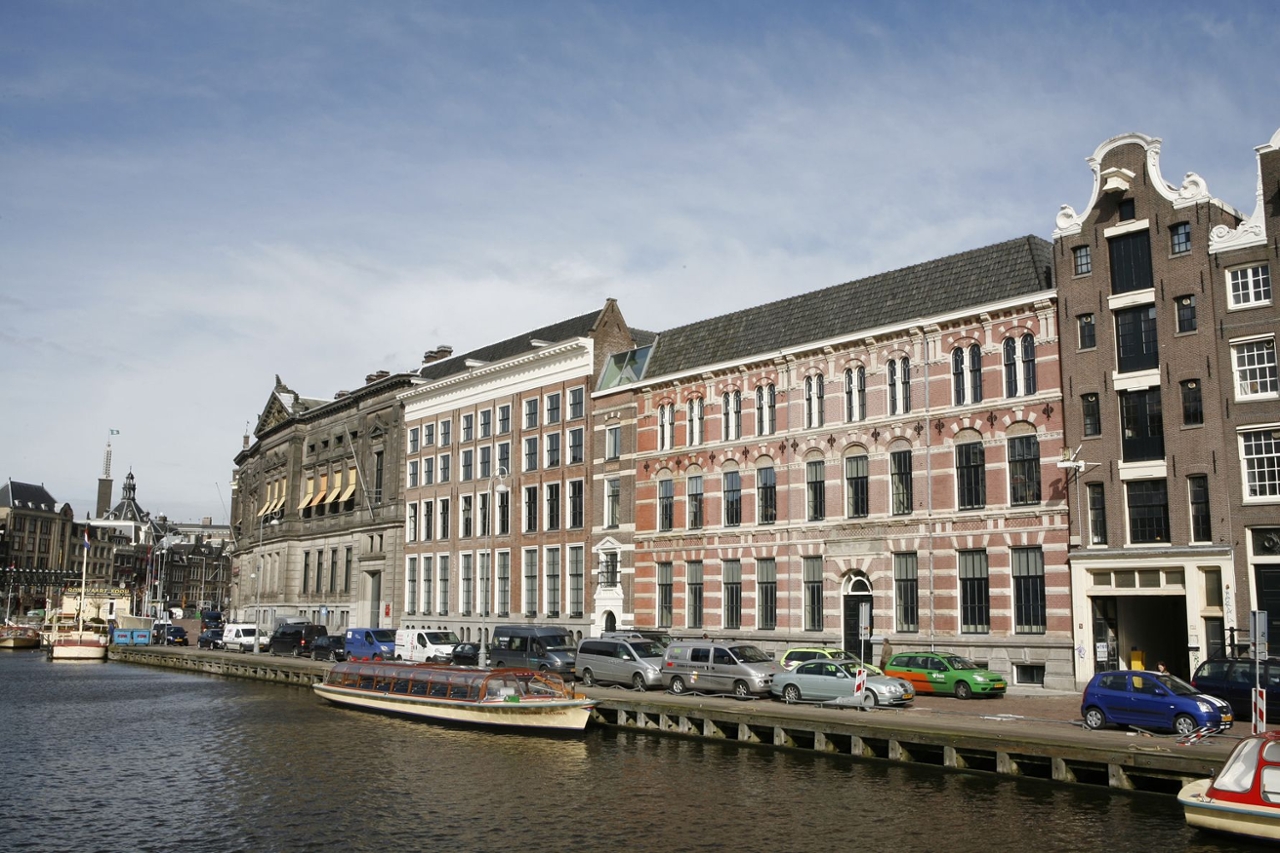
Bibliotheca Rosenthaliana
Leeser Rosenthal married Sophie Blumenthal in Hanover, and then he spent her dowry on books. This is reported with surprising mildness by the historical record, but consider what it actually meant: a young rabbi, financially independent through his Klausrabbiner position at the Michael David'sche Stiftung, took the money meant to start a household and put it into Hebraica. Manuscripts. Incunables. Volumes of Talmud commentary and Kabbalah and Jewish law. By his death in 1868, his collection - some 6,000 volumes, 32 manuscripts, 12 Hebrew incunabula - was the largest private Jewish library in Germany. Sophie's reaction to all this is not, unfortunately, preserved. What is preserved is the library itself, now in Amsterdam, against considerable odds.
Bismarck Said No
When Leeser died, his son George inherited the books and a problem. The Rosenthal children wanted the library to stay intact and serve as a public resource in their father's memory. George, a banker in Amsterdam, housed the collection at his home on the Herengracht and commissioned the Dutch-Jewish bibliographer Meijer Roest to compile a proper catalogue. Then they went looking for a permanent home. They offered the entire library to Chancellor Otto von Bismarck, hoping to place it in the Royal Library in Berlin. Bismarck declined. Other European and American libraries followed suit. It is hard now to read this without flinching - a German chancellor in the 1870s passing on the largest Jewish library in his country - but in 1880 the city of Amsterdam, then building out its new university library on the Singel canal, accepted the gift "with warmest thanks for a princely gift." Roest was appointed curator the following year.
What a Library Catalogue Can Do in a War
By 1940, the Bibliotheca Rosenthaliana had grown into the largest collection of Jewish books and manuscripts in Continental Europe. Then the Germans came, this time as occupiers. Curator Louis Hirschel and his assistant M. S. Hillesum were dismissed in November 1940. The reading room was sealed shut the following summer. But Hirschel and Herman de la Fontaine Verwey, the University librarian, had time to plan. The library's only complete catalogue was a handwritten Hebrew card index. They shuffled it thoroughly. The reading room was overstocked and had no shelf numbers - books could be removed without leaving visible gaps. Using old seals discarded when new ones had been applied, they smuggled the most valuable volumes out and hid them in a shelter in Castricum, west of Amsterdam, with the University's other treasures. When the order came in June 1944 to pack up the library for shipment to the Nazi Institute for Study of the Jewish Question, the people sent to do the work did not know what they were looking at. They took what was visible. Most of the deeper collection had already vanished into the basement and the shelter.
Hungen, Near Frankfurt
What the Nazis did take was crated and sent to Germany. The Institute for Study of the Jewish Question, run by Alfred Rosenberg's Einsatzstab, was a sprawling looting operation that intended to use stolen Jewish books to prove ideological theses about Jewish degeneracy. The Bibliotheca Rosenthaliana boxes ended up in storage near Hungen, outside Frankfurt am Main. The war ended before the institute could do much with them. Most boxes came back to Amsterdam. The same cannot be said for Hirschel, who was murdered at Bergen-Belsen in 1944, or for his assistant Hillesum, who was killed at Auschwitz in 1943. They had saved the library. They could not save themselves, their families, or the people whose collections they had spent their working lives cataloguing.
The Manuscript Hannah Wrote
Walk through the special collections today and you can ask to see things that almost no one else has. The Esslingen Machzor, completed by the scribe Kalonymos ben Judah on 12 January 1290 - one of the great medieval Ashkenazi prayer books, large enough to suggest it was made for community use. A late thirteenth-century copy of Sefer Or Zarua, the magnum opus of Rabbi Isaac ben Moses of Vienna, one of only two surviving medieval copies (the other is in the British Library). The Pekidim & Amarkalim archive: 10,100 letters documenting the early Jewish settlement in Ottoman Palestine. And, dated 10 June 1386, a copy of the Sefer Mitzwot Katan signed by its scribe - Hannah, daughter of Menachem Zion. Of more than four thousand known medieval Hebrew scribes, fewer than ten were women. Hannah is one of them. The quality of her hand suggests she came from a scholarly family, but the record does not say. Her signature is enough.
What Returns
The Bibliotheca Rosenthaliana continues at the University of Amsterdam's Special Collections, expanded steadily across two centuries to cover all fields of Jewish study. The Hebrew and Yiddish manuscripts have been digitized by the National Library of Israel. The Menasseh ben Israel books - works of the seventeenth-century Amsterdam rabbi who lobbied Cromwell to readmit Jews to England - were the first to go online, back in 1999. The library is functional, working, ordinary. Students come and look up references. They do not always know that the books in front of them were once packed into crates marked for Frankfurt, and that the only reason they made it back is that two librarians risked their lives shuffling a card catalogue.
From the Air
The University of Amsterdam Special Collections occupies a building on the Oude Turfmarkt at 52.368N, 4.890E, just off the Rokin in central Amsterdam. Nearest airport: Amsterdam Schiphol (EHAM), 14km southwest. From cruising altitude the building is invisible - one unit in the dense fabric of the old city. The Singel and Oude Turfmarkt mark a transition between the medieval core and the Golden Age canal ring.