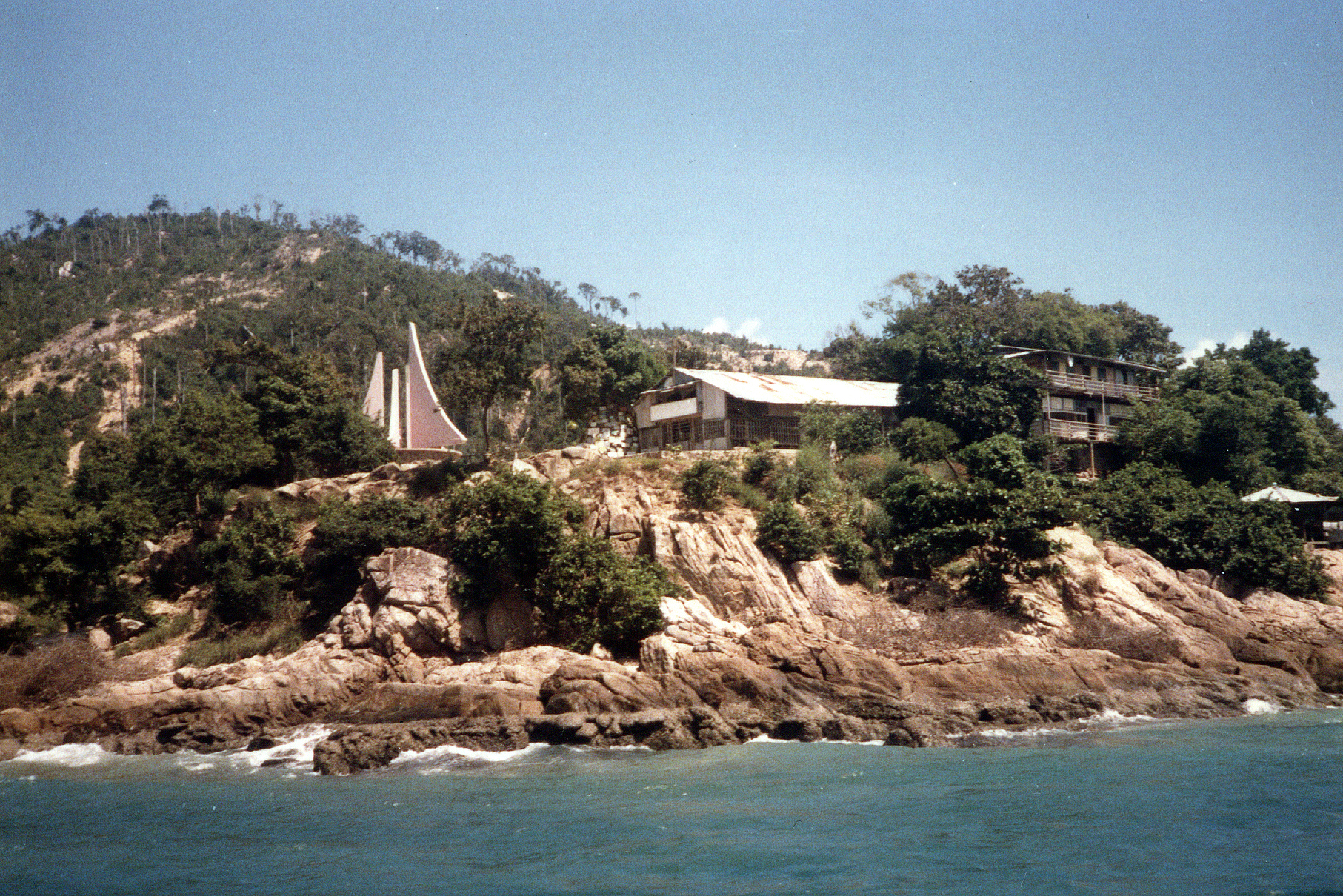
Bidong Island
By June 1979, approximately 40,000 people were living on a patch of flat ground hardly larger than a football field. Bidong Island, a speck in the South China Sea off the coast of Terengganu, Malaysia, had been designated a refugee camp less than a year earlier with an official capacity of 4,500. It was said to be the most densely populated place on Earth. The refugees called themselves boat people, and every one of them had survived a journey that thousands of others had not -- across open water in overloaded vessels, past pirates who robbed, raped, and killed with impunity, to an island where survival was not guaranteed but was at least possible. Leo Cherne, who visited the camp, called it "Hell Isle." The people living there simply called it better than the alternative.
The Fall and the Flood
On 30 April 1975, the Vietnam War ended with the fall of Saigon. Millions of Vietnamese faced the prospect of life under Communist rule, and many chose to flee. The first boat carrying 47 refugees arrived in Malaysia in May 1975, but the exodus remained a trickle until 1978, when political repression and economic collapse in Vietnam turned it into a torrent. Bidong Island was officially opened as a refugee camp on 8 August 1978 with 121 Vietnamese refugees. By August, another 600 had arrived. After that, boats came almost daily. The Malaysian government, overwhelmed and unwilling to absorb the refugees permanently, funneled arrivals to Bidong and other designated camps. Boats that tried to land elsewhere on the coast were often pushed back to sea or towed to the island. Southeast Asian governments made clear they would accept the refugees only as a transit point, not a destination.
Surviving Hell Isle
Conditions on Bidong tested the limits of human endurance. Refugees constructed makeshift shelters two and three stories high from the timbers of their own wrecked boats, plastic sheeting, flattened tin cans, and scraps of corrugated iron. Latrines were inadequate. Wells ran foul. Tropical rainstorms sent rivers of contaminated water coursing through the camp. Every drop of clean water and every grain of rice had to be shipped from the mainland, and water was rationed to one gallon per person per day. Doctors were plentiful -- many refugees were professionals -- but medicine was scarce, sanitation nearly nonexistent, and hepatitis rampant. Yet the camp functioned. The refugees organized themselves with remarkable efficiency, establishing small businesses, food distribution networks, and a water rationing system that kept people alive. The Malaysian Red Crescent Society, the United Nations High Commissioner for Refugees, and a constellation of NGOs provided support, while immigration officials from countries around the world visited the island to interview refugees for resettlement.
A Diplomatic Lifeline
The crisis forced the world's hand. At a Geneva conference in July 1979, Vietnam agreed to restrain the flow of refugees, and Southeast Asian nations agreed to accept all who reached their shores -- provided Western countries guaranteed resettlement for the majority. President Jimmy Carter doubled the United States' monthly quota for Indochinese refugees from 7,000 to 14,000. Canada, Australia, and France expanded their programs in turn. Slowly, the population of Bidong began to decline as families departed for new lives in Houston, Sydney, Montreal, and Paris. The island became a way station rather than a dead end, though the wait could stretch for months or years while paperwork ground through distant bureaucracies. For many refugees, Bidong was the place where the terror of the crossing gave way to the grinding uncertainty of limbo.
Closure and Forced Return
Bidong closed as a refugee camp on 30 October 1991. By then, roughly 250,000 Vietnamese had passed through the island. But the story did not end cleanly. The remaining refugees in Malaysia faced forced repatriation to Vietnam -- a prospect they protested fiercely, having risked their lives specifically to leave. Between 1991 and 28 August 2005, when the last refugees departed, approximately 9,000 Vietnamese were sent back. The repatriations were contentious, raising questions about whether people who had endured so much to escape should be compelled to return. For the international community, it was a pragmatic resolution to a crisis that had lasted more than a decade. For the individuals involved, it was a second upheaval.
An Island Remembers
In 1999, Bidong was opened to tourism, and the island has regained much of the beauty that existed before 40,000 desperate people transformed it into one of history's most improbable cities. The jungle has reclaimed the hillside, coral reefs surround the shore, and Universiti Malaysia Terengganu operates a marine research station where students study the ecosystems that are slowly healing. Former refugees have returned to visit, walking beaches they once scanned for approaching boats and standing on ground where they waited for news that a country -- any country -- would take them. The island that was once the most crowded place on Earth is now one of the quietest spots on the Malaysian coast, a place where the South China Sea laps against a shore that holds more stories than any research station can catalog.
From the Air
Located at approximately 5.62°N, 103.07°E in the South China Sea, about 15 km off the coast of Terengganu, Malaysia. The island is accessible from the coastal town of Merang. From the air, Bidong appears as a small, densely forested island surrounded by clear tropical waters and coral reefs. Sultan Mahmud Airport (WMKN) in Kuala Nerus/Kuala Terengganu is the nearest major airfield, roughly 40 km to the southwest. At low altitude (1,000-3,000 feet), the island's small size and isolation are striking -- it is difficult to believe 40,000 people once lived here.