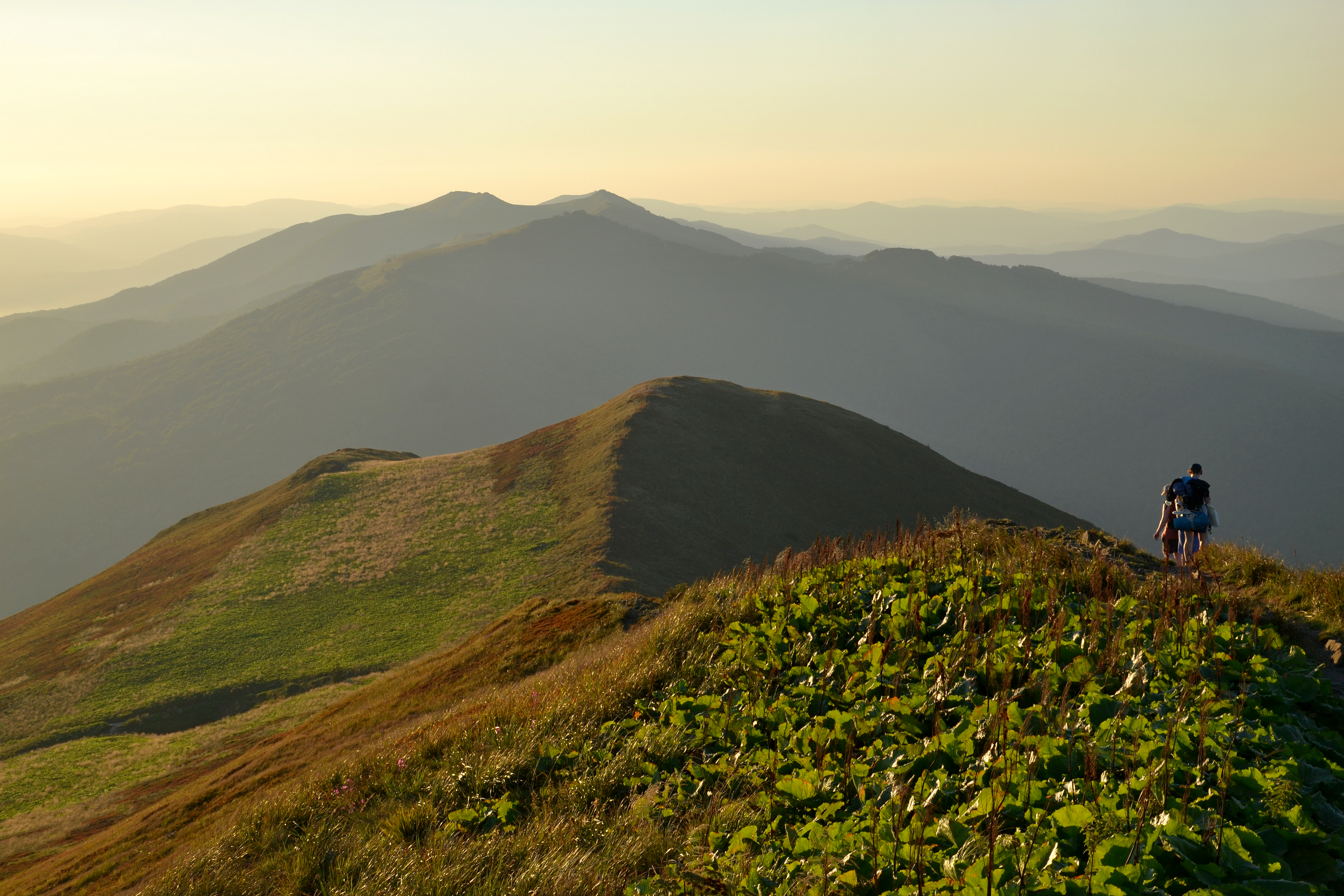
Bieszczady National Park
The villages are still there, or what remains of them. Stone foundations. A wall half-standing. An orchard gone wild, apple trees fruiting for no one. In the southeastern corner of Poland, where the Bieszczady Mountains meet the borders of Slovakia and Ukraine, entire communities vanished in the 1950s -- their populations expelled during post-war ethnic resettlement campaigns. What grew back in their absence was wilderness. In 1973, the Polish government declared this emptied landscape a national park. Today, Bieszczady National Park is the largest mountainous park in Poland and one of its most pristine, a place so remote that brown bears, wolves, and European bison move through forests where people once lived.
The Emptying of a Mountain Country
Settlement in the Bieszczady came late and never took firm hold. Serious habitation began only in the late 14th century, when small pastoral and logging communities established themselves in the valleys. The region never expanded much. By the 17th century, economic decline drove some residents to plundering the caravans that passed through the mountains on their way to Hungary. During the Second World War, the Bieszczady became a theater of partisan warfare -- shifting allegiances, ambushes, reprisals. The violence culminated in the forced expulsion of the local population in the 1950s, an operation that depopulated dozens of villages. Their ruins remain visible today, slowly being consumed by the forest. Walking through one of these abandoned settlements, you encounter the particular silence of a place that was once home and is now turning back into earth.
Ridgelines of Grass Above a Sea of Beech
The Bieszczady are not alpine. There are no jagged peaks, no permanent snowfields, no technical climbing routes. What the range offers instead is something gentler and, in its own way, more striking: mountains covered almost entirely in primeval beech forest, their canopy unbroken for kilometers, until the highest ridges break above the treeline into broad, grassy meadows the locals call poloniny. These high meadows are the park's signature landscape -- windswept in every season, commanding views across a seemingly uninhabited world. Polonina Wetlinska and Polonina Carynska are the most visited, their gentle slopes accessible to hikers of moderate fitness. Below the poloniny, the forests harbor European bison, brown bear, wolf, aesculapian snake, and black stork. The summers are mild, averaging around 15 degrees Celsius, but rain arrives suddenly and frequently, and thunderstorms build fast over the ridges.
A Park That Resists Convenience
Visiting Bieszczady requires a certain acceptance of inconvenience. There is one petrol station in the entire park. Local roads sometimes cross through fords that may or may not be dry. Public transport is essentially nonexistent -- private minibus drivers run irregular schedules between a few trailheads and wait until their vehicles are full before departing. Taxis operate during daylight hours only; finding one at night is a genuine challenge. The nearest real supermarkets are in Lesko or Ustrzyki Dolne, about 40 kilometers away through the hills. Come well stocked, because the park's convenience stores will overcharge you without hesitation. This difficulty of access is part of the point. Bieszczady is Poland's refuge for people who want to be somewhere that modernity has not fully reached, where the journey matters as much as the destination.
Darkness Falls Early Here
The park lies in a border zone -- Slovakia to the south, Ukraine to the east along the San River valley -- and surprise passport controls are common. But the more pressing boundary is temporal: get off the mountains before five in the afternoon. After that hour, the minibus drivers quit, and the darkness that settles over the Bieszczady is a deep, rural darkness, uncut by streetlights or distant glow. Hikers caught out after dark may find themselves unable to see the trail at all. The park charges a symbolic entry fee of 9 zloty per adult, less for students and pensioners. Camping is legal only in designated spots called pole namiotowe, which provide tap water and power outlets. Sleeping in the backcountry is prohibited. These are small rules for a large wilderness, a landscape where bears and boars are the primary safety concern and where the night belongs entirely to the animals.
From the Air
Located at 49.11N, 22.66E in the southeastern tip of Poland's Podkarpackie voivodeship, bordering Slovakia and Ukraine. The park's poloniny (treeless ridgelines) are distinctive from the air -- grassy summits emerging from continuous beech forest canopy. Best viewed at 3,000-5,000 feet AGL. The San River valley marks the eastern boundary. Nearest airports: Rzeszow-Jasionka Airport (EPRZ), approximately 130 km northwest. The park sits at the junction of three national borders, with Slovakia's Poloniny National Park immediately to the south.