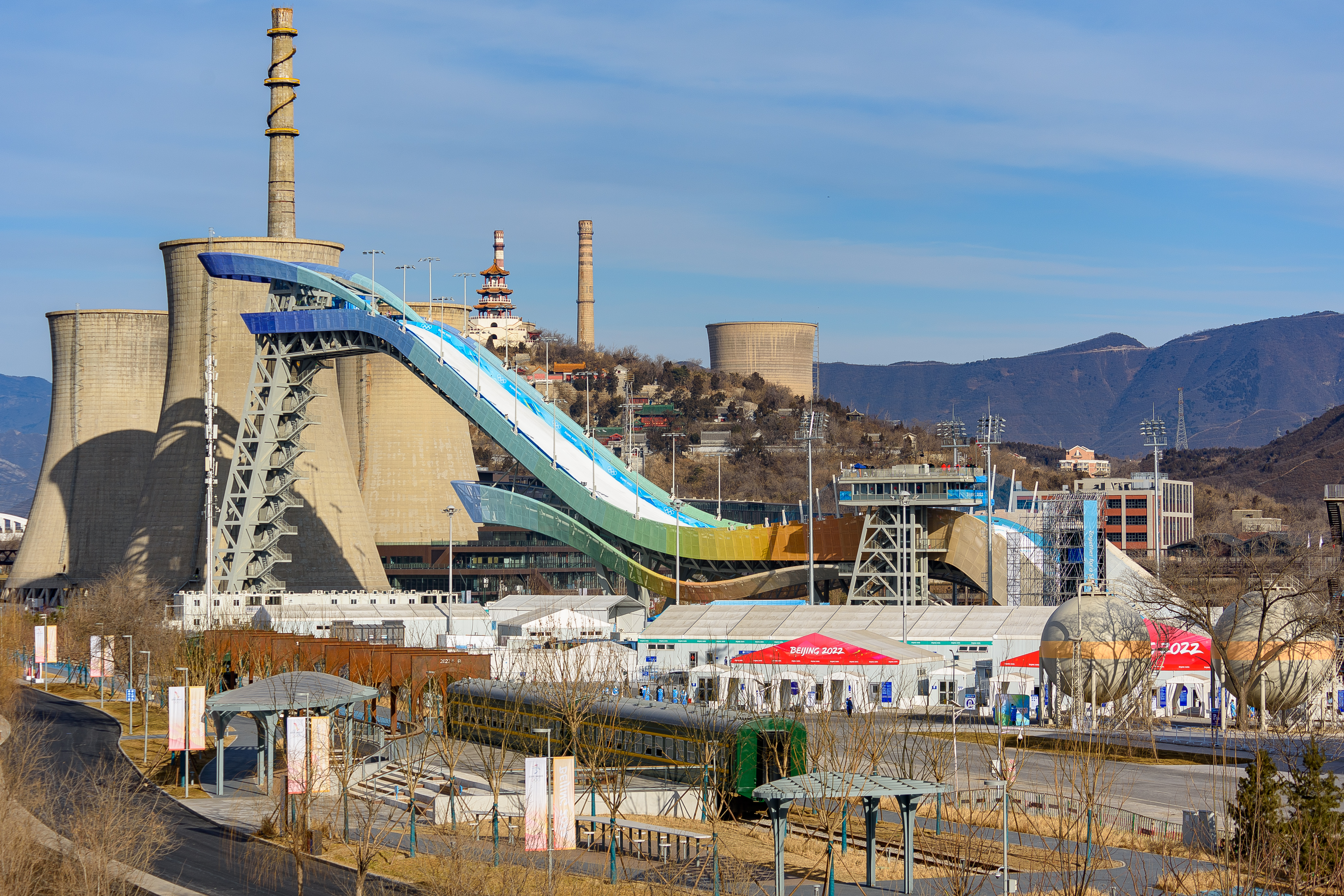
Big Air Shougang
The images were so bizarre they went viral before the first skier even left the ramp. A gleaming white ski jump, dusted with manufactured snow, soaring upward beside four massive industrial cooling towers -- no mountains in sight, no alpine valley, no pines. Just the concrete skeleton of a decommissioned steel mill in western Beijing's Shijingshan District. Big Air Shougang, the world's first permanent big air venue, was built not to blend in but to provoke, and during the 2022 Winter Olympics it delivered one of the Games' most unforgettable visual contrasts.
From Molten Steel to Manufactured Snow
For decades, the Shougang Group steel mill was one of Beijing's largest industrial employers and one of its worst polluters. The plant operated for nearly a century before the city government, under pressure to clean Beijing's air ahead of the 2008 Summer Olympics, ordered its closure. The last furnace went cold in December 2010. What remained was a sprawling industrial campus of blast furnaces, cooling towers, and rail sidings -- too massive to demolish easily, too central to ignore. Rather than raze the site, planners saw an opportunity. The old mill became one of the most ambitious urban renewal projects in China, reimagined as a mixed-use campus for technology companies, cultural venues, and eventually, Olympic sport.
The Ramp Between the Towers
Construction of the big air venue ran from 2018 to November 1, 2019, producing a structure unlike any other in competitive skiing or snowboarding. The ramp rises 60 meters, launching athletes into the air against a backdrop of hulking cooling towers rather than the mountain panoramas typical of snow sports. During the 2022 Winter Olympics, four medal events took place here: men's and women's freestyle skiing big air and men's and women's snowboarding big air. The juxtaposition was polarizing. Reuters and SBNation described the scene as "dystopian," while others praised the venue as visionary -- a monument to what industrial wastelands can become. Chinese state media held up the venue as a symbol of the country's capacity for reinvention, proof that the smokestacks of the past could share space with Olympic glory.
Snow Sports in a Snow-Free City
Perhaps the strangest thing about Big Air Shougang is its location in a city that rarely sees significant snowfall. Beijing sits on the edge of the North China Plain, far from any ski resort, and the venue relied entirely on artificial snow -- itself a source of environmental debate throughout the 2022 Games. As the only snow sports venue in the city proper, it was one of just two competition venues built within Beijing for the Winter Olympics. The rest were located in the mountains northwest of the capital. After the Games, the venue remained open as a permanent facility, hosting international competitions and serving as an anchor for the broader Shougang industrial park redevelopment. Where blast furnaces once glowed orange through the smog, freestyle skiers now twist through the Beijing sky.
From the Air
Located at 39.91N, 116.15E in Beijing's Shijingshan District, in the western part of the city. From the air, look for the distinctive white ramp structure adjacent to four large cooling towers amid the former Shougang steel mill complex along the Yongding River. Nearest major airport is Beijing Capital International Airport (ZBAA/PEK), approximately 35 km northeast. Beijing Daxing International Airport (ZBAD/PKX) lies about 55 km southeast. Best viewed at 2,000-4,000 ft for the industrial-to-Olympic contrast.