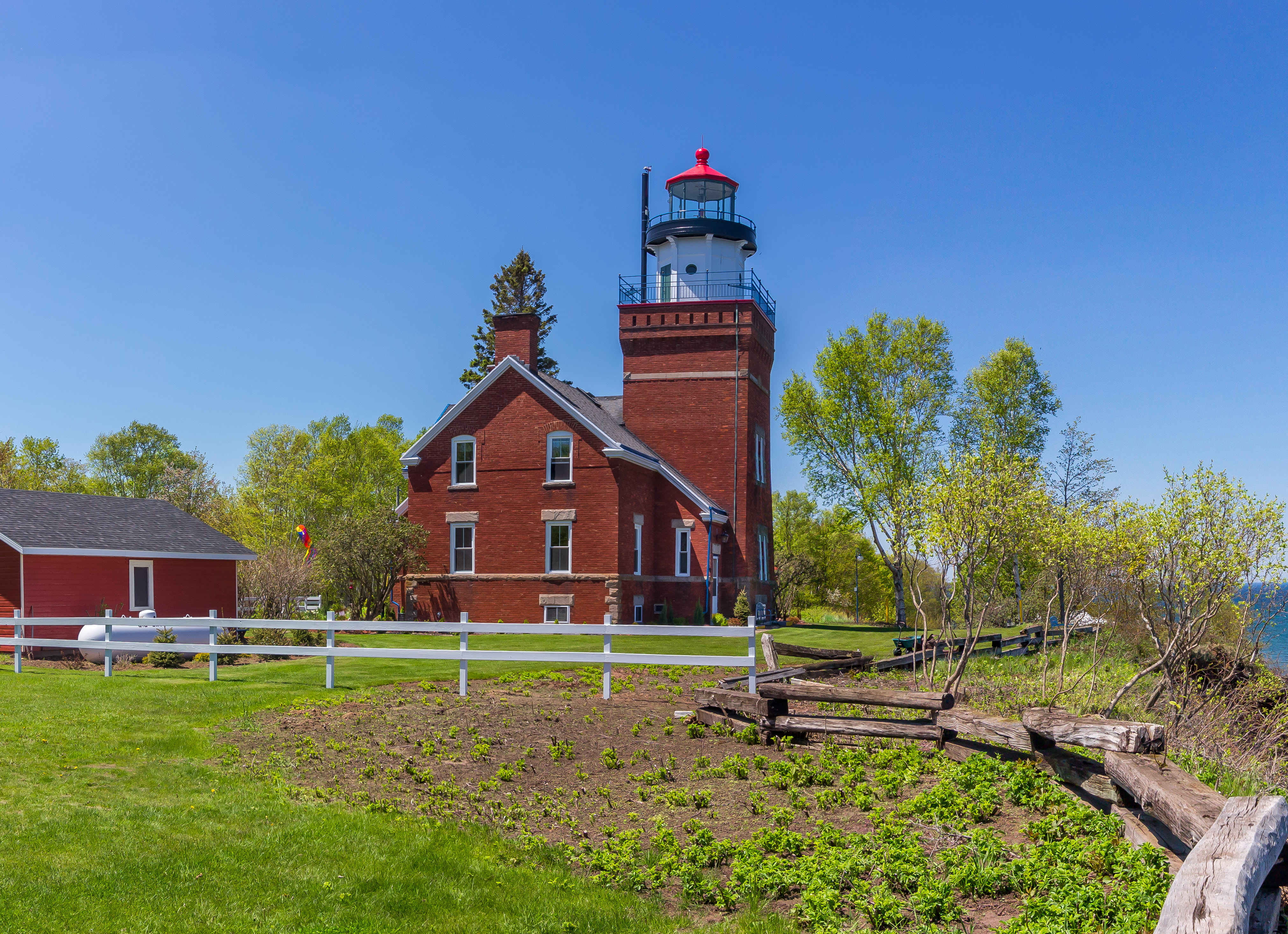
Big Bay Point Light
The red-haired man appears in mirrors. Doors slam in rooms where no one is sleeping. These are the stories guests tell at Big Bay Point Light, a bed and breakfast that happens to occupy a functioning lighthouse on the Upper Peninsula of Michigan -- one where the first keeper, William Prior, disappeared in 1901 and was found eighteen months later, hanging from a tree a mile into the woods. Whether Prior killed himself from grief after his son George died of a leg injury, or whether something darker happened, no one has settled. What is settled is that the light station he tended still stands on its tall bluff above Lake Superior, its intricate fortress-style brickwork still intact, its octagonal lantern still visible from the water, and its guest rooms still occasionally visited by something with red hair and a fondness for slamming doors.
Filling the Dark Gap
The Lighthouse Board received the recommendation in 1882: Big Bay Point sat midway between Granite Island and the Huron Islands, and the two lights on either side were invisible to each other. The stretch between them was entirely dark. Ships had been wrecking on Big Bay Point for years, feeling their way along an unlighted coast where fog could erase the horizon without warning. The station was built to fill that gap, a brick keeper's dwelling with an attached tower tall enough to place the light high above Lake Superior. A fog signal building followed, housing two steam train whistles that punched through the murk until 1928, when a modern air diaphone replaced them. The design was a duplex -- two families sharing a structure, the head keeper's side the only one with access to the tower office. Each half had six rooms, a kitchen pump connected to a basement cistern, and the grinding isolation of a post reachable only by water.
Keepers at the Edge of the World
Life at Big Bay Point was genuinely remote. When the light was built, no road reached the station. Everything arrived by boat -- supplies, mail, replacement personnel. The keepers' wives schooled their children in the dwelling, cooked in kitchens plumbed to rainwater cisterns, and shared their walls with the families on the other side of the duplex. When paint contaminated the cistern water, the alternative was hauling buckets up from Lake Superior. As the country shifted to eight-hour work shifts, a third keeper was added and housed in a frame building at the bottom of the bluff, complete with its own outhouse. The compound grew: two brick privies, an oil house for the Fresnel lens fuel, a dock, a well house. Each structure an answer to a specific problem of living at the edge of the navigable world, where the only reliable neighbor was the light itself.
The Vanishing of William Prior
William Prior was the first keeper assigned to Big Bay Point. Red-haired and devoted to the station, he watched his son George die from a leg injury -- the kind of loss magnified by isolation, where grief had no neighbors to absorb it. In 1901, Prior walked away from the lighthouse and did not come back. Nearly a year and a half later, his body was found hanging from a tree roughly a mile from the station. Whether he chose that tree himself or was put there by someone else remains an open question. What followed was the ghost story. Guests at the bed and breakfast report a red-haired figure visible in mirrors, doors banging shut in the middle of the night, the particular unease of sleeping in a building where tragedy soaked into the brickwork. The lighthouse was listed on the National Register of Historic Places on November 12, 1988. The ghost, presumably, was already in residence.
Sleeping Where the Light Was
The station was automated in 1941, and by 1961 a steel tower on the grounds carried the active navigation light, making the original structure expendable. It was sold to a buyer named Pick, who restored the building and furnished it with antiques. Eventually the 18-room keeper's dwelling became what it is today: one of the few operational lighthouse bed and breakfasts in the country. The original third-order Fresnel lens, once displayed in the fog signal building, is now on loan to the Marquette Maritime Museum. The tower still rises above the bluff with its fortress-style brickwork near the apex, matching the style of its contemporary, Old Mackinac Point Light. Guests sleep in rooms where keepers once listened for the fog bell, and the brick walls that held back Lake Superior storms for over a century now hold the comfortable quiet of a place that has outlived its original purpose and found a better one.
From the Air
Located at 46.84°N, 87.68°W on a tall bluff over a rocky point near Big Bay, Michigan, approximately 25nm northwest of Marquette on the Upper Peninsula. The lighthouse is a distinctive red-brick structure visible on the clifftop from the water and from moderate altitude. Nearest major airport is Sawyer International Airport (KSAW) approximately 20nm to the southeast. The light station sits midway along the coast between Granite Island Light (to the southeast) and Huron Islands Lighthouse (to the northwest). A steel navigation tower on the grounds still carries an active aid to navigation. The bluff gives the structure dramatic visibility from Lake Superior approaches. Expect variable weather conditions typical of the southern Lake Superior coast, with fog common in spring and early summer. The surrounding shoreline is rocky with limited emergency landing options.