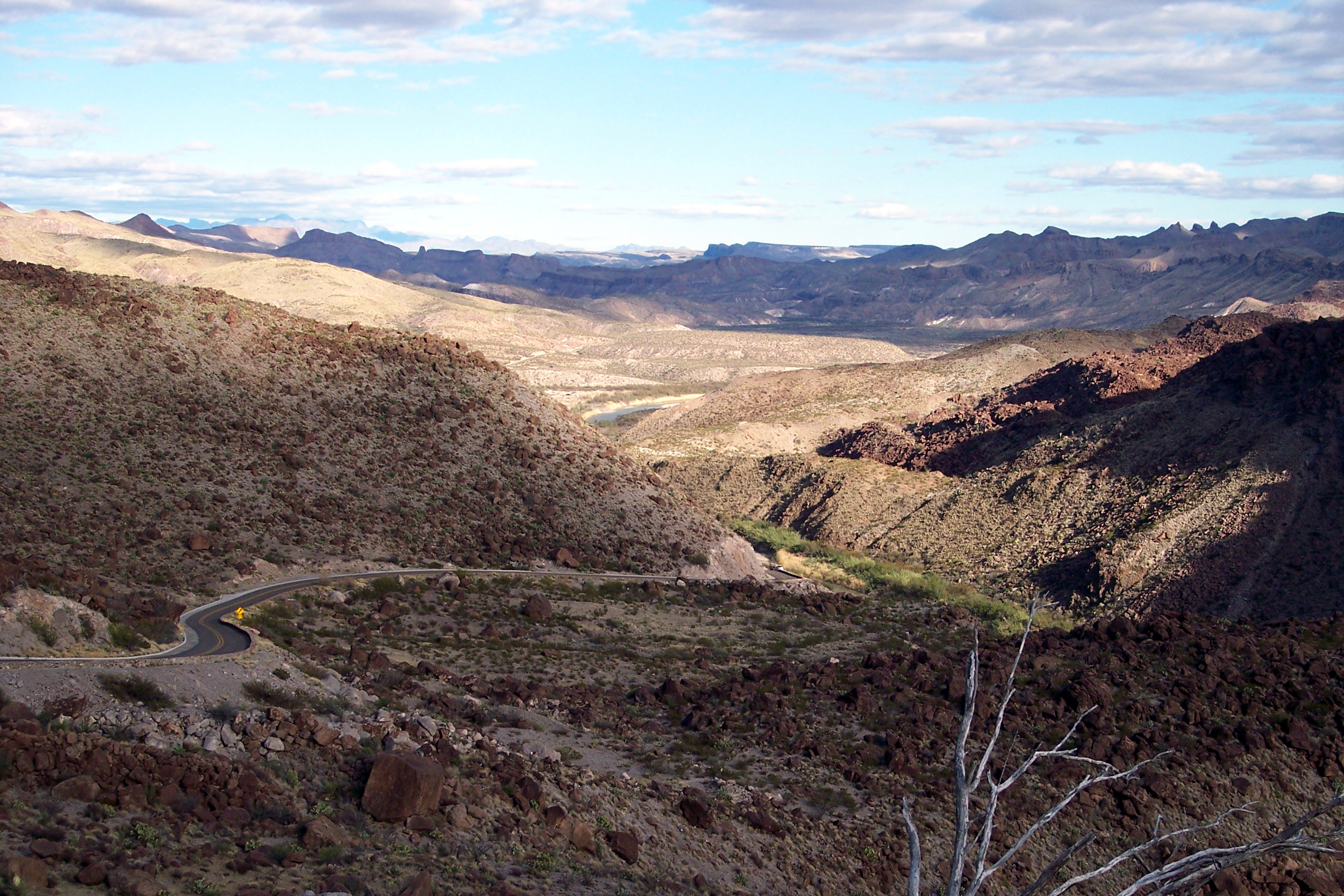
Big Bend National Park
The Chisos Mountains have no business being here. They rise from the Chihuahuan Desert floor like a mirage made stone, the only mountain range in the United States fully contained within a national park's boundaries. At their feet, the Rio Grande makes the dramatic turn that gives Big Bend its name, carving through Santa Elena Canyon's thousand-foot walls before continuing its long journey to the Gulf. This is Texas at its most unexpected, a land where archaeological sites date back ten thousand years, where buffalo soldiers once patrolled, and where the sky after dark holds more stars than most Americans have ever seen.
Deep Time Written in Stone
Big Bend is a paleontologist's paradise. Researchers have worked here since 1907, when Johan Udden discovered shark and ammonite fossils. In 1940, legendary fossil hunter Barnum Brown uncovered neck vertebrae of Alamosaurus, a giant sauropod, along with jawbones of Deinosuchus, an ancient crocodilian. The rocks tell of dramatic transformations: 83 to 72 million years ago, this land was a complex mosaic of deltas where hadrosaurs, ceratopsids, and tyrannosauroids roamed. Later, during the Javelina Formation period 72 to 67 million years ago, Quetzalcoatlus spread its wings here, the largest pterosaur ever known, with a wingspan that may have exceeded thirty feet. The first fossil museum burned in 1941, taking mammoth teeth and saber-tooth cat remains with it.
Peoples of the Bend
The Chisos people were here first, loosely organized hunters and gatherers speaking a Uto-Aztecan language that connected them to peoples from central Mexico to the Great Basin. The Jumano traded throughout West Texas. Then came the Mescalero Apache in the eighteenth century, displacing the Chisos. The Comanche passed through along their raiding trail into Mexico. Spanish expeditions arrived around 1535, following in the footsteps of Alvar Nunez Cabeza de Vaca. Presidios rose along the Rio Grande, then fell to financial troubles and Apache raids. After the Mexican-American War, buffalo soldiers protected settlers, and Henry Flipper, the first African American graduate of West Point, served nearby at Shafter. Ranchers arrived around 1880, and by 1900 their sheep, goats, and cattle had overgrazed the delicate desert.
The Living Desert
More than 1,200 plant species color the Big Bend landscape. Prickly pear and claretcup cactus bloom alongside bluebonnets in spring, sometimes revealing rare white and pink varieties. Desert marigold, ocotillo, and lechuguilla thrive in the harsh conditions. The candelilla plant once supported entire communities; wax camps like Glenn Springs processed its valuable coating. At night, the desert comes alive. About two dozen cougars patrol the park despite 150 reported sightings per year. Coyotes, kangaroo rats, roadrunners, golden eagles, and javelinas share the land. Mexican black bears roam the mountains. Plans to reintroduce the Mexican wolf failed in the 1980s when Texas rejected the proposal.
A Birder's Promised Land
Over 450 bird species have been recorded at Big Bend, drawing enthusiasts from around the world. The park holds the only breeding ground in the United States for the Colima warbler, a small gray bird that arrives in the Chisos Mountains each April, nests through summer in the high canyons, then returns to southwestern Mexico by mid-September. Eight distinct land-cover types create this diversity: desert shrubland, igneous grassland, limestone grassland, riparian vegetation, montane woodland, bare ground, developed areas, and surface water. The elevation changes between the hot desert floor at 1,800 feet and Emory Peak at 7,832 feet create climate zones that support species from both temperate and tropical origins.
Under the Darkest Skies
In 2012, the International Dark-Sky Association designated Big Bend an International Dark Sky Park with its highest Gold Tier rating, recognizing skies free from all but the most minor light pollution. National Park Service measurements confirm what visitors have long known: Big Bend has the darkest skies in the contiguous United States. Thousands of stars, bright planets, and the Milky Way blaze overhead on clear nights. The park remains one of the largest, most remote, and least-visited national parks in the Lower 48, averaging just 377,154 visitors annually from 2009 to 2019. Those who make the journey find trails that circle the Chisos, hot springs where J.O. Langford once welcomed guests, and a border crossing to Boquillas, Mexico that reopened in 2013 after being closed following September 11.
From the Air
Big Bend National Park is located at 29.25N, 103.25W in the great bend of the Rio Grande in West Texas. The Chisos Mountains rise dramatically from the desert floor and are unmistakable from altitude, the only mountain range fully contained within a U.S. national park. Santa Elena Canyon's thousand-foot walls mark where the Rio Grande cuts through Mesa de Anguila on the western boundary. The nearest airports are Alpine-Casparis Municipal (E38) approximately 60 miles north and Lajitas International (T89) near the western boundary. International airspace with Mexico begins at the Rio Grande. Watch for rapidly changing weather conditions and extreme summer temperatures that can exceed 100F at lower elevations.