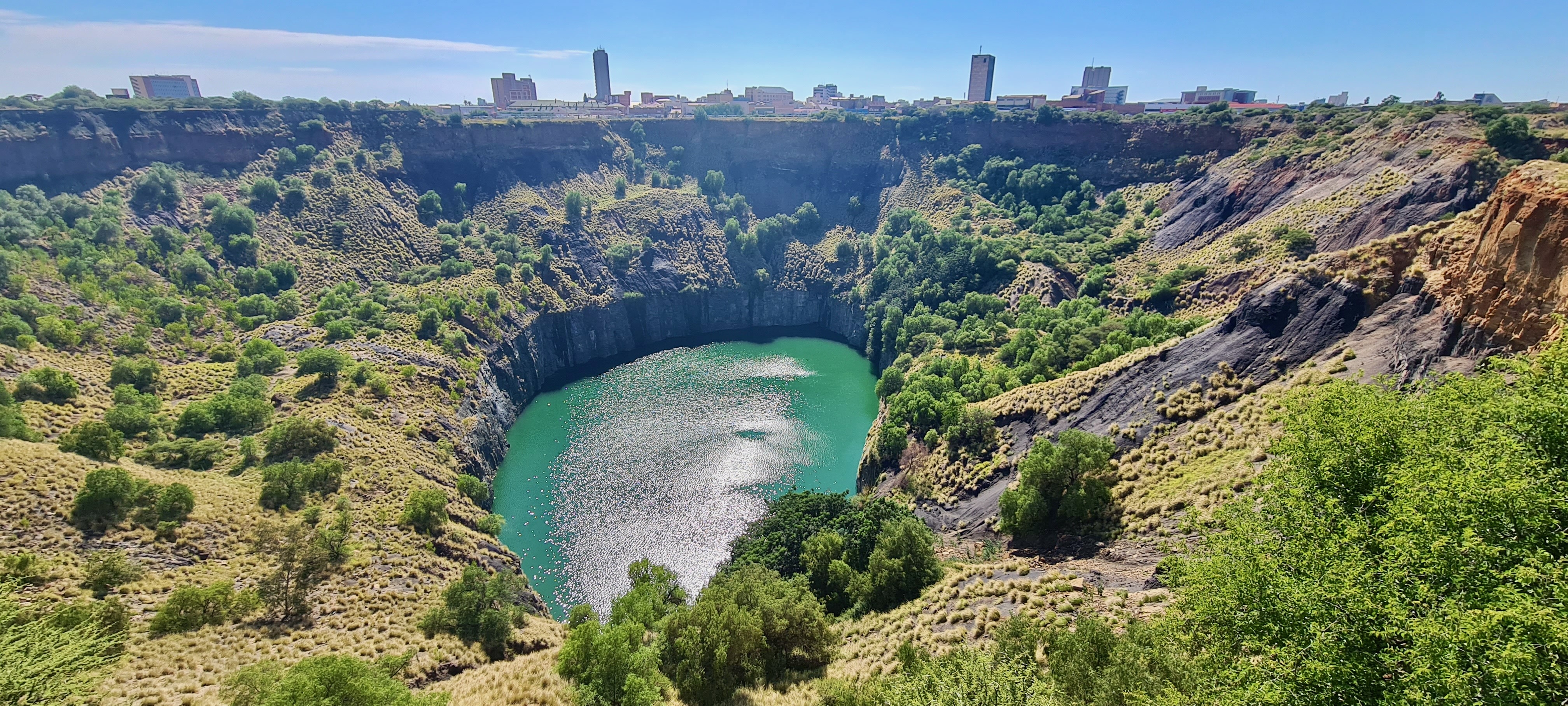
Big Hole
Fifty thousand people do not descend on a patch of scrubland in the Northern Cape without reason. In 1871, that reason was a diamond found on Colesberg Kopje, a small hill on a farm belonging to the De Beers brothers. Within months, the hill had vanished -- pick by pick, bucket by bucket, carted away by men who slept in tents, drank filthy water, and died of scurvy, pneumonia, and rockfalls in roughly equal measure. What they left behind is a hole 463 meters wide, excavated to a depth of 240 meters by nothing more than human muscle and iron tools. The Big Hole of Kimberley is not beautiful. It is astonishing.
A Hill Becomes an Absence
The diamonds came from a kimberlite pipe, a geological conduit that had carried carbon crystals from deep in the Earth's mantle to within reach of picks and shovels. Members of the "Red Cap Party" from Colesberg made the first find, and the rush that followed turned a farming district into one of the most frenetic mining camps the world had seen. They called it New Rush before settling on Kimberley. By 1872, the camp had swelled to 50,000 -- a city of canvas and desperation, sweltering through Northern Cape summers with scarce water and no sanitation. Over 43 years, miners extracted more than 22 million tons of rock and earth. The yield: 3,000 kilograms of diamonds, some 14.5 million carats. The cost in human lives was never properly tallied.
Rhodes, Barnato, and the Scramble Underground
As the hole deepened, individual claims became unworkable. Roadways between plots collapsed. Flooding was constant. The chaos suited men like Cecil Rhodes, who understood that the real fortune lay not in finding diamonds but in controlling who could dig for them. On 13 March 1888, Rhodes and his allies -- Alfred Beit and the flamboyant Barney Barnato -- amalgamated the competing claims into De Beers Consolidated Mines Limited. The Big Hole was now one operation under one company, and Rhodes had the monopoly he wanted. Underground mining pushed the kimberlite pipe to a depth of 1,097 meters before the operation ceased on 14 August 1914, the same month that Europe plunged into war. By then, the open pit had been partially backfilled with debris and had begun collecting rainwater, forming the eerie green lake that visitors see today.
The Workers the Records Almost Forgot
Hospital records from Kimberley between 1897 and 1899 tell a story the diamond industry preferred to leave underground. Of 7,853 patients admitted, 5,368 were Black miners segregated into designated wards -- a "Native surgical ward" and a separate ward for women and children. Among these patients, 1,144 died. The causes -- tuberculosis, pneumonia, scurvy, diarrhoea -- speak of crowded housing, inadequate nutrition, and working conditions designed to maximize extraction with minimal expenditure on the people doing the extracting. Sesotho-language newspapers of the era published letters from miners naming colleagues killed in rockfalls and cage accidents, recording their home villages and chiefs. These letters are among the few first-person accounts of what life in the Big Hole actually felt like. Miners organized, too: strikes were common, and the Koata Strategy -- a form of collective resistance -- gave workers a measure of leverage in a system built to deny them any.
From Pit to Monument
When the mine closed in 1914, the open pit simply sat there -- a void at the edge of town, slowly filling with water. Locals treated it as a curiosity. By the 1960s, relics of early Kimberley began collecting around its rim, and in 1965 De Beers appointed a museum consultant to formalize what was already happening. The result is an open-air museum that reconstructs the rough-and-ready streetscapes of 1870s Kimberley, complete with period buildings, mining equipment, and a Diamond Hall. The centenary celebrations of 1971 gave the museum its official opening. Between 2002 and 2005, De Beers invested R50 million in a modern tourism facility themed around "Diamonds and Destiny." Whether the Big Hole is the largest hand-dug excavation on Earth remains contested -- researchers have since argued that the Jagersfontein and Bultfontein mines may surpass it in depth or volume. But no rival hole has a museum, a gift shop, or the same grip on the imagination.
From the Air
Located at 28.74S, 24.76E in the city of Kimberley, Northern Cape, South Africa. The Big Hole is clearly visible from the air as a large circular void on the city's western edge, its green water contrasting sharply with the surrounding urban grid. Best viewed at 3,000-5,000 feet AGL. Nearest airport: Kimberley Airport (FAKM), approximately 7 km south of the city center. The terrain is flat semi-arid veld, so the hole is the dominant feature in an otherwise featureless landscape. Visibility is generally excellent in this dry region.