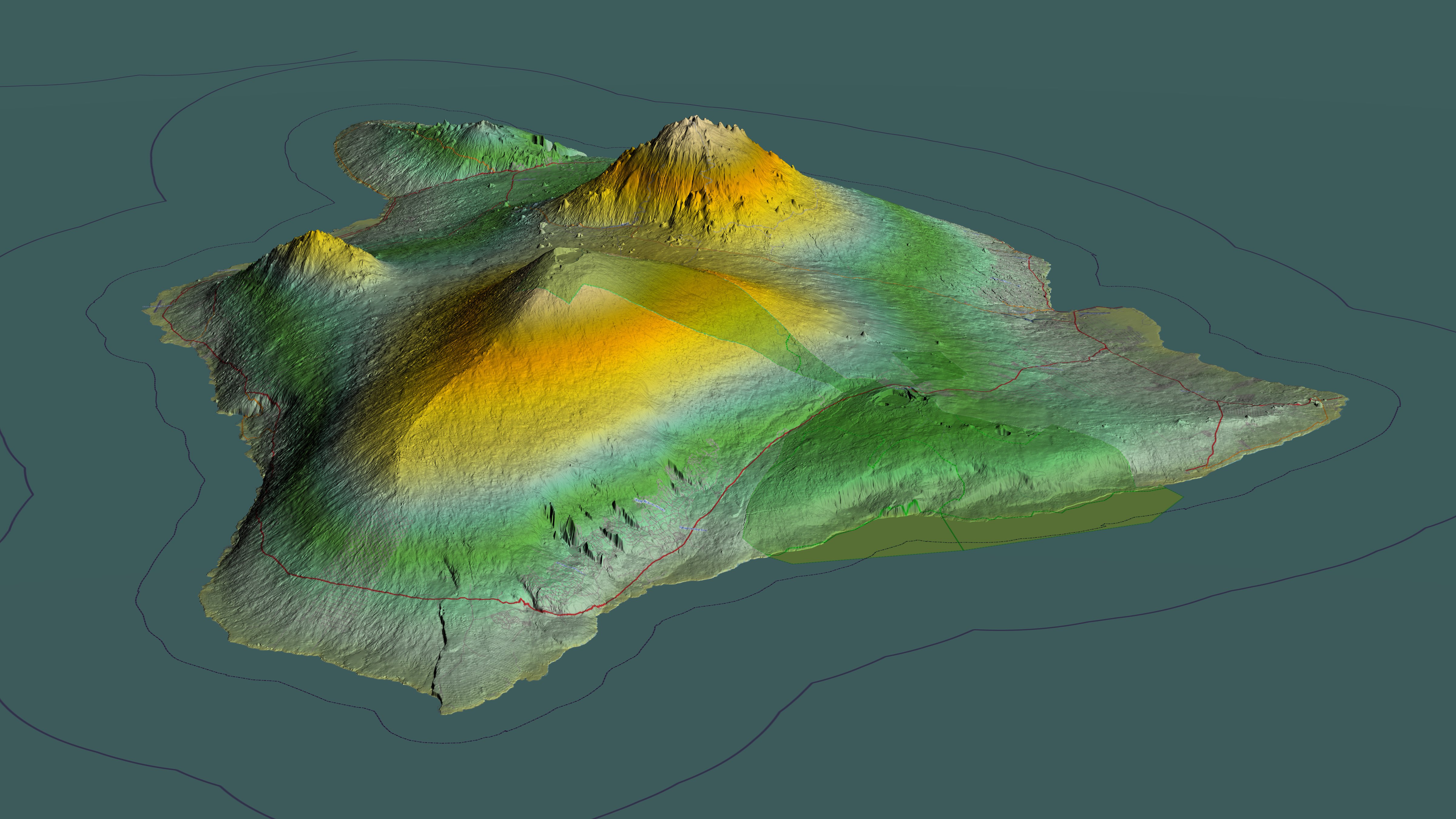
Big Island
The Big Island earns its nickname honestly - it's larger than all the other Hawaiian islands combined, and still growing. Kilauea, one of the world's most active volcanoes, has added hundreds of acres to its eastern shore since eruptions began in 1983. But size barely captures the island's extremes. Mauna Kea rises 13,796 feet above sea level, its summit sometimes dusted with snow while beaches bake below. Measured from its base on the ocean floor, it exceeds 33,000 feet - taller than Everest. Mauna Loa, the largest mountain on Earth by volume, last erupted in 2022. This is a landscape still in violent creation, where new land emerges from the sea in clouds of steam.
Fire and Stone
Hawaii Volcanoes National Park protects both Kilauea and Mauna Loa, offering access to an active volcanic landscape unlike any other in the United States. The Crater Rim Drive circles Kilauea's summit caldera, where Halema'uma'u Crater glows at night with the light of molten rock. Chain of Craters Road descends through decades of lava flows to the coast, where new land meets the sea. The landscape shifts with each eruption - roads buried, viewing platforms relocated, entire communities sometimes evacuated. Visitors can hike across hardened lava fields still warm underfoot, peer into steam vents, and walk through lava tubes formed when the outer crust cooled while molten rock continued flowing within.
Kona and Kohala
The leeward coast offers a different island. Kailua-Kona, once a fishing village where Hawaiian royalty spent winters, now anchors a coast of resort hotels and coffee plantations. Kona coffee, grown on the slopes of Hualalai volcano, ranks among the world's most prized - the combination of volcanic soil, altitude, and afternoon clouds creating conditions found nowhere else. Further north, the Kohala Coast's luxury resorts occupy a landscape so dry it seems more Mediterranean than Hawaiian - Queen Ka'ahumanu Highway crossing miles of black lava before reaching beaches carved from the volcanic rock. The contrast with the island's wet side could hardly be more dramatic.
The Wet Side
Hilo, on the island's eastern shore, receives over 130 inches of rain annually - one of the wettest cities in the United States. The result is a lush, green landscape of waterfalls, tropical gardens, and rainforest that seems to belong to a different island than the sun-baked Kohala Coast. The Hamakua Coast, running north from Hilo, follows cliffs draped in vegetation, with waterfalls cascading hundreds of feet to the ocean. Waipio Valley, once home to thousands of Native Hawaiians, opens dramatically at the coast - steep walls enclosing a mile-wide amphitheater of taro patches and black sand beach accessible only by a road too steep for conventional vehicles.
Summit and Stars
Mauna Kea's summit hosts the world's premier astronomical observatories - the thin, dry air at nearly 14,000 feet offering some of the clearest viewing conditions on Earth. The Keck telescopes, Subaru, and a dozen other instruments cluster on the barren summit, their domes visible from across the island. Access requires a four-wheel-drive vehicle and acclimatization to altitude; visitors sometimes experience symptoms even standing at the visitor center at 9,200 feet. In winter, snow covers the peak, and Hawaiians have been known to ski slopes that overlook tropical beaches. The mountain holds profound significance in Hawaiian culture - the realm of the gods, the place where sky meets earth, now shared uneasily with modern astronomy.
Black Sand and Green Flash
The Big Island's beaches come in colors found nowhere else. Punalu'u's black sand, ground from basalt by the relentless sea, hosts basking green sea turtles. At Papakolea, olivine crystals give the sand a distinctive green tint - one of only four green sand beaches on Earth. The lack of coral reefs around much of the island means waves crash directly on volcanic rock, creating dramatic coastlines but fewer swimming beaches than older Hawaiian islands. Sunset on the Kohala Coast often produces the 'green flash' - that momentary burst of green light as the sun drops below a flat horizon. The island is young enough that its character remains defined by fire and water, creation and destruction, the raw forces that shaped Hawaii continuing their work.
From the Air
Located at 19.59°N, 155.45°W, the Big Island is roughly 4,000 square miles - larger than all other Hawaiian islands combined. Mauna Kea (13,796 feet) and Mauna Loa (13,681 feet) dominate the skyline, often snow-capped in winter. Kona International Airport (PHKO) serves the west coast; Hilo International (PHTO) serves the east. The active lava flows in Hawaii Volcanoes National Park may be visible at night. The dramatic contrast between the dry leeward coast and wet windward side is apparent at cruising altitude. Kilauea's summit caldera and recent lava flows are prominent features.