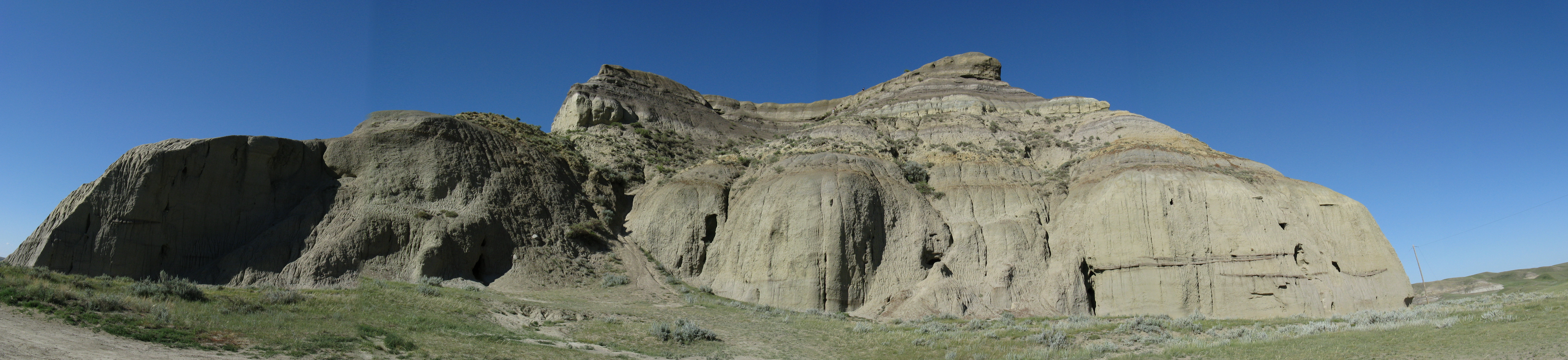
Big Muddy Badlands
The Sundance Kid rode through here. So did Henry Borne, Sam Kelly, and dozens of other outlaws fleeing American law enforcement in the late 1800s, pushing north along the Outlaw Trail until they reached this remote corner of southern Saskatchewan. They chose the Big Muddy Badlands for good reason: a maze of eroded sandstone, hidden coulees, and caves where a man could disappear. The land itself seemed to conspire in their favor, carved into a labyrinth of shadows and stone that swallowed pursuers whole.
Born from Catastrophe
The Big Muddy Valley owes its existence to violence on a geological scale. Over 12,000 years ago, as the last ice age loosened its grip on the continent, a massive glacial lake sat where Old Wives Lake exists today. When that prehistoric reservoir burst, the resulting flood scoured the prairie with apocalyptic force, carving a valley that stretches between Saskatchewan and Montana. The floodwaters stripped away softer sediments and left behind the twisted sandstone formations and compressed clay buttes that define the badlands today. Big Muddy Lake, a large salt lake, now sits at the heart of this scarred landscape, a quiet reminder of the cataclysm that created it.
The Stone Sentinel
Rising from the flat prairie like a geological anomaly, Castle Butte commands attention from miles away. This massive outcrop of sandstone and compressed clay towers above the surrounding grassland south of Bengough on Highway 34. The butte has served as a landmark for millennia, its distinctive silhouette visible from great distances across the open prairie. Indigenous peoples, fur traders, and early settlers all used it for navigation. Today, visitors can walk to its base and contemplate the same view that outlaws once scanned for approaching posses. The butte sits roughly halfway between Big Muddy Lake and Willow Bunch Lake, anchoring the valley's stark geography.
Sanctuary of the Lawless
The Big Muddy Badlands formed the northern terminus of the Outlaw Trail, that legendary network of hideouts stretching from Mexico to Canada. Horse thieves, cattle rustlers, and wanted men found refuge in the badlands' natural fortifications. The most famous was the Sundance Kid, though local legends remember characters like Coyote Pete and the Pigeon Toed Kid with equal fondness. In 1999, 256 hectares were designated as the Sam Kelly Sites and added to the Canadian Register of Historic Places. The protected area contains nine archaeological sites: stone rings and effigies left by Indigenous peoples, caves where outlaws waited out pursuit, and the crumbling remains of homesteads built by settlers brave enough to make a life here.
Ancient Messages in Stone
Long before outlaws sought refuge here, Indigenous peoples left their mark on this landscape. The Buffalo Effigy, constructed from fieldstone, overlooks West Beaver Creek near the Montana border. The 64-hectare site also contains stone cairns and at least eight stone rings, silent testimony to ceremonies and gatherings that took place centuries ago. On a hill overlooking Big Muddy Lake sits the Minton Turtle Effigy, first identified by archaeologist Thomas Kehoe in 1965. Whether it represents a turtle or, as some Indigenous elders suggest, a badger, the effigy speaks to a deep spiritual connection between the people who built it and this unforgiving land.
Wings Over the Salt Flats
The badlands harbor four Important Bird Areas of Canada, protecting the salt lakes where nationally endangered piping plovers nest each year. Willow Bunch Lake hosts one of the three largest breeding concentrations of piping plovers in the Canadian Prairies. The harsh, alkaline environment that discouraged permanent human settlement has become sanctuary for these small shorebirds. Alkali Lake straddles the Montana border, while the Coteau Lakes and Big Muddy Lake provide additional habitat across nearly the entire valley. Ranching and tourism now sustain the sparse human population, with tours departing from the nearby town of Coronach to guide visitors through this haunting landscape where geology, history, and wildlife converge.
From the Air
Located at 49.22N, 105.22W in southern Saskatchewan near the Montana border. The Big Muddy Valley runs roughly north-south and is visible from altitude as a darker, eroded gash in the surrounding golden prairie. Castle Butte is the most prominent landmark, standing alone on the plains. The nearest airport is Regina International (CYQR) approximately 180 km to the northeast. Best viewed in morning or evening light when shadows emphasize the badlands topography. The international border with Montana is clearly visible as the straight line where the landscape character changes.