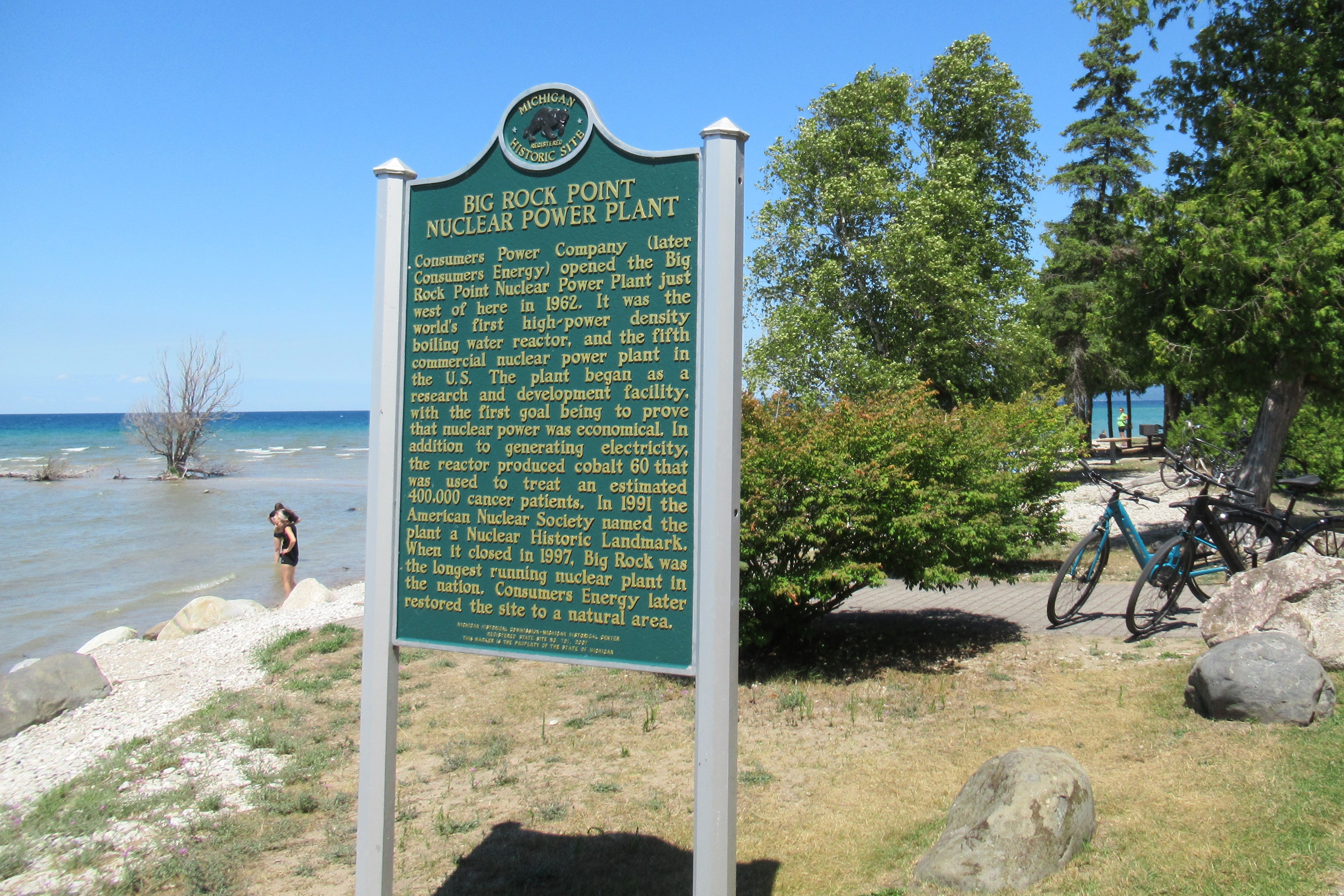
Big Rock Point Nuclear Power Plant
A future president pitched it on camera. For years, the smokestack behind its generator guided freighter captains into Charlevoix harbor. And when workers finally shut it down and tried to drain the emergency backup system, they discovered the pipe had corroded shut -- meaning the last line of defense against a nuclear meltdown had been useless for at least fourteen years. Big Rock Point, Michigan's first nuclear power plant and the nation's fifth, packed more strange history into its thirty-five years of operation than most facilities manage in a century.
The Atomic Age Comes to Charlevoix
Ground broke on July 20, 1960, on a stretch of Lake Michigan shoreline just north of Charlevoix. Twenty-nine months and $27.7 million later, Consumers Power had its boiling water reactor, built by General Electric with Bechtel Corporation as primary contractor. The license arrived on August 29, 1962; the reactor went critical on September 27; and the first electricity flowed on December 8 of that year. At 67 megawatts, Big Rock was modest -- its single ten-ton uranium fuel load could match the output of 260,000 tons of coal, but the plant would never be a grid powerhouse. Its significance was symbolic: Michigan had entered the nuclear age. To mark the occasion, General Electric tapped its corporate spokesman, Ronald Reagan, to narrate a promotional film called 'Headstart on Tomorrow.' Reagan stood before the plant and sold the public on a future powered by the atom, a decade before he would sell them on something else entirely.
Isotopes and Landmarks
Big Rock Point did more than generate electricity. From 1971 to 1982, the plant produced cobalt-60, a radioactive isotope critical to the medical industry for cancer radiation therapy and sterilization of surgical equipment. The reactor's dual purpose -- power and medicine -- earned it recognition as a Nuclear Historic Landmark from the American Nuclear Society. Meanwhile, the tall smokestack rising behind the main generator served an entirely unrelated function: it became a navigational landmark for commercial freighters on Lake Michigan. Boaters and captains aboard Great Lakes ships used it as a visual reference point to locate Charlevoix harbor. For decades, that stack was as much a part of the maritime landscape as any lighthouse.
A System That Never Worked
The reactor scrammed for the final time at 10:33 a.m. on August 29, 1997 -- exactly thirty-five years to the day after its operating license was issued. Economics, not safety, drove the decision: Consumers Energy had planned to run until the license expired in May 2000, but crunching the numbers in January 1997 showed it was no longer feasible. What came next, during decommissioning, was far more unsettling. Technicians attempted to drain the Liquid Poison System, a backup tank filled with a boron solution designed to halt a nuclear chain reaction if control rods failed during an emergency scram. The boron solution would not drain. The pipe had corroded shut. Investigators determined the system had been inoperable for at least the previous fourteen years. For more than a decade, Big Rock Point had operated with a broken last resort -- a safety net that existed on paper but not in practice.
Fireball Over the Bay
The nuclear plant was not the only dramatic presence on this stretch of coastline. Nearby stood a military installation: Bay Shore Radar Bombing Score Group, a Strategic Air Command detachment where B-52C bombers practiced simulated bombing runs at low altitude. On the evening of January 7, 1971, a B-52C flying under the call sign 'Hiram 16' departed Westover Air Force Base near Springfield, Massachusetts. After completing three successful electronic bombing passes in coordination with the Bay Shore crew, contact was lost at 6:33 p.m. Witnesses along the shore watched a fireball fall from the sky, followed by a massive explosion as the aircraft struck the water of Little Traverse Bay, just five miles north of Big Rock Point. All nine crew members perished. The crash remains one of the most haunting Cold War incidents on the Great Lakes.
Vanishing Act
Decommissioning cost $390 million -- more than fourteen times the original construction price. The last fuel was pulled from the core on September 20, 1997. Decontamination finished in 1999. On August 25, 2003, the reactor vessel itself was removed and shipped to Barnwell, South Carolina. Today, the entire site has been demolished. A mile of Lake Michigan shoreline that once housed a nuclear reactor shows almost no trace of it. The only remnants are eight spent fuel casks sitting on a basketball-court-sized parcel of land, responsibility for which was transferred to Entergy when it purchased Consumers' Palisades Nuclear Plant. In 2006, Michigan considered buying the site for a state park -- a remarkable second act for land that once split atoms. The freighters still pass, but the landmark stack is gone.
From the Air
Located at 45.36N, 85.18W on the Lake Michigan shoreline, approximately 5 miles north of Charlevoix, Michigan. The site has been fully decommissioned and demolished -- no visible structures remain except a small fenced area for spent fuel cask storage. Look for the Charlevoix harbor and shoreline as reference points. Little Traverse Bay, site of the 1971 B-52C crash, lies approximately 5 miles to the north. Nearest airports: Charlevoix Municipal Airport (KCVX) approximately 3nm south, Pellston Regional Airport (KPLN) approximately 20nm northeast. Recommended viewing altitude: 2,000-3,000 feet for shoreline context. The Lake Michigan coastline here runs roughly north-south with wooded bluffs.