Big White
The snow ghosts watch you ski. Subalpine fir trees, completely encased in rime ice from the region's famous 'champagne powder' snow, stand like frozen sentinels across Big White's upper slopes. These surreal formations have become the resort's unofficial mascot, appearing in marketing materials and Instagram feeds, a visual shorthand for conditions so consistently cold and dry that moisture freezes on contact with any surface. Big White sits in the southern Monashee Mountains, fifty-six kilometers southeast of Kelowna, collecting 750 centimeters of snow annually while the Okanagan vineyards below bask in sunshine. The resort claims third place among British Columbia's ski areas, behind only Whistler-Blackcomb, and has parlayed its reliable conditions into a full-service destination that operates summer and winter alike.
The Numbers Game
Statistics tell Big White's story efficiently: summit elevation 2,319 meters, vertical drop 777 meters, 118 marked runs served by 16 lifts across 2,765 acres of patrolled terrain and over 7,000 skiable acres total. Night skiing illuminates 38 acres - the largest such operation in western Canada - extending the ski day well past sunset for those unwilling to stop while powder remains. The village itself perches at 1,755 meters, high enough that arriving guests sometimes feel the altitude, particularly those driving up from sea-level Vancouver. Most visitors adjust within a day; those who don't find themselves breathing hard on runs that shouldn't wind them.
A Village That Works
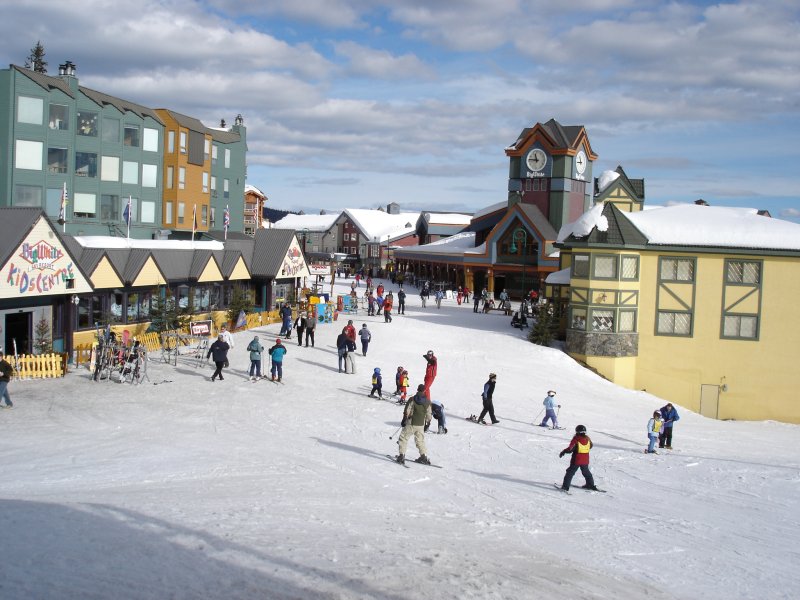
Big White's central village achieves what many ski resorts attempt and few perfect: genuine ski-in, ski-out convenience. Accommodation clusters along the slopes, connected by pathways that double as runs, so guests carrying skis and boots need never worry about shuttle timing or parking logistics. Restaurants and bars occupy the village core; equipment rentals stand within stumbling distance of the lifts; a small grocery store covers forgotten essentials. It's not a big village - nothing here approaches Whistler's scale or nightlife - but it functions smoothly, designed around the assumption that visitors came to ski and would prefer to spend their non-skiing hours as close to the slopes as possible.
Beyond the Lifts
Winter diversions extend well beyond the chairlifts. Cross-country skiers find kilometers of groomed trails; snowshoers wander the forest edges; tubing runs offer screaming descents without the learning curve of skiing. Sleigh rides and dog sledding cater to those seeking mountain experience without the athletic component, while ice skating and snowmobiling round out the winter menu. Come summer, the mountain transforms: biking trails replace ski runs, winery tours draw visitors from the village, and hikers discover views that winter's white curtain had concealed. The resort operates year-round, though the summer crowds thin considerably compared to the ski-season peaks.
The Okanagan Connection
Big White's proximity to Kelowna and the Okanagan Valley creates a peculiar dynamic: world-class skiing within an hour's drive of Canada's warmest summer region. Some visitors split trips between snow and wine, spending mornings on the slopes and afternoons in tasting rooms. Others use Kelowna as a staging point, flying into YLW and driving the fifty-six kilometers up Highway 33 to Big White Road. The resort makes a compelling day-trip from Kelowna, but overnight stays reveal its full character - evening runs under lights, après-ski that doesn't require a car, mornings where you can click into your bindings steps from your door. Silver Star, Big White's northern neighbor, lies two hours away via Highways 97 and 33, close enough for dedicated powder-chasers to compare conditions across both mountains.
From the Air
Located at 49.72N, 118.93W in the southern Monashee Mountains, approximately 56km southeast of Kelowna. The resort is visible from altitude as a developed area with cleared ski runs on Big White Mountain, one of the highest peaks in the southern Monashees at 2,319m summit elevation. Access is via Highway 33 from Kelowna, then Big White Road. Kelowna International Airport (YLW) is the nearest commercial airport, approximately 45 minutes by car. Vancouver (YVR) lies 438km west (4.5 hours driving); Spokane (GEG) lies 453km south (4.5 hours). Expect heavy winter snowfall averaging 750cm annually; terrain rises from approximately 1,500m at the base to over 2,300m at the summit.