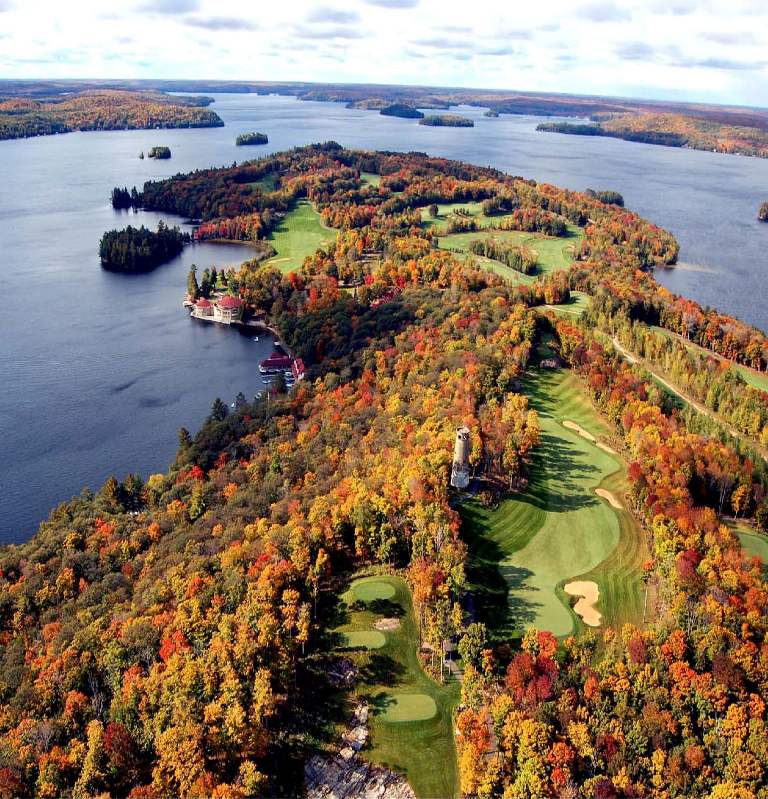
Bigwin Island
During the Second World War, the constitution of the Netherlands was stored inside a rotunda on a forested island in central Ontario. The Dutch royal family, exiled from their homeland, summered here from 1941 to 1945 while the Nazis occupied the Low Countries. Young Princess Beatrix -- who would one day become queen -- played among the same buildings where Toronto socialites danced to big-band orchestras on warm Muskoka evenings. The island was Bigwin, the largest on Lake of Bays, and its story spans centuries of history layered one upon another: Indigenous burial grounds beneath resort fairways, a 350-room inn built by horses hauling materials across winter ice, and a 3,000-foot airstrip once used by wealthy cottagers flying in from the south.
The Name on the Graves
Long before any resort existed, Bigwin Island held sacred ground. Multiple Indigenous burial sites dot the island and the shallows immediately offshore -- some submerged by flooding caused by industrial damming of the lake. The island takes its name from Chief John Bigwin, and when the first property developers arrived, they made a covenant: all graves would be preserved and protected from desecration, and the chief himself would be buried here with his ancestors when his time came. That agreement established the terms of coexistence that would define the island's character -- a place where new ambitions were built around older obligations, where golf greens wrap around landscapes that carry deeper meaning.
An Inn Built on Ice
Charles Orlando Shaw, a Huntsville businessman, founded the Bigwin Inn Company Ltd. in 1915 and hired architect John Wilson of Collingwood to design an exclusive summer resort. Wilson's vision was eclectic and bold: classical columns met Mediterranean arches, Tudor half-timbering stood alongside craftsman bungalows, and a dodecagonal pavilion rose at the water's edge. He placed buildings to follow the natural shoreline and flooded interiors with sunlight. The Indian Head Dining Room could seat 750 guests at once. Because the island had no road connection, most construction took place during winter, when frozen Lake of Bays became a highway for horses and sleighs hauling lumber and stone. The inn opened in 1920 with 350 guest rooms and quickly became one of Muskoka's most celebrated destinations, drawing tourists from Toronto and the American eastern seaboard.
Music, Monarchs, and the Dance Pavilion
The 1930s were paradoxically Bigwin Inn's golden age. While the Depression crushed resorts elsewhere, the dance pavilion drew renowned musicians who kept the island alive with jazz and swing through the summer nights. The marine dining room and the Tea House were added, along with a ferry house to shelter the fleet of boats connecting the island to the mainland. Then came the war and the remarkable episode of the Dutch royals. From 1941 to 1945, the exiled family of Princess Juliana summered on the island in private cottages while the government-in-exile operated from Ottawa. Princess Beatrix, future queen of the Netherlands, spent her childhood summers here. The rotunda -- that same grand circular hall where resort guests gathered for cocktails -- became the secure vault for the Dutch constitution, spirited out of Europe ahead of the German advance.
Closing Time
C. O. Shaw died of a heart attack in 1942, and with him went the animating force behind the resort. Ownership changed hands repeatedly. Frank Leslie purchased the property in 1949 and operated it on a non-profit basis, successfully booking entertainers who kept Bigwin popular, but illness forced him to sell in the 1960s. The inn closed for good in 1966. What followed was decades of slow decay. The west lodge, dance pavilion, kitchens, golf clubhouse, staff bungalows, stables, and the rotunda were all demolished. The 3,000-foot concrete airstrip -- built so wealthy cottagers from Toronto and the United States could fly directly to the island -- was landscaped over, its north end repurposed for boat storage. The ferry Bigwin sat in the ferry house for years, gradually sinking on its cross beams, the subject of liens and mortgages, until it was finally rescued and restored.
A Second Life on the Fairway
Real estate developer Alan Peters purchased the island in 1986 with partner Jack Wadsworth and set about building something new from the old bones. Golf course architect Doug Carrick designed what became the Bigwin Island Golf Club, a par-72 championship course measuring 7,166 yards from the back tees. The course has a notable quirk for an island surrounded by water: it has no water hazards. Peters transferred ownership to its members in 2011. Today the Bigwin Inn dining room and tea house have been restored to service, and perimeter lots continue to sell as private cottage sites. The observation tower stands but looks neglected. The rotunda fireplaces survive, all except one that was removed because it obstructed a golf course view. Bigwin Island endures as a place where each generation builds atop the last, the new never quite erasing the old.
From the Air
Located at 45.24N, 79.03W on Lake of Bays in Ontario's Muskoka region. Bigwin Island is clearly visible as the largest island on the lake, distinguished by its size and the manicured golf course fairways visible from altitude. The former 3,000-foot airstrip is no longer operational but its footprint may be faintly visible. Best viewed below 3,000 feet AGL. Nearby airports: Muskoka Airport (CYQA) approximately 20nm west near Gravenhurst. The surrounding lake and Canadian Shield landscape of granite, pine, and water make excellent visual reference points.