Bijbels Museum
Some museums are buildings. The Bijbels Museum is now a road. In July 2020 it closed the doors of its Herengracht canal-house galleries, dispersed its centuries-old collection to other institutions, and started moving. The pieces had grown out of one man's obsession - a 19th-century Dutch reverend named Leendert Schouten who, between sermons, was carving a wooden model of the Tabernacle described in Exodus and gathering every artifact he could find from the lands of the Bible. For 169 years his collection sat in rooms. Now the museum that bore his work has chosen exile. It carries its stories from church to bookshop to country estate, an exhibition without an address.
A Reverend's Tabernacle
Leendert Schouten (1828-1905) was a Dutch Protestant minister who could not let the Old Testament stay on the page. He wanted to build it. So he did. He constructed a detailed wooden model of the Tabernacle - the portable sanctuary the Israelites carried through the wilderness - and around it he assembled a private museum of biblical artifacts: objects from the time and region of the scriptures, including pieces dated to the first century BCE and the first century CE. He gathered Bibles, including a 1477 Delft Bible (the first Bible ever printed in the Netherlands) and a 1637 first-edition Statenvertaling (the Authorised Dutch translation that did for Dutch what the King James did for English). His collection was a sermon in three dimensions. After his death the collection continued, and in 1975 it found a home in the upper floors of two of the Cromhouthuizen, the canal mansions designed by Philips Vingboons in the 1660s for the Cromhout family on the Herengracht.
Stolen and Recovered
In July 2007 the museum was robbed. Nine objects vanished from a display case - bronze figurines, heart-shaped scarabs, a Roman coin. The kind of small portable artifacts a thief could pocket. The theft stayed quiet for a while. Then, two years later, seven of the missing objects surfaced at Christie's auction house in New York, where someone had tried to sell them. The recovery completed a strange archaeological round-trip: ancient objects collected in the Holy Land, carried to Amsterdam, stolen from a canal house, shipped to Manhattan, and identified just before they disappeared into private collections. Museum thefts often end darker than this one. Most stolen pieces never come back. These seven did.
The Nomadic Turn
In 2016 the Amsterdam Fund for the Arts cut the museum's grant for the 2017-2020 period. The plans submitted were judged insufficient. Until then, the museum had been receiving more than 200,000 euros a year. The loss forced a reckoning. In May 2018 the museum decided to dispose of its collection - not because it had failed, but because it wanted to do something different. The collection would be entrusted to other museums that could care for it properly. Schouten's Tabernacle model and his Temple Mount model went to Museum Catharijneconvent in Utrecht. The special Bibles, including the Delft Bible and the Statenvertaling, went to the Vrije Universiteit in Amsterdam. The Cromhouthuizen rooms closed on 1 July 2020. The museum reopened the next day as something stranger: a museum without walls, a curator-and-team operating from an office at the Corvershof, sending exhibitions out into the country.
Stories Without Walls
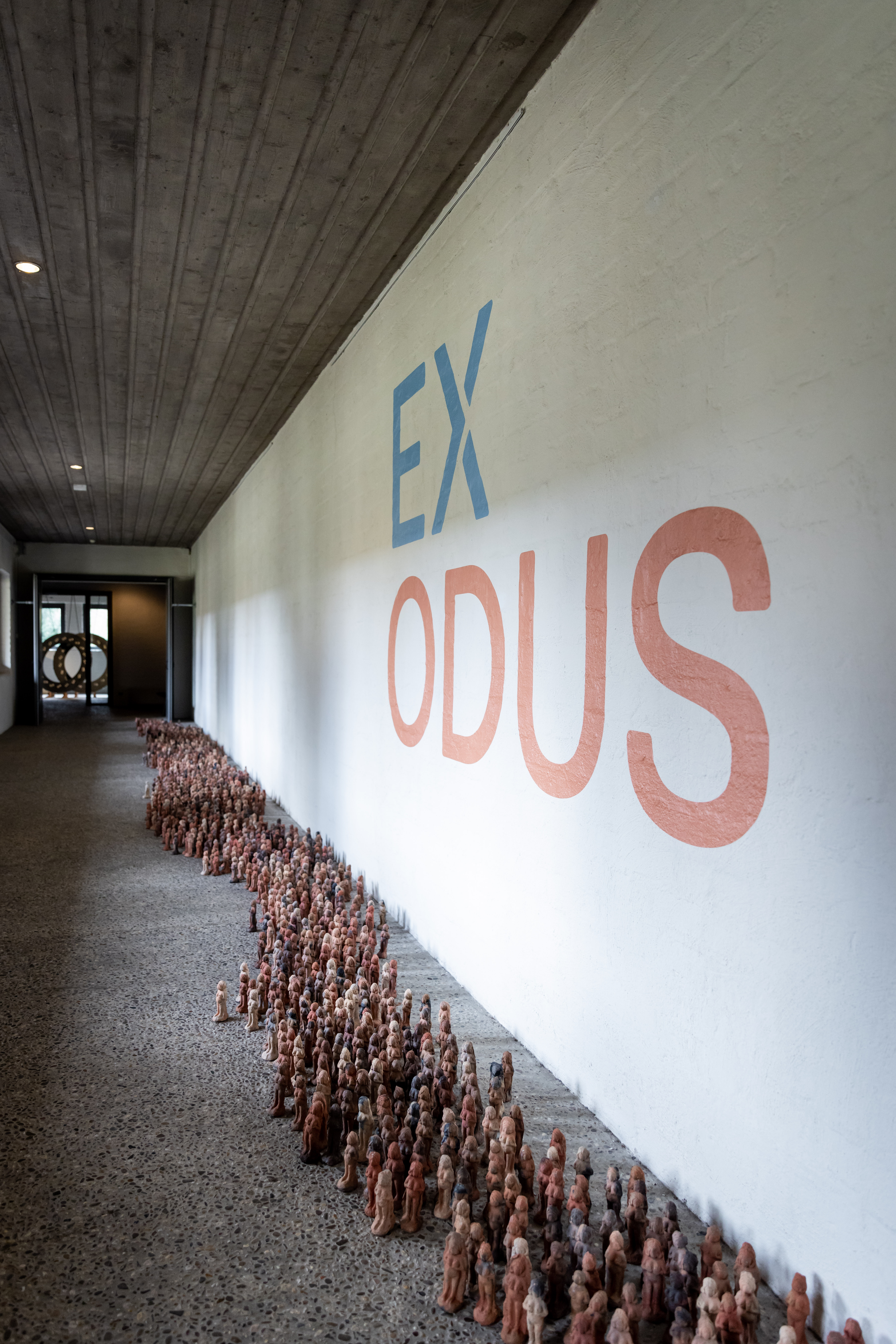
The first nomadic exhibition was NIEUWE AARDE: 12 visioenen ("New Earth: 12 Visions"), held in the Westerkerk in central Amsterdam from October to December 2020. An open call for artistic visions of a new earth, mounted inside the seventeenth-century church where Rembrandt is buried. Then came Tijd en Eeuwigheid ("Time and Eternity"), poetry in image and word, traveling from Escher in het Paleis in The Hague to a monastery in Uden to Klooster Ter Apel to CIRCL Amsterdam between 2021 and 2022. Then Eva, Sara en Hanna - women of the world, biblical and contemporary - traveling from a Haarlem photo gallery to the Amsterdam Public Library. Then EXODUS in 2023 at Buitenplaats Doornburgh, where 28 artists were chosen from more than 700 submissions to interpret the idea of leaving. The biblical themes haven't changed. They are still hope, exile, flood, faith, vision. What has changed is that the museum has decided the stories travel better than the objects. Believer or unbeliever, the Bijbels Museum wants you in the room - whichever room it happens to be in this month.
From the Air
The museum's former Herengracht home sits at 52.369 N, 4.886 E in central Amsterdam, in the heart of the UNESCO-protected Grachtengordel canal belt. Geohash u173z. The current administrative office is at the Corvershof on the eastern side of the city center. Schiphol Airport (EHAM) is 13 km southwest. Approaching aircraft pass over the canal belt at moderate altitudes; the Cromhouthuizen complex on the Herengracht is one of the elegantly gabled mansions visible along the curve of the canal.