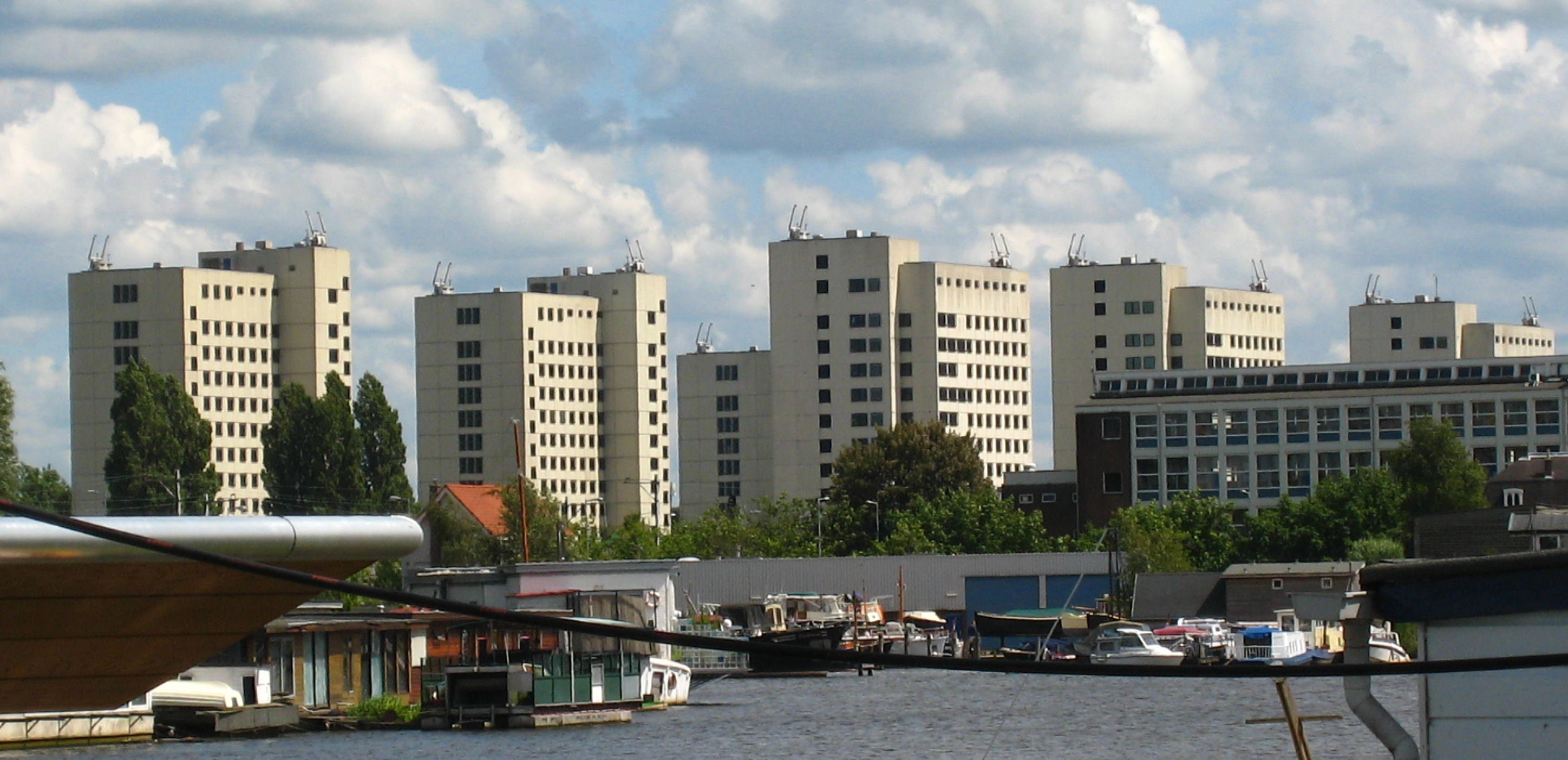
Bijlmerbajes
From the platform at Amsterdam Amstel station, six matching concrete towers used to rise above the office blocks and the river bend like a deliberately strange skyline. Built between 1972 and 1978 and arranged in a tight cluster east of the Amstel, they were officially named the Penitentiaire Inrichting Over-Amstel, and almost no one ever called them that. The locals called them the Bijlmerbajes, an Amsterdam compound that joined the name of the neighboring Bijlmermeer high-rises with the slang word bajes, meaning prison. The towers were designed to be a humane prison, a model of late-twentieth-century Dutch progressive thought about incarceration. They closed in June 2016. As of 2022, demolition crews and architects have been quietly turning what was once the country's most distinctive prison into one of its most ambitious residential redevelopments.
A Prison Without Bars
When the complex opened in 1978, its most discussed architectural feature was what it did not have: bars on the windows. The Dutch penal philosophy of the period emphasized rehabilitation over punishment, and the architects took it literally. Glass panels were chosen to give inmates light, sightlines, and a measure of dignity. The glass turned out to be more breakable than promised, and bars, called lamellen, were retrofitted onto the exterior. The compromise told you something about the gap between Dutch ideals and Dutch realities in prison design. The six towers were each fourteen floors high, and each operated as a semi-independent facility with its own population and program. Inmates moved between the towers via a 260-meter glass-roofed corridor that ran underground from tower to tower. The staff named it the Kalverstraat, after the famous shopping street in central Amsterdam, partly as gallows humor and partly because it was, in fact, the busiest pedestrian thoroughfare inside any building in the country.
Six Towers, Six Worlds
Each tower held a different type of inmate. Het Schouw, named after a bend in the nearby Amstel River, held people awaiting sentencing in a standard arrangement with five pavilions. De Weg, Dutch for The Road, held 135 repeat offenders, the so-called veelplegers. Demersluis, named for a former sluice between the Amstel and the old Zuiderzee, handled the central intake and also held arrestanten, people locked up for unpaid fines or skipped community service. De Schans housed 120 inmates in the Dutch ISD program, a sentence specifically designed for chronic petty offenders, many of them drug-addicted, in which prosecutors could request a two-year sentence even for minor crimes. And then there was Het Veer, the most sobering tower of the six. Het Veer was a national crisis facility for inmates whose psychiatric problems were too severe for any other prison to handle, with sixty male and six female beds. About three hundred people cycled through Het Veer each year. It was, and remained until the closure, the only Dutch prison facility where forced depot medication could be administered, because it was the only one with twenty-four-hour medical staff.
The Decision to Close
By the 2010s the Netherlands had a problem that few European countries can claim: there were not enough prisoners to fill its prisons. Dutch incarceration rates had fallen steadily for decades, the result of a justice system that increasingly used fines, electronic monitoring, and community service in place of imprisonment. Empty cells became a political liability, and a series of older facilities was scheduled for closure. The Bijlmerbajes, despite its size and central location, was on the list. The last inmates left in June 2016 and the towers stood empty, briefly used for short-term housing of asylum seekers, then for art installations, then for a public open day at which thousands of Amsterdammers walked through cells that until recently had been somebody's address.
Bajeskwartier
In 2017 five development teams competed for the right to redevelop the complex. The winning proposal preserved one of the original towers as a vertical forest with planted facades, demolished the others, and built a new residential neighborhood called Bajeskwartier in their place. The design includes apartments, gardens, schools, a brewery, public squares, and the deliberate preservation of fragments of the old prison: a length of the Kalverstraat tunnel kept as a pedestrian walkway, individual cells turned into glass-walled meeting rooms in the surviving tower, the foundation outlines of the demolished towers marked in the new paving. The finished project was presented to its first residents in 2022. The redevelopment is one of the largest adaptive-reuse projects in Dutch real estate, and it raises a question the developers have not entirely resolved: what does it mean to live, deliberately, in a place that for forty years was somewhere people were kept against their will? Bajeskwartier is one answer. The Bijlmerbajes, in another sense, is gone.
From the Air
The former Bijlmerbajes site sits at roughly 52.339N, 4.923E, on the east bank of the Amstel River near Amsterdam Amstel railway station, about 4 km southeast of central Amsterdam. From the air, until recent demolition, the site was unmistakable: a tight cluster of six identical fourteen-story towers next to a curved bend in the Amstel, set against the Rembrandt, Breitner, and Mondriaan office towers a short distance west. As Bajeskwartier rises, the cluster is becoming a lower-rise residential district with one preserved green-clad tower. Schiphol Airport (EHAM) is roughly 10 km southwest. The Spaklerweg metro station is the closest navigation reference.