Bijlmermeer
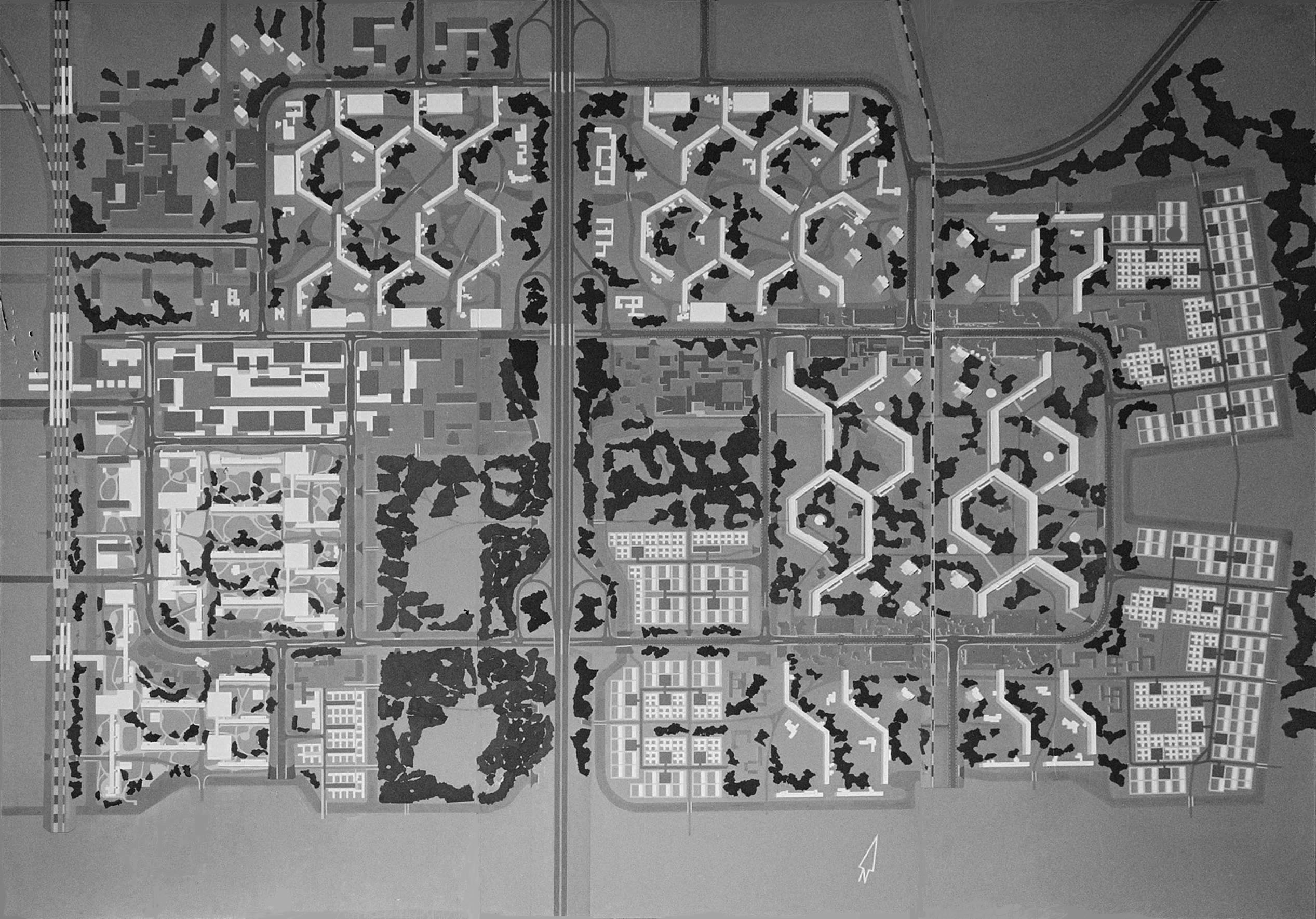
Architect Siegfried Nassuth drew a honeycomb in the polder south of Amsterdam and called it the future. The year was 1965, and the future, as Nassuth and his team saw it, looked like nearly identical high-rise blocks laid out in a hexagonal grid, cars routed onto elevated decks overhead, lawns and bicycle paths flowing freely below. Bijlmermeer was meant to be a suburb in the sky for the Dutch middle class - light, air, views, the modernist creed made concrete. Six decades later, almost nothing has gone according to that plan, and that is the story.
A Drained Lake, A Drawn Future
Before there was a neighborhood there was water. The original Bijlmermeer was a lake on the wet edge of Amsterdam, drained in the 17th century when the city needed more farmland. For three hundred years the polder grew cabbages and grazed cows, governed in turn by Weesp and Weesperkarspel, until the 1960s when Amsterdam needed somewhere to put a generation of new residents. Planners did not just lay out streets. They reached for a complete urban theory. Tubular walkways would connect every building. Each apartment came with its own garage space. The two-level traffic separation kept cars overhead and pedestrians safe below. The grid was hexagonal because hexagons tessellate efficiently and the future, the planners believed, should look engineered.
The Middle Class Never Came
The honeycomb opened to its first tenants in 1968 and ran into the simplest of problems: the people it was built for did not want it. Dutch families with money preferred low-rise suburbs to anonymous slabs. Then history intervened. In 1975 Suriname became independent, and tens of thousands of Surinamese citizens, holding Dutch passports, moved to the Netherlands during a national housing crunch. The empty flats in Bijlmermeer absorbed many of them. Ghanaians, Antilleans, and others followed. By the 1980s the neighborhood that planners had designed for one population housed an entirely different one - poorer, blacker, and largely abandoned by the city that built it. Crime rose. The elevated walkways that had looked so visionary on paper became corridors no one wanted to walk after dark. By the mid-1990s Bijlmermeer was registering twenty thousand police complaints a year.
Tearing Down the Future
By the late 1990s Amsterdam admitted what residents had been saying for years: the design itself was part of the problem. The scale was, in the city's own word, inhuman. So they began to undo it. Whole honeycomb blocks came down. Where slabs had loomed, low-rise townhouses went up. The elevated roads were brought back to ground level so drivers, cyclists and pedestrians could see each other and a street could feel like a street again. A metro line, the Oostlijn, finally connected the district to Amsterdam Centraal. Around it grew the Johan Cruyff Arena, the Ziggo Dome, the Amsterdamse Poort shopping centre - a whole new commercial heart called ArenaPoort. The renewal was not a vindication of the original plan. It was a quiet admission that the plan had failed, and that what worked was something closer to a normal city.
What the People Built
The remarkable thing about the second Bijlmer is that it became something the planners never imagined and the city never quite credited. The Surinamese, Ghanaian and Antillean residents who had been dropped into the failing utopia did not leave when conditions improved. They built. Each summer the Kwaku Festival fills the park for six weekends with Surinamese roti and Antillean music and African drum circles. Anton de Kom, the Surinamese anti-colonial writer who died in a Nazi camp, has a square named after him at the heart of the neighborhood. The footballers Ryan Babel and Daley Blind grew up here. So did the kickboxer Remy Bonjasky and the academic Gloria Wekker. In 2024 nearly fifty thousand people from more than 150 nationalities called Bijlmermeer home. The neighborhood the city once wrote off as a failed experiment turned out to be a place - particular, layered, alive.
The Tree That Stayed
On 4 October 1992 an El Al cargo 747 lost two engines after takeoff from Schiphol and came down on two of the honeycomb flats, Groeneveen and Klein-Kruitberg. Forty-seven people were killed - four crew members aboard and forty-three on the ground - a number the survivors have always considered low, because many of the buildings' undocumented residents were never counted. The collapsed blocks were demolished. A grey poplar standing just behind them lived. Its trunk carries eye-shaped marks that Dutch tradition reads as eyes, and so the tree became De Boom Die Alles Zag - the tree that saw it all. Every October the community gathers there. Bijlmermeer is a place that has been rebuilt and rebuilt and is still being rebuilt, but some things, the residents decided, would not be replaced.
From the Air
Located at 52.32 N, 4.97 E, southeast of central Amsterdam between the Amsterdam-Rhine Canal and the Gaasperplas. From the air the surviving honeycomb high-rises are still visible in a distinctive arc on the eastern edge, alongside the silver dish of the Johan Cruyff Arena and the dark mass of the Ziggo Dome. Amsterdam Schiphol (EHAM) sits about 13 nautical miles west. Rotterdam The Hague (EHRD) lies 30 nm southwest. Approach from the south offers the clearest read of the original hexagonal plan against the newer low-rise infill.