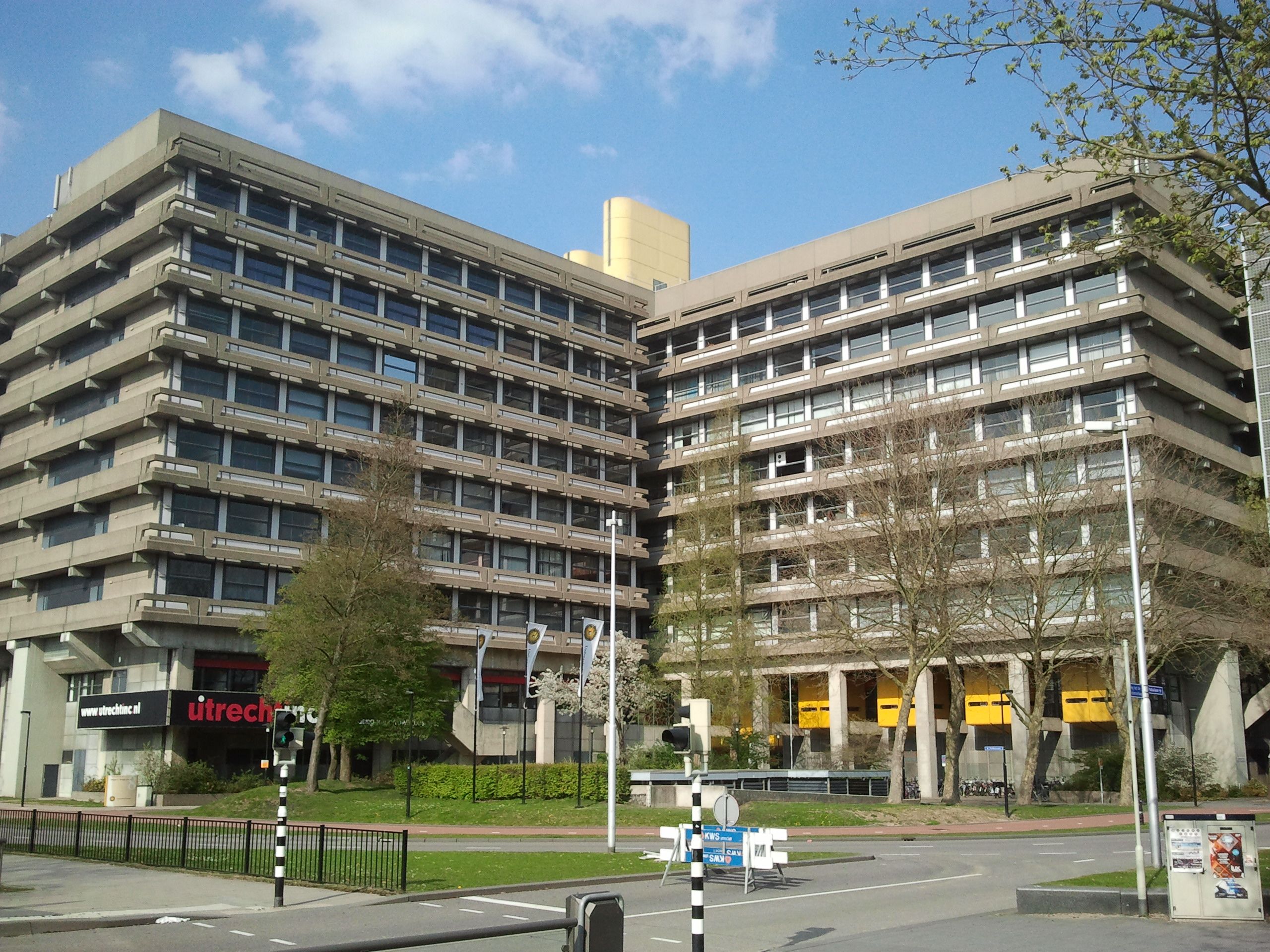
Bijvoet Centre for Biomolecular Research
In 1949, in a laboratory at Utrecht University, a Dutch crystallographer named Johannes Martin Bijvoet did something that chemistry had been waiting fifty years for. He aimed an X-ray beam at a crystal of sodium rubidium tartrate, and he proved which way the molecule actually twisted. Until that experiment, chemists had known that certain molecules existed in mirror-image versions - left-handed and right-handed forms - but no one could say which version was which. Bijvoet's anomalous-scattering trick settled the question. The biological consequences were immediate: every drug, every protein, every sugar in the body now had an addressable handedness. Almost forty years later, in 1988, Utrecht and the Dutch national science organization founded an institute in his name and gave it a wide brief: figure out how the structures of biological molecules drive what they do. Today the Bijvoet Centre houses one of the world's first 1.2-gigahertz NMR magnets, sends llama antibodies after cancer cells, and trains the next generation of structural biologists in the Hugo R. Kruyt building on Utrecht's Science Park.
Why the Name Matters
Johannes Martin Bijvoet (1892-1980) worked at Utrecht for most of his career. His 1949 absolute-configuration experiment used a phenomenon called anomalous X-ray scattering, where atoms heavier than the rest of a crystal scatter X-rays slightly out of phase under the right wavelength. By choosing rubidium as the heavy atom and aiming his beam at carefully grown sodium rubidium tartrate, Bijvoet could read off whether the tartrate molecule was the (+) or (-) form on a measurable physical scale. The result was a small printed table in a Nature paper. The implication was enormous. Pharmaceutical chemists could now design drugs knowing which enantiomer would fit the body's receptors and which would do nothing - or, in some cases, do harm. The thalidomide tragedy of a decade later, in which one mirror form of a drug helped morning sickness while the other caused birth defects, made the importance of absolute configuration painfully clear. The institute that bears Bijvoet's name has been working on the same general problem, at finer and finer resolution, ever since.
Four Tools, One Question
Founded jointly by Utrecht University and what is now the Chemical Sciences division of the Netherlands Organisation for Scientific Research, the Bijvoet Centre opened formally on 27 October 1989. Nobel laureate Hartmut Michel gave the keynote at the inaugural symposium. The original brief was to study the molecular structure and reactivity of medium-sized biologically important molecules - and to develop new methods for doing so. The institute organized itself around four core techniques, all of which remain central thirty-plus years on: nuclear magnetic resonance spectroscopy, which reads the magnetic signatures of atoms inside intact molecules; X-ray crystallography, the technique Bijvoet himself had pioneered; electron microscopy, which images molecules and complexes directly; and mass spectrometry, which weighs them with extraordinary precision. The Centre runs around 150 people - 10 full professors, 20 senior researchers, 50 postdocs, 50 PhD students - and most of them rotate, at some point, between two or three of these methods. The questions are usually shaped like: what does this protein look like when it is working, and what does it look like when it has gone wrong?
Llamas and Lung Disease
Two of the Centre's working examples show what that question looks like in practice. The first is cystic fibrosis. The disease is caused by mutations in a protein called CFTR, which sits in the membranes of cells in the lungs, pancreas, and other organs. When CFTR misfolds, the protein never reaches the surface where it is supposed to work, and chloride ions cannot move properly across cell membranes. Bijvoet researchers have been mapping the structure of CFTR in its mutated and normal forms - and looking for small molecules that can stabilize the misfolded version long enough for it to reach the cell surface and function. The second example involves llamas. Camelids - llamas, camels, alpacas - produce a peculiar class of single-chain antibodies that are smaller and more stable than the conventional antibodies of other mammals. The fragments of these antibodies, sometimes called nanobullets at Bijvoet, can be engineered to carry chemotherapy drugs directly to tumor cells while leaving healthy tissue alone. The result is a delivery system that uses an evolutionary quirk of South American livestock to make cancer treatment more precise.
The Loudest Magnet in the Building
In 2012 a Dutch consortium led by Bijvoet professor Marc Baldus won 18.5 million euros from the Netherlands Organisation for Scientific Research to build a national ultra-high-field NMR facility. The centerpiece arrived in stages: a 1.2-gigahertz NMR spectrometer, one of the first in the world, capable of resolving the structure of proteins at atomic detail in solution. To get a sense of scale, the magnet's superconducting coils have to be cooled to within about four degrees of absolute zero, and the static field they generate is roughly 28 tesla - over half a million times stronger than the Earth's. State Secretary Sander Dekker formally opened the national NMR facility on 5 November 2015, initially centered on a 950 MHz spectrometer; the full 1.2-gigahertz instrument arrived in 2021 as one of the first in the world. The Bijvoet Centre also operates a rare solid-state dynamic nuclear polarization NMR spectrometer, a technique that uses electron spins to dramatically boost the signal of nuclear spins and let researchers study molecules in conditions closer to their working environments. Other instruments include a custom mass spectrometer, developed jointly with Thermo Fisher Scientific, that can weigh entire protein complexes - including therapeutic antibodies - intact, rather than smashing them into fragments first.
Prizes, Pupils, and the Bijvoet Medal
Two recent scientific directors of the Centre have won the NWO Spinoza Prize, the highest scientific honor in the Netherlands - Piet Gros in 2010 and Albert Heck in 2017. Heck's group runs the Netherlands Proteomics Centre out of the same building. In 2012 the Bijvoet Centre became the first Life Sciences institute in Europe to win an Innovative Doctoral Programme grant from the EU Marie Curie programme, a recognition aimed at the quality of its PhD training. The Centre also awards its own honor, the Bijvoet Medal, given to scientists who have made outstanding contributions to biomolecular chemistry and structural biology. Past recipients include Nobel laureate Hartmut Michel (chemistry, 1988), Kurt Wuthrich (chemistry, 2002), Nicolaas Bloembergen (physics, 1981), the mass-spectrometry pioneer Matthias Mann, and the Italian metalloprotein chemist Ivano Bertini. Friedrich Forster has been scientific director since 2023, following Alexandre Bonvin, Marc Baldus, Piet Gros, Albert Heck, Rob Kaptein, and the founding director Hans Vliegenthart. The Centre still sits in the Hugo R. Kruyt building on Utrecht's Science Park. The work in the building still circles back, eventually, to the question Bijvoet himself answered first: when a molecule has a structure, what does the structure do?
From the Air
Coordinates 52.086 N, 5.169 E, on Utrecht University's Uithof / Science Park campus, on the eastern edge of the city of Utrecht. From the air the campus is identifiable as a cluster of large modern research and hospital buildings east of the city center, separated from older Utrecht by parkland and the A27 motorway. The Hugo R. Kruyt building - a long mid-rise associated with the chemistry departments - sits among them. Nearest major airport: Amsterdam Schiphol (EHAM), about 50 km northwest. Smaller field at Lelystad (EHLE), 40 km north. Best viewed from 2,500-5,000 ft in clear conditions, when the regular geometry of the Science Park stands out against the residential fabric of central Utrecht and the green of the surrounding polders.