Bilbao (Mesoamerican site)
In 1877, a German ethnographer named Carl Berendt loaded thirty-one carved stone monuments onto a ship at Puerto San Jose on Guatemala's Pacific coast. One fell overboard during loading and was lost to the sea. The rest arrived in Berlin six years later, where they remain today -- intricately carved stelae depicting ballplayers clutching severed heads, vines sprouting cocoa pods with human faces, and deities borrowed from civilizations hundreds of miles away. The stones came from Bilbao, an archaeological site on the outskirts of Santa Lucia Cotzumalguapa that had flourished during the Late Classic period, roughly AD 600 to 800. What Berendt's crew removed was extraordinary. What they left behind, buried under volcanic soil and sugarcane, is still being understood.
A City in the Volcano's Shadow
Bilbao sits at roughly 370 meters above sea level on Guatemala's Pacific coastal plain, in the Escuintla department. Just 21 kilometers away, Volcan de Fuego rises to 3,835 meters -- one of the most active volcanoes on Earth, erupting regularly enough to blanket the surrounding lowlands in ash. The people who built Bilbao lived with this reality for centuries: ash falls damaging crops, burying dwellings, and covering transport routes. Yet they stayed, building an urban center that eventually stretched across 10 square kilometers. Bilbao was part of what archaeologists call the Cotzumalhuapa Nuclear Zone, a sprawling complex that included two other major sites, El Baul and El Castillo, all linked by paved causeways. Bilbao anchored the southernmost portion of this zone, and its core consisted of open platforms descending gradually to the south, without boundary walls -- suggesting a place designed for public access, perhaps for ritual gatherings visible to many.
Stones That Tell Stories
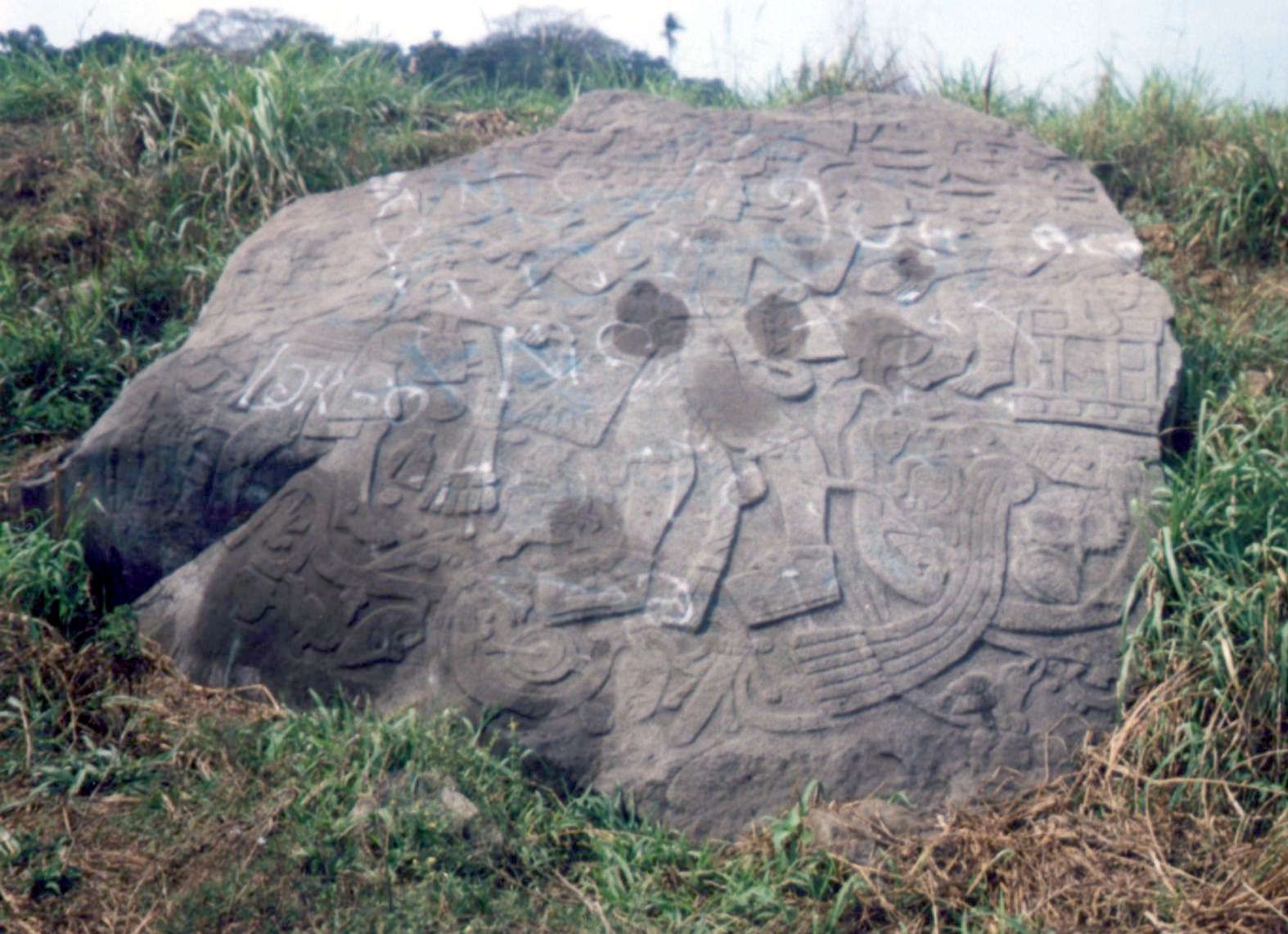
Fifty-eight monuments were cataloged at Bilbao by archaeologist Lee A. Parsons, and the sculptures reveal a culture obsessed with the ritual ballgame and its connection to sacrifice and agricultural fertility. Monument 1 depicts a ballplayer holding a knife in one hand and a severed head in the other, standing atop a dismembered torso. Four smaller figures surround him, each also carrying severed heads. The imagery is violent, but it is also deeply symbolic: ballgame reliefs at Bilbao feature blossoming plants and fruiting vines, linking human sacrifice to the renewal of the earth. Monument 21, a basalt boulder still sitting in a sugarcane field, bears a bas-relief of three figures surrounded by twisting vines that sprout cocoa pods bearing human faces -- birds, snakes, and a butterfly with a human head fill the remaining space. One figure's skirt may depict the face of Xipe Totec, the central Mexican deity of spring and renewal. Potbelly sculptures -- boulders carved into rotund human forms -- represent an even older tradition, dating to the Late Preclassic period.
The Question of Mexican Influence
Who were the people of Bilbao, and where did their ideas come from? Parsons proposed that the site was a colony founded during the Middle Classic, around AD 400 to 550, by the distant metropolis of Teotihuacan in the Valley of Mexico, with El Tajin serving as an intermediary. Under this theory, Bilbao became independent between AD 550 and 700, after Teotihuacan's influence waned. Archaeologist Marion Popenoe de Hatch later redated the site's major occupation to the Late Classic, complicating this narrative. The Mexican influence is undeniable -- carvings of Tlaloc, the rain deity, appear on boulders by a stream, and Xiuhcoatl fire-serpent plumes adorn headdresses on Monument 19. But whether this influence arrived directly from central Mexico or was transmitted through neighboring Pacific coastal polities near Tiquisate or La Gomera remains an open question. Bilbao's art sits at a cultural crossroads, blending local Cotzumalhuapa traditions with imagery from civilizations far to the north.
Plundered, Planted Over, and Still Revealing
Austrian physician Simeon Habel first drew Bilbao's sculptures in 1863, and the Smithsonian Institution published his drawings in 1878. Adolph Bastian of Berlin's Royal Museum visited in 1876 and arranged the removal of the finest pieces. Engineer Albert Napp mapped the site in 1884, but his original map vanished for more than a century before turning up in Berlin in 1994. When Europeans first found Bilbao, it was covered in forest. That forest was cleared for coffee plantations, which were later replaced by sugarcane -- the crop that still blankets the site today. Bilbao's architecture lies under a thick layer of volcanic soil, and only the largest structures can be distinguished as mounds beneath the cane fields. The remaining boulder sculptures sit among earth mounds in the ceremonial center, visited by those who know where to look. The Monument Plaza, where the Berlin stelae originally stood, was once accessible by ramps and stairways. Today it is quiet, its finest works displayed in a museum eight thousand kilometers away.
From the Air
Bilbao is located at 14.35N, 91.03W on Guatemala's Pacific coastal plain at approximately 370 meters elevation, near the town of Santa Lucia Cotzumalguapa in the Escuintla department. From 3,000-5,000 feet AGL, the site appears as sugarcane fields on flat terrain with scattered mounds. Volcan de Fuego (3,835m) dominates the northern skyline. The nearest significant airport is La Aurora International Airport (MGGT) in Guatemala City, approximately 65 km northeast. Weather is typically warm and humid with afternoon convective activity common in the rainy season (May-October).