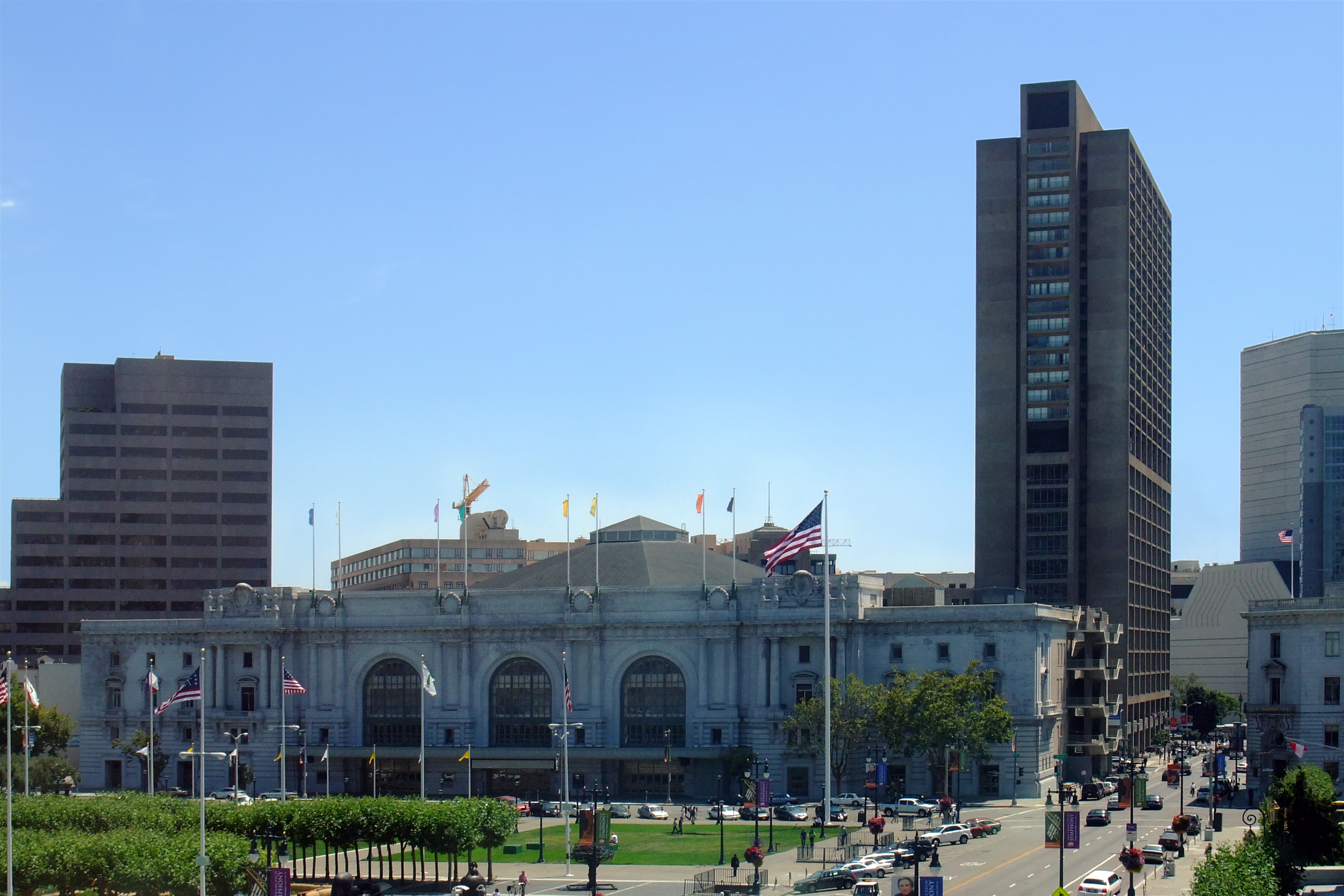
Bill Graham Civic Auditorium
The telegram that named a city's arena after the wrong Graham tells you everything about this building's tangled, magnificent history. When the San Francisco Board of Supervisors voted in 1992 to honor rock impresario Bill Graham, who had died in a helicopter crash the year before, Chronicle columnist Herb Caen couldn't resist pointing out that James T. Graham -- no relation -- had actually managed the Civic Auditorium for sixteen years and booked Elvis, Judy Garland, and the Jefferson Airplane through its doors. Two Grahams, one stage, and more than a century of San Francisco spectacle in between.
Born from a World's Fair
Architects John Galen Howard, Frederick Herman Meyer, and John W. Reid Jr. designed the auditorium for the 1915 Panama-Pacific International Exposition, the grand celebration that announced San Francisco's recovery from the 1906 earthquake. While most Expo structures were temporary confections of plaster and chicken wire, the Civic Auditorium was built to last -- a Beaux-Arts hall anchoring the new Civic Center district. Its 8,500-seat capacity made it the city's premier gathering space for decades. In 1920, Democrats convened here to nominate James M. Cox for president. The San Francisco Opera called it home from 1923 to 1932, filling its cavernous interior with arias before the War Memorial Opera House was completed.
The Other Graham's Golden Years
Jim Graham took the reins in 1954 and turned the auditorium into ground zero for Bay Area entertainment. Elvis Presley played on October 26, 1957. Judy Garland sang on September 13, 1961. The Temptations and Gladys Knight & the Pips shared a bill on January 26, 1968. Between the headliners, Graham filled the calendar with Barnum & Bailey circuses, Golden Gloves boxing, Roller Derby bouts, Ice Capades, and the International Dog Show. President Eisenhower spoke here in 1956 on the centennial of the Republican Party. On June 1, 1968, the auditorium hosted a fundraiser for Robert F. Kennedy -- four days before his assassination in Los Angeles. When the San Francisco Warriors moved from Philadelphia in 1962, it was Jim Graham who signed them to play at the Civic before they outgrew it for the Cow Palace.
Where the Future Was Demonstrated
On December 9, 1968, a Stanford Research Institute engineer named Douglas Engelbart stood on the auditorium stage and showed a roomful of computer scientists something none of them had ever seen: a mouse, a graphical user interface, hypertext links, video conferencing, and collaborative real-time editing. The demonstration, later dubbed the "Mother of All Demos," laid out the entire blueprint for personal computing twenty years before most people would touch a keyboard. It happened here, in a building designed for opera and boxing, during the Fall Joint Computer Conference. The juxtaposition captures the auditorium's essential character -- a space indifferent to categories, where anything could happen next.
Bill's House Now
After the rock promoter Bill Graham died in October 1991, the renaming felt inevitable. Graham had revolutionized the concert business from San Francisco, turning the Fillmore and Winterland into temples of psychedelic rock. The Civic Auditorium became his namesake in 1992 and continued hosting acts across every genre -- U2, Lady Gaga, Bob Dylan, Phish, and Slayer have all played under its roof. An underground expansion called Brooks Hall, completed in 1958 beneath the adjacent Civic Center Plaza, once served as a convention annex. Since 2010, Another Planet Entertainment has operated the venue, keeping it booked with concerts, tech product launches, and the occasional Apple keynote. The building remains city-owned, a public asset that has served San Francisco continuously for more than a century.
From the Air
Located at 37.7785°N, 122.417°W in San Francisco's Civic Center district. The Beaux-Arts roof is visible adjacent to City Hall's distinctive dome. Best viewed at 2,000-3,000 feet AGL. Nearest airports: KSFO (San Francisco International, 11 nm south), KOAK (Oakland International, 10 nm east). The Civic Center complex is a clear visual landmark from the air.