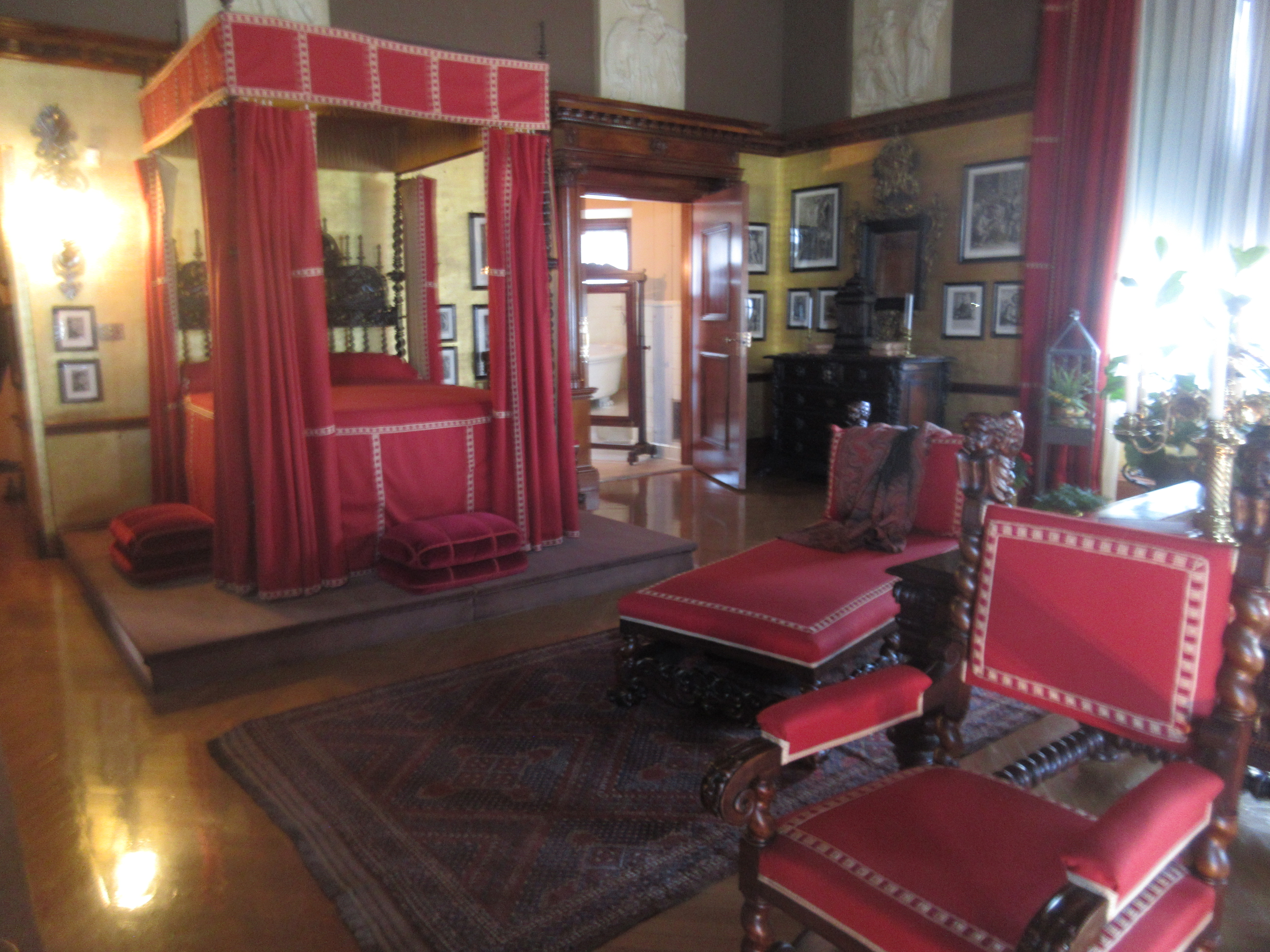
Biltmore Estate
During World War II, the National Gallery of Art in Washington, D.C. needed a hiding place for some of America's most treasured artwork. They chose a half-finished Music Room inside a 250-room mansion in the mountains of North Carolina. By 1942, 62 paintings and 17 sculptures, including Gilbert Stuart's portrait of George Washington and works by Rembrandt, Raphael, and Anthony van Dyck, had been loaded onto a train and shipped to Biltmore Estate in Asheville. The irony was rich: the mansion itself was already one of the most extraordinary collections of art, architecture, and ambition ever assembled under one roof in America.
The Youngest Vanderbilt's Mountain Escape
George Washington Vanderbilt II was the baby of the family, and by the 1880s his older siblings had already staked their claims on the Gilded Age landscape with lavish summer houses in Newport, Rhode Island; the Gold Coast of Long Island; and Hyde Park, New York. George fell in love with the scenery and climate around Asheville, North Carolina, and decided to build what he modestly called his "little mountain escape." He assembled nearly 700 land parcels totaling thousands of acres, including over 50 farms and at least five cemeteries. He named the estate Biltmore, combining De Bilt, his ancestors' place of origin in the Netherlands, with the Old English word "more" for open, rolling land. Construction began in 1889 and required about 1,000 workers and 60 stonemasons. A dedicated railroad spur was built just to haul materials to the site.
A Chateau in the Blue Ridge
Vanderbilt commissioned architect Richard Morris Hunt, who had already designed houses for several Vanderbilt family members, to create something unprecedented. Hunt drew inspiration from French Renaissance chateaux that he and Vanderbilt had toured together in early 1889, including the Chateau de Blois, Chenonceau, and Chambord in France, and Waddesdon Manor in England. The result was a four-story Indiana limestone palace with steeply pitched roofs, turrets, gargoyles, and grotesques. The east facade features a three-story winding staircase with carved statues of St. Louis and Joan of Arc by Austrian sculptor Karl Bitter. The rear loggia opens to views of the Blue Ridge Mountains, its ceiling decorated with terracotta tiles in a herringbone pattern, set in a self-supporting vault system patented by Spanish architect Rafael Guastavino, who personally supervised the installation. Sixteen chimneys punctuate the slate roof, each tile individually drilled and wired into the steel infrastructure.
250 Rooms of Gilded Ambition
Vanderbilt opened Biltmore on Christmas Eve, 1895, to family and friends. The mansion cost roughly $5 million to build. Inside, 250 rooms include 35 bedrooms, 43 bathrooms, 65 fireplaces, and three kitchens, along with an electric Otis elevator, forced-air heating, and centrally controlled clocks and fire alarms. The Banquet Hall seats 64 guests beneath a barrel-vaulted ceiling, surrounded by Flemish tapestries and a triple fireplace. The two-story Library holds over 10,000 volumes in eight languages and features a concealed passageway to the guest rooms. The ceiling painting, The Chariot of Aurora by Giovanni Antonio Pellegrini, was brought from the Palazzo Pisani Moretta in Venice and is considered the most important surviving work by that artist. Guests over the years included novelists Edith Wharton and Henry James, and several U.S. presidents.
A Self-Sustaining World
Vanderbilt intended Biltmore to function like a European working estate. He and Frederick Law Olmsted designed Biltmore Village with rental cottages, a post office, shops, a school, and a church now known as the Cathedral of All Souls. The estate ran scientific forestry programs, poultry and cattle farms, and a dairy. In 1901, the Vanderbilts helped fund Biltmore Industries, which taught local young people to make hand-carved furniture, woven baskets, and homespun wool. Vanderbilt also sold a large portion of the land to the federal government, and his widow Edith completed the sale after his unexpected death in 1914 from complications of an appendectomy. That land became the nucleus of Pisgah National Forest. The estate is now split by the French Broad River and covers approximately 8,000 acres, drawing around 1.4 million visitors annually.
The Family's Long Hold
Vanderbilt's daughter Cornelia married John Francis Amherst Cecil in 1924, and the couple eventually divorced in 1934. Cornelia left and never returned, but John Cecil lived in the Bachelors' Wing until his death in 1954. Their son William A. V. Cecil Sr. returned in the late 1950s and partnered with his brother George to transform the financially struggling estate into the self-sustaining enterprise their grandfather had envisioned. William inherited the house; George got the dairy farm, which became Biltmore Farms. The estate was designated a National Historic Landmark in 1963. Today The Biltmore Company, still family-held, operates the house as a museum alongside a winery in the former dairy barn, two hotels, and the Antler Hill Village complex of shops and restaurants. After Hurricane Helene caused flooding damage in late 2024, the estate donated $2 million to relief efforts and reopened in November of that year.
From the Air
Located at 35.540N, 82.552W south of downtown Asheville, North Carolina, in the Blue Ridge Mountains. The massive estate is bisected by the French Broad River and is visible from altitude as a large clearing with the distinctive chateau at its center. Best viewed at 3,000-5,000 feet AGL from the east to appreciate the facade. Nearby airports include Asheville Regional (KAVL) approximately 8 nm south. The Blue Ridge Parkway runs along ridgelines to the east and south. Expect mountain turbulence and variable visibility in the valleys.