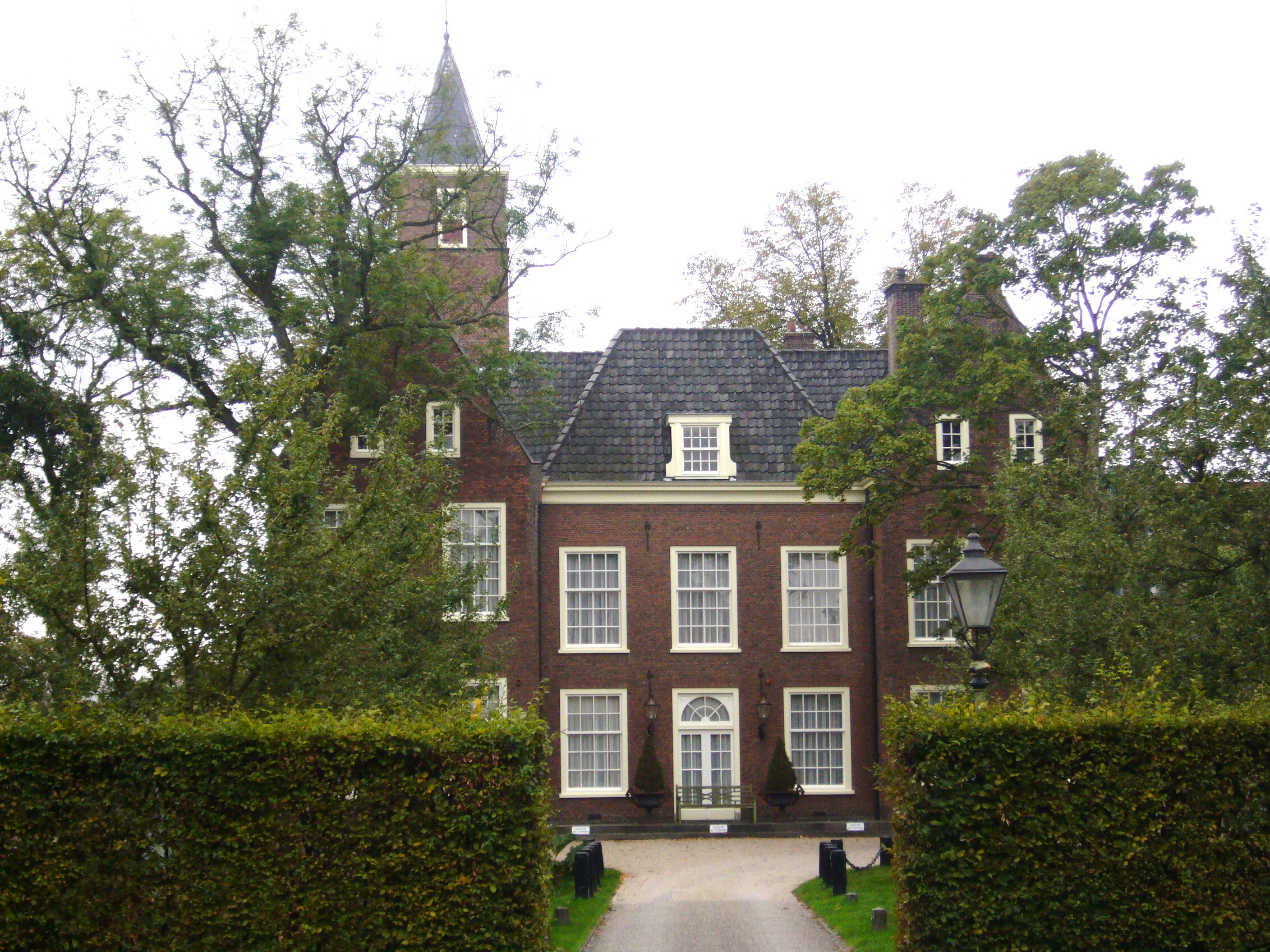
Binckhorst Castle
Walk through the Binckhorst neighborhood of The Hague today and you will find sheet-metal warehouses, concrete batching plants, and a forest of construction cranes lifting glass apartment blocks into the sky. Drop your eyes from the cranes and there it is, almost embarrassed to still be standing: a low, irregular brick manor on a small artificial hill, surrounded by a moat. Binckhorst Castle has been here, in one form or another, for at least seven centuries. It has been besieged twice, demolished once, restored from the ground up in the 1930s, requisitioned by the Dutch army, occupied as a Nazi party office, used as an orphanage and a plastic surgery clinic, and is currently full of children. The cranes around it will eventually pass on. It probably won't.
A name older than the building
The name Binckhorst is recorded as early as 1076, when an Evert van der Binckhorst appears in the documents - though nobody is quite sure whether that reference is to this exact site. The word itself is geographic. Horst denotes higher ground with trees, and bink may mean a stack or height. The land here was once distinctly higher than its surroundings, and at some point an enterprising owner had it levelled, the soil carted away to raise the lower ground nearby. In 1567 Jacob Snouckaert wrote about doing exactly this. The castle's hill is what was left when the rest of the high ground was wheeled off in carts. The road that runs past, Binckhorstlaan, may follow the line of a Roman road that once connected to Forum Hadriani, the Roman town near modern Voorburg. The Binckhorst has been a landmark for a very long time.
Trebuchets and family feuds
In 1308 the huys Binchorst was transferred to Count William III of Holland by Simon van Benthem, then granted back as a fief. Simon had married Jacoba van Wassenaar, who brought Rosenburgh Castle as her dowry, and one of their sons - Jacob - inherited Binckhorst and adopted its name. He was a bailiff of Rijnland and Woerden, a member of the count's council, and a committed partisan of the Hook faction in the Hook and Cod Wars, a long Dutch civil conflict between rival aristocratic alliances. In 1351, at the war's outset, Count William V's forces brought a small trebuchet from the siege of Rosenburg and pointed it at Binckhorst. A few days of battering and the castle fell. Eight years later, in 1359, troops from the Cod city of Delft besieged and took both Binckhorst and the nearby Polanen Castle. After that second siege, the castle was reportedly destroyed.
The economics of a canal
Binckhorst's strategic value came from water. In 1344 the Haagse Trekvliet was dug from the moats of The Hague to the Vliet, the canal running between Leiden and Delft. The new channel ran past the castle, and whoever held the castle could choke or tax the traffic that moved along it. In an era when canals were the freight arteries of Holland, that mattered enormously. Centuries later, in 1464, the castle passed to Dirk Poes Zijbrandszn, and from there into a tangle of inheritance disputes. The Snouckaert family acquired it through marriage in 1563; the Poes family briefly seized it back with 50 armed men and some guns; the Snouckaerts won the resulting lawsuit. Jacob Snouckaert was the patron for whom Philibert van Borsselen wrote, in 1613, the first Dutch poem dedicated to the lord of a country estate: Den Binckhorst, ofte Het lof des gelucsalighen ende gherustmoedighen Land-Levens. Praise for the contented life of country gentry, addressed to a man who had inherited a small fortress.
Rebuilt from almost nothing
The castle you see today is mostly a 1930s reconstruction, and that reconstruction is itself a story. By 1929, the building was in such poor condition that South Holland refused to subsidize its preservation - the surroundings, the province said, no longer justified the building. In 1932 the tiny Dutch fascist party briefly used it as a headquarters. In 1934 a painter named Cor Noltee lived there. In February 1935 a youth employment program finally agreed to restore the castle, and once the work began, the archaeologist Jaap Renaud discovered that almost nothing in the standing walls was medieval. Bricks were too small. Walls were too thin. Foundations were essentially absent - some rows of re-used medieval kloostermoppen tossed under thin sixteenth-century brickwork. The tower had wandered 60 centimeters out of plumb. Most of the building was torn down and rebuilt with its original bricks. Only the stair tower and a small piece beside it are truly old. The hill survived, the moat survived, the silhouette survived, but the castle, in physical terms, was made new in 1937.
The twentieth century and beyond
World War II followed almost immediately. By October 1939 the Dutch army had moved in. During the May 1940 Battle for The Hague, three soldiers volunteered to leave the castle and try to reach a searchlight near Ypenburg airport. They were killed. Their small memorial stands in the garden. From April 1942 the castle housed boys' orphanage. By 1958 the orphans had gone and a vocational construction school took the building. From the mid-1990s until 2020, a private plastic surgery clinic operated inside its rebuilt walls. Today, in 2024, the rooms ring with the noise of a kindergarten. Outside, the once-rural site is now ringed by industrial buildings being torn down and replaced by apartment towers many times the castle's height. The neighborhood is transforming again, as it has so many times before. The hill remains, the moat remains, and on top of them, a fortress that has been almost continuously reinvented for seven hundred years quietly accepts its newest residents.
From the Air
Binckhorst Castle, The Hague, Netherlands. Coordinates: 52.07 degrees N, 4.34 degrees E. The castle stands in the Binckhorst quarter on the southeast side of the city, alongside the Haagse Trekvliet canal. From the air, look for the small moated rectangle marooned among industrial sheds and rising residential towers. Recommended viewing altitude 1,500-2,500 feet for context with the Trekvliet, the medieval canal that gave the castle its strategic value. Nearest airport is Rotterdam The Hague (EHRD), about 10 nautical miles south. Schiphol (EHAM) lies roughly 25 nautical miles northeast.