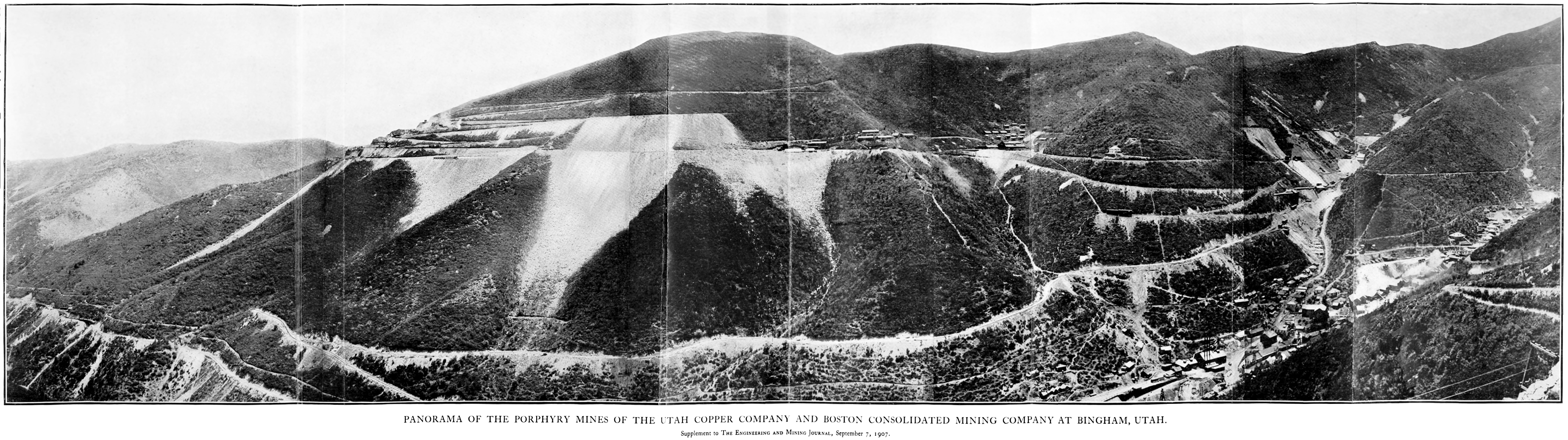
Bingham Canyon Mine
Brigham Young told them to ignore it. When Sanford and Thomas Bingham discovered copper ore while grazing cattle in this Oquirrh Mountains canyon in 1848, the Mormon leader advised against mining. Survival and settlement came first. The brothers obeyed, moving on to Weber County and leaving behind only their name. It would take fifteen more years for others to stake claims here, and more than a century of digging to create what satellites can photograph from orbit: a terraced wound in the Utah landscape over half a mile deep and two and a half miles wide, the largest human-made excavation on Earth.
Digging Deeper Than Mountains Rise
The numbers strain comprehension. The pit descends more than 4,000 feet below the original surface, deeper than many mountains are tall. Each day, workers remove approximately 450,000 tons of material from its slopes. Electric shovels swing buckets capable of lifting 98 tons of ore in a single scoop. A fleet of 64 dump trucks, each costing $3 million and carrying 255 tons at a time, hauls the material up spiraling roads carved into the pit walls. The longest of the conveyor belts stretching to the processing plant runs five miles. In over a century of continuous operation since 1906, the mine has produced more than 18.7 million tons of copper, along with gold, silver, molybdenum, platinum, and palladium. In 2005, the molybdenum alone was worth more than the copper.
From Placer Gold to Porphyry Copper
The first miners came for gold and silver, working placer claims and small veins. The real treasure, a massive porphyry copper deposit, required industrial-scale processing that early prospectors could not manage. When the railroad reached Bingham Canyon in 1873, everything changed. Enos Andrew Wall began systematic exploration in 1887, digging tunnels and test pits that revealed ore containing two percent copper, rich enough to justify the enormous investment required for extraction. By 1906, open-pit mining had begun. The pit expanded year by year, eating through the Oquirrh Mountains, following concentric zones of mineralization around an ancient volcanic intrusion. The geology reads like tree rings: a core of magnetite surrounded by zones of molybdenite, bornite, chalcopyrite, and an outer ring of lead and zinc.
When the Mountain Moved
At 9:30 p.m. on April 10, 2013, approximately 165 million tons of dirt and rock broke loose and thundered into the pit. It was possibly the largest non-volcanic landslide in North American recorded history. Remarkably, no one was hurt. Engineers had installed interferometric radar to monitor the increasingly unstable walls, and the system detected movement in time to evacuate workers the previous day. The slide buried equipment under hundreds of feet of debris and cut copper production significantly. A second slide forced evacuation of 100 workers in September 2013. Another occurred in May 2021. The steep walls that make the mine so productive also make it inherently unstable, a calculation the operators must constantly recalculate as the pit grows ever deeper.
A Century of Scars
Industrial mining on this scale leaves marks beyond the pit itself. By 1904, sulfur dioxide emissions from valley smelters were destroying crops across the Salt Lake region. Farmers sued, and a federal judge ordered the smelters closed if they could not control pollution. Groundwater contamination spread beneath the operation, creating a plume of hazardous materials including arsenic, lead, and cadmium. Homes built on former floodplains showed dangerous levels of contamination when tested in 1990. The EPA proposed listing Kennecott as a Superfund site in 1994. The company avoided that designation by committing to voluntary cleanup, spending over $400 million since the early 1990s on remediation efforts. The legacy of contamination will outlast the mine itself.
Visible from Orbit
Astronauts have photographed Bingham Canyon from space, its terraced benches and spiraling haul roads unmistakable against the surrounding landscape. The mine employs roughly 2,000 workers and remains one of the top copper producers in the world, supplying 13 to 18 percent of America's copper needs. Owned by the British-Australian giant Rio Tinto, the operation includes not just the pit but a concentrator plant, smelter, and refinery. Copper emerges at 99.99 percent purity, while gold and silver are recovered from the residue. The pit continues to deepen, the trucks continue to climb, and the mountain continues to yield its metals. How long it will last, no one knows. When it ends, the people of the Salt Lake Valley will inherit the pit.
From the Air
Located at 40.52N, 112.15W in the Oquirrh Mountains, approximately 25 miles southwest of Salt Lake City, Utah. The pit is unmistakable from the air: a massive terraced excavation over 2.5 miles wide and visible even at cruise altitudes. The beige and gray terraces contrast sharply with surrounding terrain. Look for the haul roads spiraling down into the pit and the tailings ponds to the northeast near Magna. Nearest airports: Salt Lake City International (KSLC) 25nm northeast, South Valley Regional (U42) 15nm east. Best viewing altitude: 8,000-12,000 feet AGL. Restricted airspace may apply near the mine operation.