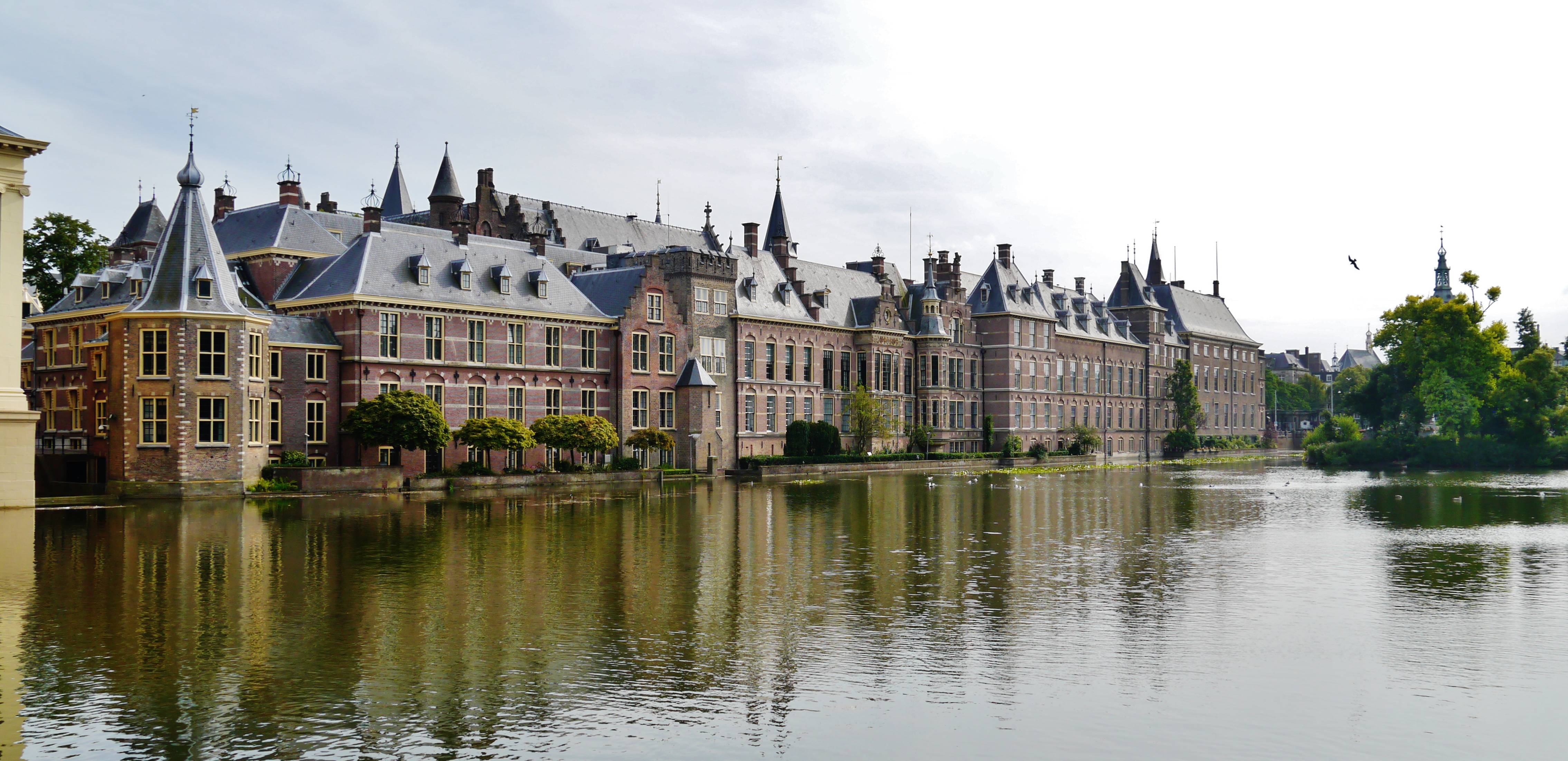
Binnenhof
Count Floris IV did not set out to build a parliament. In 1229 he bought a parcel of marsh and dunes beside a small pond, west of nowhere in particular, and put up a hunting lodge so he could chase deer between meetings. Eight hundred years later, the lodge is gone, the deer are gone, the counts are gone, and what stands on that patch of ground is the Binnenhof - the oldest building in the world that has been continuously used to govern a country.
From Hunting Lodge to Knight's Hall
Floris's grandson, also called William, became King of the Romans in 1248 - effectively the elected king of Germany - and a hunting lodge no longer suited his station. He began building a great hall on the family estate by the pond. His son, Floris V, finished it. They called it the Ridderzaal, the Knight's Hall, a vast Gothic room with a timber roof shaped like an upturned ship. The family had not yet imagined a parliament, or a republic, or a kingdom of the Netherlands - none of those things existed. They were building a place where a count could feast his vassals and hold his court. The walls went up around it. Gates were added. A private wing for the count, a public side where business was done. By accident, they were laying down the bones of a building that would outlast their entire dynasty.
Eight Centuries of Owners
The House of Holland died out in 1299 and the place passed to the counts of Hainaut, who barely came. Then the dukes of Bavaria, who liked it enough that Albert I made it his primary residence. Then the dukes of Burgundy, who almost never visited, leaving the buildings to their stadtholders. Each landlord left a wing, a chamber, a chapel, a fresh coat of paint. By 1581, when Philip II of Spain was deposed and the Dutch Republic declared, the Binnenhof had been added to and subtracted from for so long that nobody was entirely sure what was original. The Ridderzaal itself had been demoted to a covered market, where booksellers and stallholders did business under the eavesdropper-heads carved into the roof beams - wooden faces meant to remind speakers in the hall that the higher powers were listening, and lying was unwise.
The Building That Nearly Wasn't
Twice the Binnenhof came close to being torn down by the people who governed from it. The first time was under Napoleon: between 1806 and 1810 the French moved the Dutch capital to Amsterdam, the Binnenhof emptied out, and bureaucrats began discussing demolition. Independence saved it. The second time was 1848, when a new constitution swept aside the old order and the States General decided that a modern parliamentary democracy needed modern parliament buildings - not a draughty medieval hodgepodge full of dukes' ghosts. The local residents of The Hague disagreed. They protested. They won. By the time anyone got around to seriously remodelling the place, sentiment had hardened into preservation: this was where the Dutch had governed themselves since they had been a Dutch nation, and you did not knock it down to build something fashionable.
The Little Tower
Tucked into the north corner of the complex, jutting into the Hofvijver pond, is a small stone tower called simply the Torentje. Since 1982 it has been the office of the Prime Minister of the Netherlands. Every Dutch PM since Lubbers has worked in this turret over the water, taking calls a few metres from ducks. In 2004 an underwater gate was installed at the lake bottom, on the perfectly sensible grounds that someone in scuba gear could otherwise swim right up to the prime ministerial windows. Elsewhere in the complex are the chambers of the Senate (looking out over the pond), the House of Representatives (in a modern eastern wing added in 1992 because 150 MPs no longer fit in the old hall), and the Trêveszaal - the Treaty Room - originally built to negotiate during the Eighty Years' War, now the meeting room of the cabinet. Government is conducted in rooms older than most countries.
The Renovation
In autumn 2021, the morning after the king delivered his speech from the Ridderzaal as he does every year, the entire Binnenhof emptied out for the first time in centuries. The renovation that began that day is the most thorough in its eight-hundred-year history: roof tiles, foundations, eavesdropper heads, asbestos in the modern wings, eight hundred years of accumulated wiring. Parliament moved across the street to a stand-in office while the work continues. The estimated completion, originally set for 2028, has slipped repeatedly - as of 2026 the target is 2031, with costs exceeding €2.7 billion and the Dutch press tracking every overrun in tones somewhere between affection and exasperation. The Binnenhof has had work done before. What you see when you stand at the gate today is essentially the same view people had in 1620 when the Stadtholder's Gate went up - with William II of the Netherlands on his bronze horse, one of very few equestrian statues the Dutch ever erected, guarding the entrance to the office of the boss of his old country.
From the Air
Coordinates 52.0796°N, 4.3134°E, in the heart of The Hague. Recommended viewing altitude 2,000-3,000 ft for the courtyard and surrounding pond. The Binnenhof's Ridderzaal is the small Gothic building with a steeply pitched roof at the centre of a rectangular courtyard, with the rectangular Hofvijver pond on its north side. Look for the small round Torentje turret on the pond's edge - that's the prime minister's office. Nearest airport is Rotterdam The Hague (EHRD) about 11 nm south.