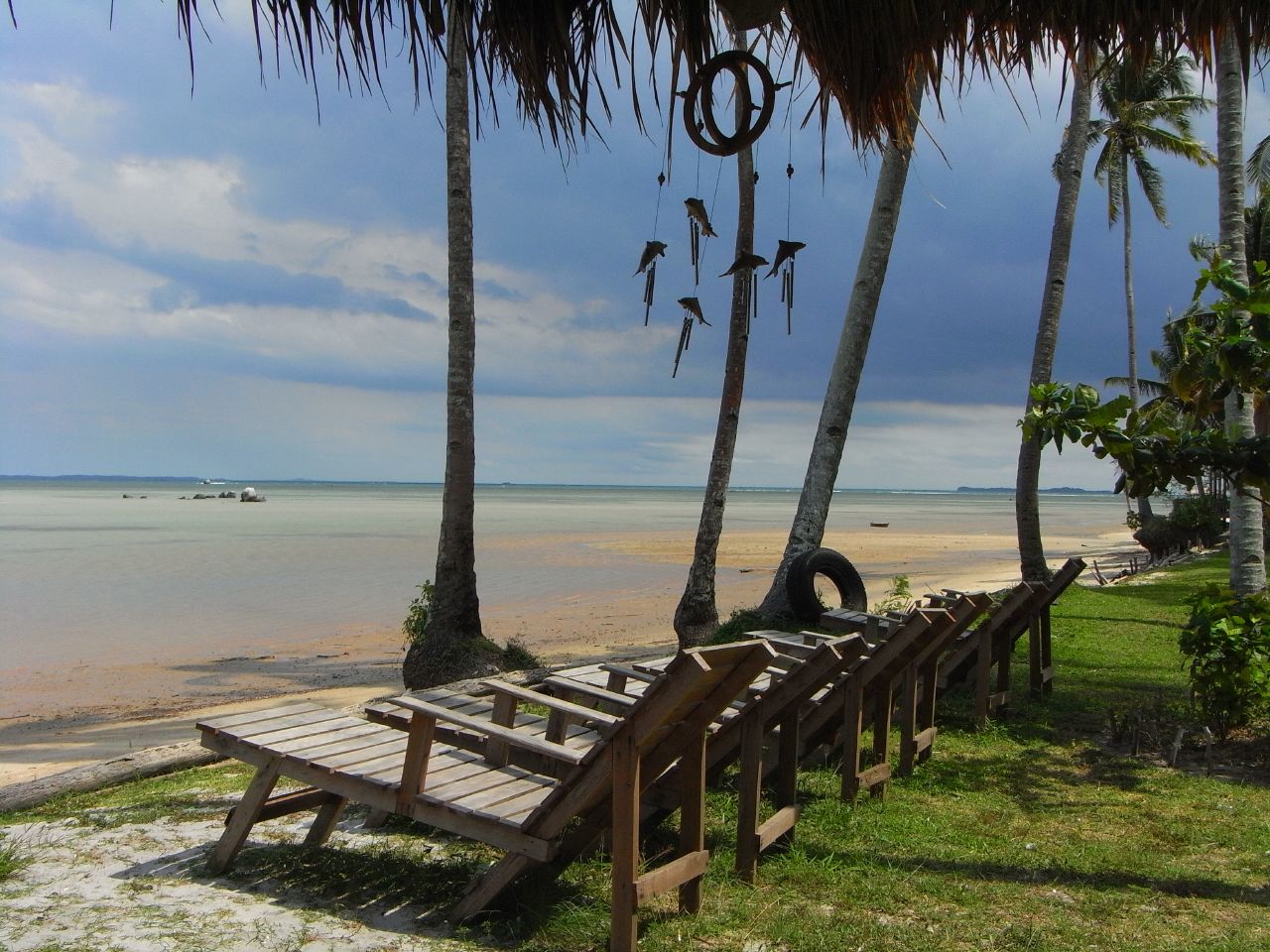
Bintan Island
Ibn Battuta, the great Arabian chronicler, described the Riau Islands in the fourteenth century with a traveler's wariness: "Here there are little islands, from which armed black pirates with poised arrows emerged, possessing armed warships; they plunder people but do not enslave them." Seven centuries later, the largest of those islands welcomes over 600,000 tourists a year, most of them arriving by catamaran from Singapore for a weekend of beach resorts and golf. Bintan Island -- known for centuries as Negeri Segantang Lada, or simply "Pirate Island" -- has reinvented itself many times, but the old reputation has never quite washed away.
Where Empires Came to Trade and Fight
Bintan's strategic position on the India-China trade route made it valuable long before anyone thought to build a resort on it. Malay pirates operating from the island's harbors forced passing Chinese merchant vessels into port, demanding trade or simply seizing cargo. Large quantities of Chinese ceramics recovered on Bintan trace back to the early Song dynasty, between 960 and 1127 -- evidence of centuries of commerce, coerced or otherwise. The island first entered the geopolitical spotlight in 1511, when Sultan Mahmud of the fallen Sultanate of Malacca fled here after the Portuguese captured his capital. He built a resistance base on Bintan, holding out for fifteen years before the Portuguese destroyed the stronghold in 1526. After that, the Portuguese, Dutch, Arabs, British, and Bugis all competed for influence over the island and its straits. From the mid-sixteenth century, the Sultan of the Johor-Riau kingdom shuttled his capital between Johor, Riau, and Lingga, and Bintan's fortunes rose and fell with each shift of power.
The Stilts and Alleys of Tanjung Pinang
Tanjung Pinang, the provincial capital on Bintan's southern coast, grew in a way that reveals its relationship with the sea. The low-tide mud flats were built over with stilts, and above these reaches, narrow piers called pelantars were constructed at higher elevations. The old city expanded into a maze of streets and alleys that climb from the waterfront. Pelantar II, the old pier, still thrives as a fish market. A large Chinese community maintains its presence around three Buddhist pagodas, with the Citiya Bodhi Sasana overlooking the ocean at the pier's end. The population of Tanjung Pinang has surged from under 99,000 in 1998 to over 227,000 by 2020, driven largely by the island's proximity to Singapore and Malaysia. Malays, Bugis, Chinese, and Orang Laut -- the indigenous sea nomads -- share the island, though Indonesians from other islands have arrived in such numbers that the original Malay inhabitants are now a minority in the Riau Archipelago as a whole.
Singapore's Backyard Playground
The transformation of Bintan from wild island to resort destination is a story of Singapore's economic gravity. In 1990, a presidential decree established a coordinating team to develop the Riau Province in cooperation with Singapore, which needed leisure space it could not provide on its own compact territory. By 1994, the Bintan Resort Development was partially open under a memorandum of understanding signed by the trade ministers of Singapore, Malaysia, and Indonesia. An area of 23,000 hectares on the northern coast was leased and divided into twenty to thirty projects -- 3,000 hectares for hotels, resorts, and sports facilities including championship golf courses. The resort area has its own ferry terminal with a direct 45-minute catamaran connection to Singapore's Tanah Merah terminal, effectively bypassing Tanjung Pinang entirely. A separate industrial estate of 4,000 hectares targets textiles, garments, and wood processing, functioning as a low-cost manufacturing supplement to Singapore's economy. The island that once forced ships to port at arrowpoint now welcomes them with customs counters and shuttle buses.
Beneath the Golf Courses
Bintan's older layers persist beneath the resort infrastructure. On the island's northeast end, ancient Islamic relics mark the centuries of Malay and Bugis history. The Masjid Raya, a grand mosque over 170 years old, is visible from Tanjung Pinang across the water. A seaside monument commemorates Raja Ali Haji, the Bugis commander and literary figure who gave his life resisting the Dutch. In 1819, the Penyengat-based sultanate cooperated with Sir Stamford Raffles to hand over Singapore in exchange for British military protection -- a transaction that shaped the modern map of Southeast Asia. In Senggarang town, a century-old Banyan Tree Temple draws local Chinese worshippers and Singaporean visitors. Hawksbill and green turtles still nest along the coastlines, though far less frequently than in the 1950s, when at least two nests appeared daily during nesting season. The island holds 15.88 million tons of bauxite reserves, along with deposits of kaolin, granite, white sand, and tin -- resources that have attracted mining interests alongside the resort developers.
An Island Between Worlds
At 1,173 square kilometers, Bintan is the largest of the Riau Archipelago's 3,200 islands, sitting just 10 kilometers east of Batam and a 45-minute ferry ride from one of the world's most expensive cities. The equatorial climate holds temperatures near a constant 26 degrees Celsius, with monsoon rains from November to March and dry southwest winds from June to October. Raja Haji Fisabilillah Airport handles domestic flights, though plans have circulated for an expanded hub -- complicated by the fact that the region is already saturated with airport capacity between Singapore Changi, Johor Bahru Senai, and Batam's Hang Nadim International. Bintan exists in a peculiar liminal space: Indonesian sovereign territory operating largely as an economic extension of Singapore, a former pirate stronghold now marketing itself as a golf destination, an island where seven-hundred-year-old ceramic shards from the Song dynasty lie in the same soil that supports five-star hotels. The contradictions are the island's defining feature, and they have been for a very long time.
From the Air
Located at approximately 1.08N, 104.49E in the Riau Islands of Indonesia, just southeast of Singapore. Bintan is the largest island in the Riau Archipelago, clearly visible from altitude as a distinct landmass south of the Singapore Strait. Recommended viewing altitude: 5,000-8,000 feet for the full island outline. The northern resort coast faces Singapore across the strait. Nearest airports: Raja Haji Fisabilillah Airport (WIDN) on Bintan itself, Hang Nadim International Airport (WIDD) on neighboring Batam, and Singapore Changi Airport (WSSS) approximately 45 km to the northwest. The island's 105 km coastline is clearly visible, with resort development concentrated on the northern shore.