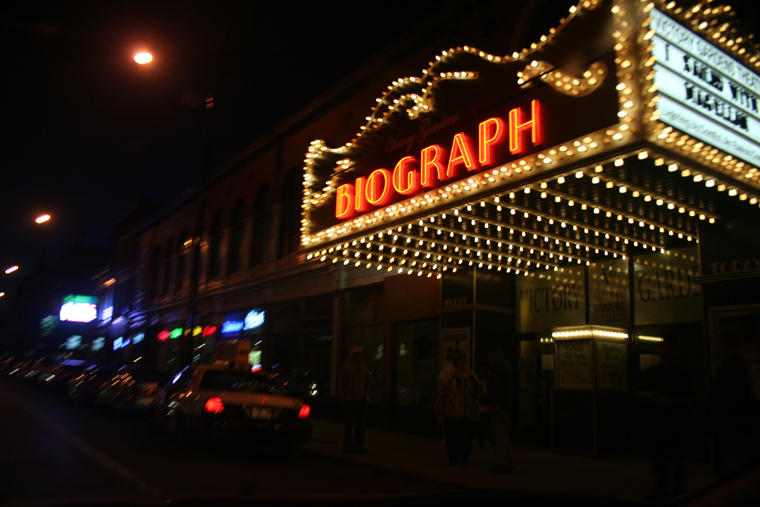
Biograph Theater
The movie was Manhattan Melodrama, a gangster picture starring Clark Gable. The date was July 22, 1934. The man buying his ticket at the Biograph Theater on Lincoln Avenue was John Dillinger, the most wanted criminal in America, a bank robber who had escaped jail twice and shot his way out of FBI traps. He was there with two women: his girlfriend Polly Hamilton and a brothel madam named Ana Cumpanas, known to history as Anna Sage, 'The Woman in Red.' What Dillinger did not know was that Sage had cut a deal with the FBI, hoping cooperation might prevent her deportation. She had agreed to wear an orange dress so agents could identify her in the crowd. FBI agent Melvin Purvis waited outside with a team of men. When Dillinger emerged from the theater and spotted them, he reached for a pistol and tried to flee. The agents shot him dead in the alley beside the theater. He was 31 years old.
A Storefront Picture Palace
The Biograph Theater was designed by architect Samuel N. Crowen and opened in 1914, one of hundreds of neighborhood movie houses that proliferated across American cities in the early twentieth century. It carried the distinguishing marks of the era: a storefront-width lobby, recessed entrance, free-standing ticket booth, and canopy marquee jutting over the sidewalk. The building was finished with red pressed brick and white-glazed terra cotta on its Lincoln Avenue facade. It was a modest place, built for the new entertainment of moving pictures in the Lincoln Park neighborhood of Chicago's North Side. For its first twenty years, the Biograph was simply a local theater, unremarkable except for its handsome brickwork. What made it famous happened not on the screen but on the sidewalk outside.
Public Enemy Number One
By the summer of 1934, John Dillinger had become a national obsession. He had robbed banks across the Midwest, escaped from the 'escape-proof' Crown Point jail using what he claimed was a wooden gun, and survived a shootout at the Little Bohemia Lodge in Wisconsin where FBI agents killed a civilian and let Dillinger slip away. J. Edgar Hoover, the young FBI director, made capturing Dillinger a personal crusade and assigned his Chicago bureau chief, 30-year-old Melvin Purvis, to lead the hunt. The break came through Anna Sage, a Romanian-born madam facing deportation. She offered to deliver Dillinger in exchange for help with her immigration case. On the evening of July 22, she accompanied Dillinger and Polly Hamilton to the Biograph for the 8:30 showing of Manhattan Melodrama. Purvis stationed agents around the theater and waited.
The Alley
The film ended around 10:30 PM. Dillinger walked out the front entrance, flanked by the two women. Purvis lit a cigar - the signal to his agents. Dillinger glanced back, saw the men converging, and bolted for the alley south of the theater. He reached for a Colt automatic in his trouser pocket. Three agents fired. Dillinger fell in the alley and died within minutes. The crowd that had been leaving the theater pressed forward. People dipped handkerchiefs and scraps of paper in the blood pooling on the pavement, collecting souvenirs. The next morning, the Chicago Daily Tribune ran the headline: 'Kill Dillinger Here.' Anna Sage was deported to Romania two years later despite her cooperation. Purvis resigned from the FBI in 1935, worn down by conflicts with Hoover. The alley beside the Biograph became one of Chicago's most visited spots, a pilgrimage site for the morbidly curious.
From Screen to Stage
The Biograph continued as a movie theater for seven decades after the shooting, cycling through various owners. In July 2004, after 90 years showing films, Victory Gardens Theater purchased the building and commissioned architect Daniel P. Coffey for an $11 million renovation. Coffey gutted the interior and constructed a proscenium-thrust stage with seating for 299. A grand staircase from the original structure was restored, leading to a second-floor studio theater seating 135. The Victory Gardens at the Biograph opened in fall 2006. The exterior, however, was preserved - that red-brick facade and terra cotta trim remain essentially as they appeared when Dillinger walked out the door. The theater was placed on the National Register of Historic Places and designated a Chicago Landmark on March 28, 2001.
The Biograph on Film
The theater's notoriety has kept it in the cultural spotlight. For the 2009 film Public Enemies, starring Johnny Depp as Dillinger, the facades of the Biograph and its adjoining businesses were redressed to appear exactly as they did in 1934 - the marquee, the storefronts, the streetscape all rolled back seventy-five years. The theater also appears in the 2000 film High Fidelity, though with a characteristic Chicago error: the gunfight with Dillinger is said to have taken place inside the theater rather than outside it. Every July, the anniversary draws visitors to Lincoln Avenue. They stand on the sidewalk, peer into the alley, and photograph the marquee. The Biograph endures as both a working theater and a monument to one of the most dramatic moments in American law enforcement history - the night the FBI's most wanted man watched a gangster movie and walked into the real thing.
From the Air
Located at 41.93°N, 87.65°W on Lincoln Avenue in Chicago's Lincoln Park neighborhood, on the North Side. The theater is a small building difficult to distinguish from altitude, but Lincoln Avenue runs diagonally through the grid and is identifiable from above. The neighborhood sits between Lake Michigan to the east and the north branch of the Chicago River to the west. Nearby airports include Chicago O'Hare International (KORD, 12 nm northwest) and Chicago Midway International (KMDW, 10 nm southwest). Best viewed at lower altitudes under 2,000 feet AGL in clear conditions.