Birch Memorial Clock Tower
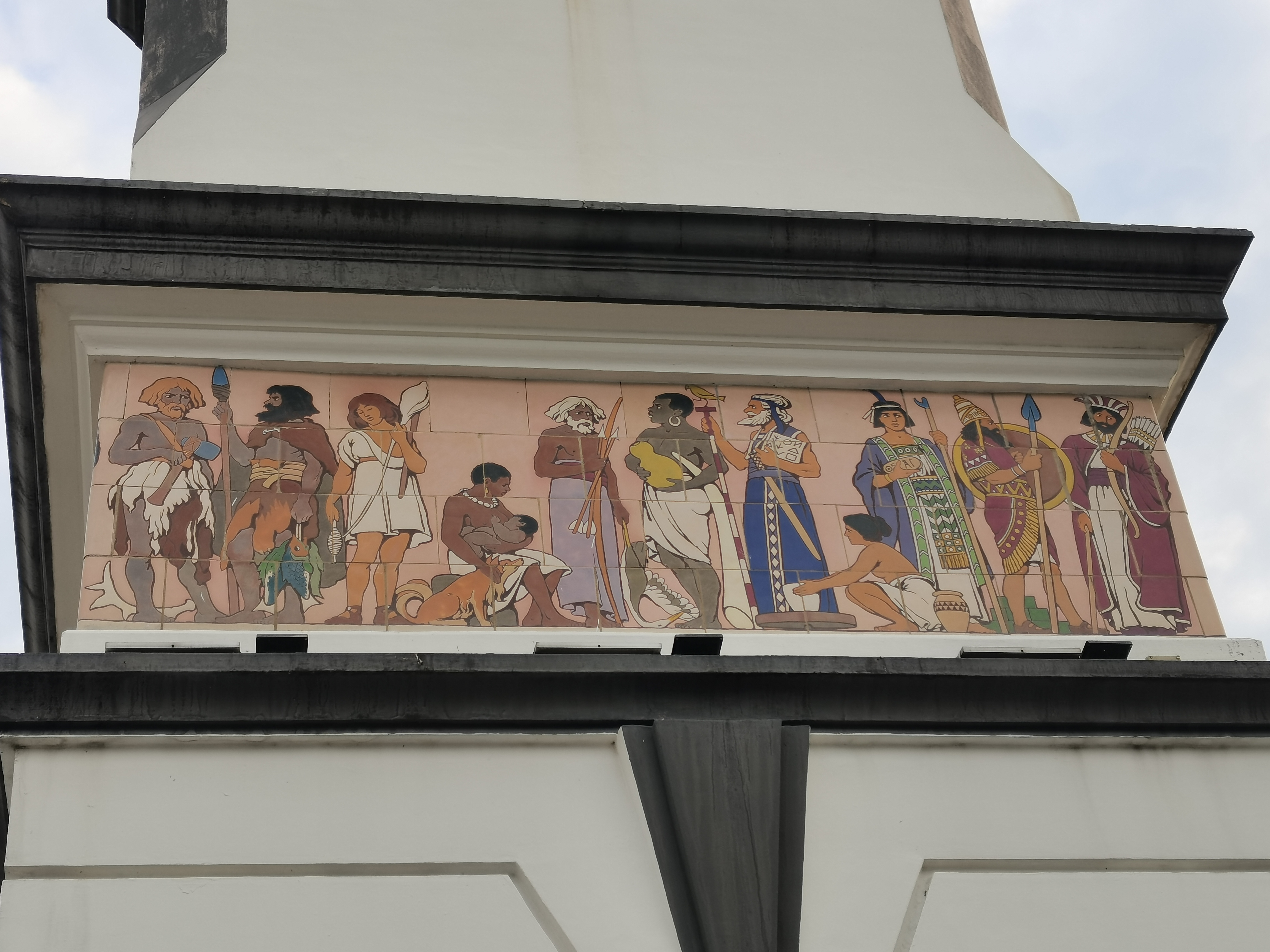
On the south-facing panel of a clock tower in Ipoh, Malaysia, there is a blank space where a figure of the Prophet Muhammad once stood. It was chiseled away on 15 July 1958 because Islam prohibits visual depictions of the Prophet -- a quiet correction to a monument that had been standing for nearly fifty years by then. The Birch Memorial Clock Tower, unveiled on 8 December 1909, was built to honor James W. W. Birch, the first British Resident of Perak, who was assassinated in 1875. But the tower's most remarkable feature has nothing to do with Birch himself. It is the four ceramic panels, designed by Doulton and Co. of London, that wrap around the base and attempt to illustrate the entire history of human civilization -- from Stone Age hunters to Thomas Edison.
A Resident's Violent End
James W. W. Birch arrived in Perak in 1874 as the first British Resident, a position created under the Pangkor Treaty to "advise" the Malay sultan on all matters except religion and custom. In practice, Birch pushed aggressively for reforms that threatened the power of local chiefs -- particularly his efforts to end debt slavery and assert direct British tax collection. On 2 November 1875, while bathing in a floating bathhouse on the Perak River at Pasir Salak, Birch was stabbed to death by warriors loyal to the Maharaja Lela and other Malay chiefs. His murder triggered a British military expedition that crushed the resistance, and Birch became a colonial martyr. Thirty-four years later, the clock tower rose in his memory at a cost of $25,000, topped with four statues representing the cardinal virtues -- prudence, justice, fortitude, and temperance -- qualities his critics might have said he lacked.
Civilization in Four Panels
The real ambition of the monument lies below the clock face. Designed and manufactured by the renowned Doulton and Co. in London, four ceramic panels circle the tower, each assigned a cardinal direction and a sweep of human history. The north panel begins with the Stone Age -- a hunter, a fisherman, a woman spinning thread -- and moves through the Iron Age to the early Eastern peoples: a Nubian bearing gold and ivory, a Chaldean astrologer, an Egyptian, an Assyrian, a Persian. The west panel picks up with Moses, David, a Phoenician, then leaps to the Far East for Confucius, Buddha, and Lao Tzu before arriving at Greece and Rome with Alexander the Great, Plato, and Augustus. It is a breathtaking compression of millennia into ceramic relief, and it carries all the confident assumptions of Edwardian Britain about what "civilization" meant and who mattered in it.
From Constantine to Edison
The southern and eastern panels continue the march forward. Constantine the Great represents Byzantium. A Crusader stands for the age of chivalry. Saint Clare of Assisi embodies faith; Thomas Aquinas, Gothic thought. Then the Renaissance arrives with Galileo, Michelangelo, Vittoria Colonna, and Columbus, followed by Martin Luther for the Reformation and Shakespeare for the Elizabethan age. The eastern panel brings the story into modernity: Newton, William Harvey, James Watt, Beethoven, Florence Nightingale, Darwin, Edison, and Joseph Lister. Among them stands a single unnamed figure -- an embroiderer -- whose anonymity amid so many famous names feels like an accidental commentary on how history remembers craft versus genius. The chimes that once rang from the tower were cast by Gillett and Johnston of Croydon, the same firm that supplied bells to cathedrals across the British Empire.
The Prophet Removed
For nearly fifty years, the south panel included a depiction of the Prophet Muhammad alongside the other figures of faith and philosophy. On 15 July 1958, the figure was removed -- a workman carefully obliterated the image because Islam forbids visual representations of the Prophet. The modification was reported matter-of-factly in the Straits Times. It was not an act of vandalism but of religious respect, carried out as Malaya was transitioning from colony to independent nation. The blank space remains, an absence that says as much as any of the carved figures around it. Meanwhile, the bronze portrait bust of Birch that once occupied a niche in the tower has also been removed over the years. The man the monument was built for is no longer physically present on it -- an irony that suits a country rewriting its relationship with colonial memory. The clock still keeps time.
From the Air
Located at 4.597N, 101.076E in the center of Ipoh, Perak, Malaysia. The clock tower stands in a prominent square in the old colonial district, near the Ipoh Railway Station and the Royal Ipoh Club. Sultan Azlan Shah Airport (WMBA) is just 5 km to the south. From the air, the tower is difficult to spot individually but sits within the clearly identifiable colonial core of Ipoh, on the western bank of the Kinta River. The Kinta Valley stretches north-south with limestone karst hills flanking both sides. Best viewed at 2,000-3,000 feet for urban context. Conditions are generally hazy in the morning, clearing by midday.