Bird Girl: The Statue That Became an Accidental Icon
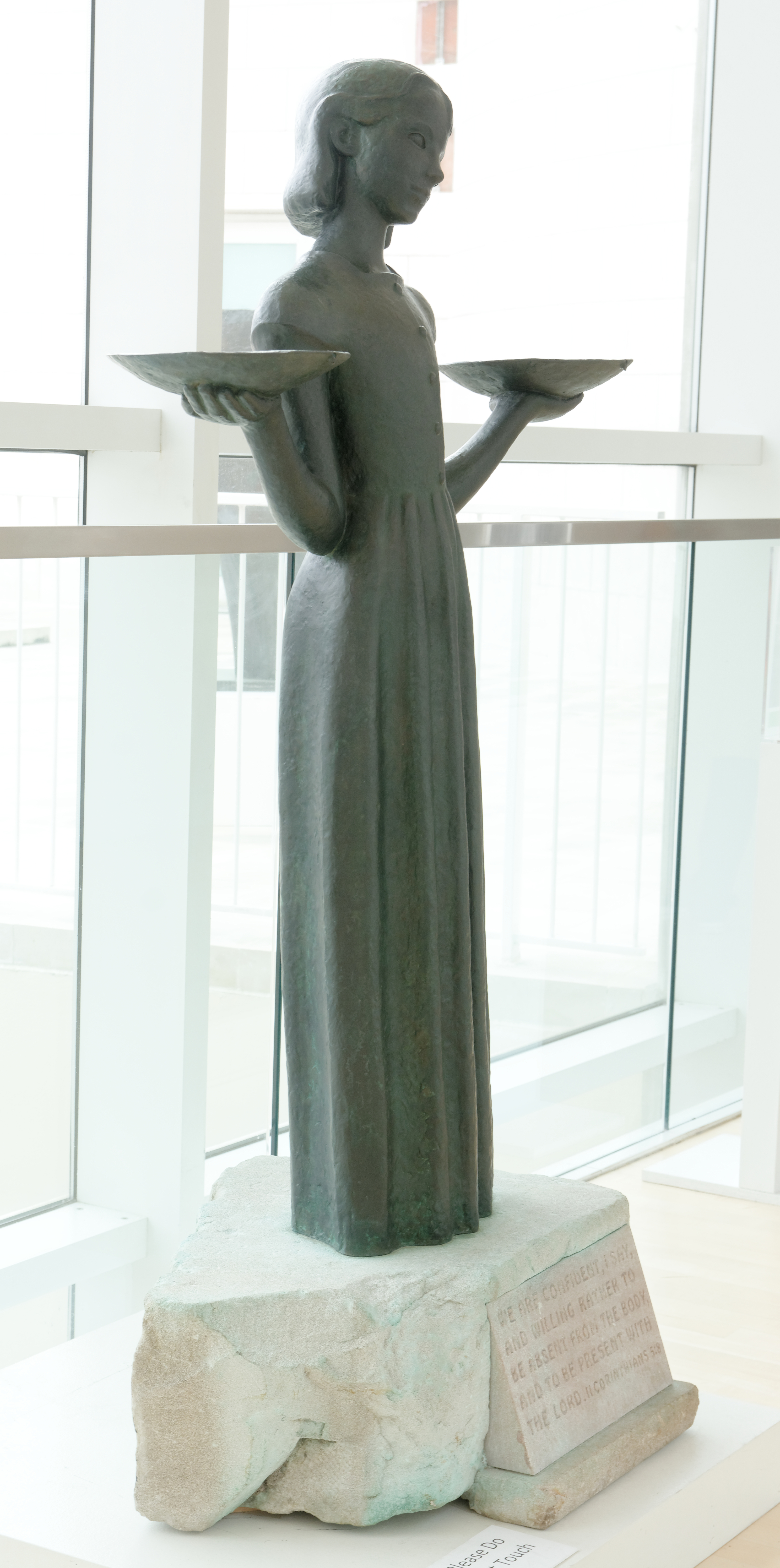
For over fifty years, nobody came looking for her. The bronze girl stood in Bonaventure Cemetery on the Trosdal family plot, her head tilted slightly left, holding two shallow bowls out from her sides as if offering something to the birds. The Trosdal family called her Little Wendy. The cemetery groundskeepers walked past her without a second glance. Then, in 1993, a photographer named Jack Leigh found her at dusk on the second day of searching, and everything changed. His photograph would land on the cover of a book that spent four years on the bestseller list, and the quiet little statue would become so famous she had to be moved indoors for her own protection.
Born at Ragdale
Sylvia Shaw Judson sculpted Bird Girl in 1936 at Ragdale, her family's summer home in Lake Forest, Illinois. Judson was a Quaker sculptor known for serene, contemplative figures, and Bird Girl carries that stillness. The pose is deceptively simple: a young girl stands straight, elbows at her waist, palms up, each hand supporting a shallow bowl. The bowls were designed to hold birdseed or water, and small holes drilled in their bottoms allowed the sculpture to function as a fountain. First sculpted in clay, the figure was cast at the Roman Bronze Works in New York City. Records indicate six casts were made between 1937 and 1940, though Judson herself later recalled only four. The sculpture debuted at the Art Institute of Chicago in 1938 under the name Girl with Bowls. Over the years it would also be called Fountain Figure, Standing Figure, and Peasant Girl. Judson first used the name Bird Girl in a 1967 book about her work.
A Photograph at Dusk
In 1993, Random House needed a cover for John Berendt's forthcoming book about Savannah, a sprawling nonfiction narrative of murder, eccentrics, and Southern gothic atmosphere titled Midnight in the Garden of Good and Evil. At Berendt's suggestion, they hired Savannah photographer Jack Leigh to find a suitable image in Bonaventure Cemetery. Leigh spent two days walking the grounds before he spotted the small bronze figure on the Trosdal plot. Dusk was approaching and he had to work fast. Back in his darkroom, he spent ten hours adjusting the lighting, transforming his photograph into something that looked lit by moonlight, with a faint halo glowing around the statue's head. The resulting image, titled Midnight, Bonaventure Cemetery, captured a mood that perfectly matched Berendt's book. Berendt called it one of the strongest book covers he had ever seen.
The Bestseller Effect
Published in 1994, Midnight in the Garden of Good and Evil became a phenomenon, spending a record 216 weeks on the New York Times bestseller list. Tourists descended on Savannah by the busload, and Bonaventure Cemetery became a pilgrimage site. Visitors crowded around the Trosdal plot to photograph the sculpture, trampling grass and climbing over graves. The Trosdal family, alarmed by the traffic at their family's burial site, removed the statue in 1997 and lent it to the Telfair Museums in Savannah. In December 2014, Bird Girl was moved again to the Telfair Academy, where she resides today in a dedicated exhibit. She stands indoors now, climate-controlled and well lit, far from the cemetery moss and river air that made her famous.
The Photographer's Final Chapter
The fame brought complications. When Warner Bros. produced a film adaptation of the book in 1997, directed by Clint Eastwood, they created a replica of Bird Girl and filmed it in the cemetery. Jack Leigh sued for copyright infringement, arguing the promotional images bore too close a resemblance to his original photograph. The lower court sided with Warner Bros., but an appeals court agreed that posters and promotional materials crossed the line and sent the case back. Warner and Leigh settled out of court for an undisclosed sum. Jack Leigh died of colon cancer on May 19, 2004, at the age of 55. He is buried in Bonaventure Cemetery, the same grounds where he took the photograph that defined his career. The cemetery that made him famous became his final resting place.
The Scattered Sisters
Bird Girl was never one of a kind. Four original bronze casts are known to survive, scattered across the eastern United States. One stands in the Edward L. Ryerson Conservation Area in Riverwoods, Illinois. Another traveled from a Washington, D.C. garden to Reading, Pennsylvania. A third remains in Lake Forest, Illinois, near where Judson created the original. And the fourth, the famous one, the one Jack Leigh found in the failing light, sits behind glass at the Telfair Academy in Savannah. Judson donated the original plaster model to the Crow Island School in Winnetka, Illinois. Each cast is identical, yet only one became an icon. The difference was not the sculpture but the moment: the right photographer, the right cemetery, the right book, and the last light of a Savannah evening.
From the Air
Located at 32.078°N, 81.095°W in Savannah, Georgia. The Bird Girl statue currently resides at the Telfair Academy in downtown Savannah's historic district, though its fame originated at Bonaventure Cemetery roughly 4 miles to the east. From altitude, Savannah's grid of tree-shaded squares is distinctive. The Wilmington River is visible east of the city, with Bonaventure Cemetery's heavy tree canopy along its western bank. Nearest airport is Savannah/Hilton Head International (KSAV), approximately 8 nautical miles northwest. The historic district and Bonaventure Cemetery are both easily visible on approach from the southeast.