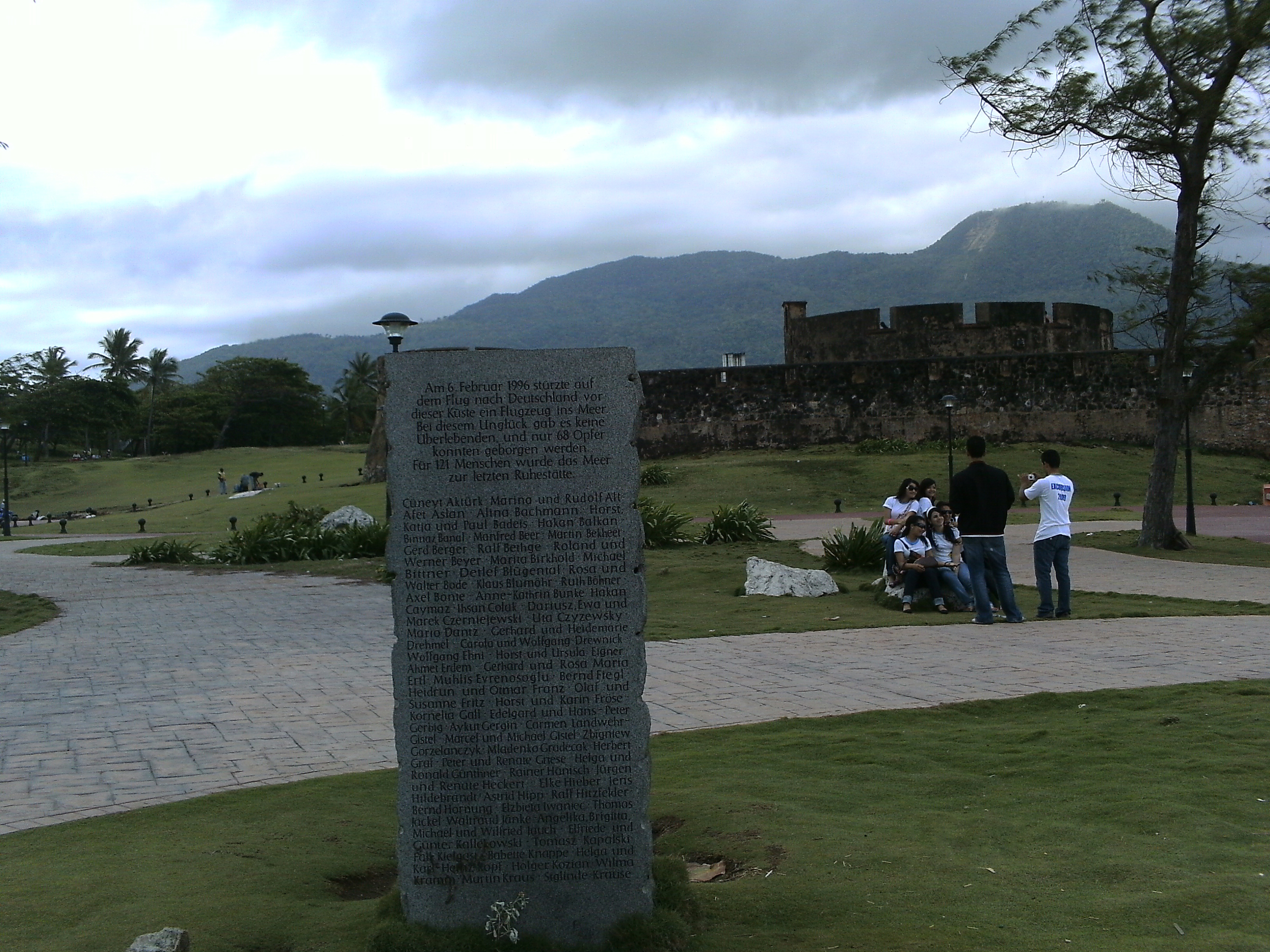
Birgenair Flight 301
A wasp built a nest inside a metal tube no wider than a pencil, and 189 people died. That is the blunt arithmetic of Birgenair Flight 301, which crashed into the Atlantic Ocean off the north coast of the Dominican Republic on the night of February 6, 1996, five minutes after takeoff from Gregorio Luperon International Airport in Puerto Plata. The Boeing 757-200 had been parked on the tarmac for 25 days. For the last two of those days, its pitot tube covers - small, bright-flagged caps designed to keep insects and debris out of the airspeed sensors - had been removed and never replaced. Somewhere in that unguarded interval, a mud-dauber wasp crawled inside and sealed one of the tubes shut, creating a blockage that would feed the cockpit instruments a phantom airspeed, confuse the crew, and hand control of the aircraft to an autopilot that was flying by lies.
Vacationers Boarding at Night
Birgenair was a Turkish-managed charter airline, and Flight 301 was operated in partnership with Alas Nacionales, a Dominican carrier. The route ran from Puerto Plata to Frankfurt, Germany, with stops in Gander, Newfoundland, and Berlin. Most of the 176 passengers were German tourists returning from Caribbean package holidays booked through Oger Tours, in which Birgenair held a 10 percent stake. Among them were nine Polish citizens, including two members of parliament: Zbigniew Gorzelanczyk of the Democratic Left Alliance and Marek Wielgus of the Nonpartisan Bloc for Support of Reforms. The crew consisted of 11 Turkish and 2 Dominican nationals. Captain Ahmet Erdem, 61, brought 24,750 hours of flight experience to the cockpit, including 1,875 hours on the 757. First Officer Aykut Gergin, 34, had 3,500 total hours but only 71 on the type. Relief pilot Muhlis Evrenesoglu, 51, carried 15,000 hours. The aircraft itself, TC-GEN, was a 12-year-old Boeing 757-225 powered by two Rolls-Royce RB211 engines. It had been stationed at Puerto Plata since January 12 - three and a half weeks of sitting idle in the tropical heat.
Two Needles, Two Truths
Flight 301 lifted off from Puerto Plata at 11:42 p.m. Atlantic Standard Time. The takeoff roll was normal. At 2,500 feet, the crew contacted main air traffic control and received clearance to climb to flight level 280. Ninety seconds into the flight, Captain Erdem engaged the autopilot. Ten seconds later, two warnings lit up the panel: rudder ratio and Mach airspeed trim. The cockpit now held two contradictory realities. The captain's airspeed indicator, fed by the blocked pitot tube, showed the aircraft accelerating through 300 knots and climbing. The first officer's indicator, connected to an unobstructed tube, read 220 knots and falling - the correct figure. Faced with two instruments telling opposite stories, Erdem concluded that both might be wrong and began checking circuit breakers. When he pulled one, the overspeed warning blared: his instrument now showed 350 knots, a speed that would tear the aircraft apart if it were real. He pulled a second breaker to silence the alarm.
The Autopilot Believes the Lie
The autopilot was programmed to take its airspeed data from the same source feeding the captain's indicator - the blocked tube. As the phantom reading climbed past 350 knots, the autopilot did exactly what it was designed to do in an overspeed scenario: it pitched the nose up and reduced engine power to slow the aircraft down. But the 757 was not going 350 knots. It was going 220, and dropping. Every correction the autopilot made - nose higher, power lower - pushed the real airspeed closer to a stall. The first officer's instruments were telling the truth the entire time, but in the cascading confusion of contradictory warnings, his readings went unheeded. As the aircraft climbed through 4,700 feet with its nose pitched dangerously high and its engines throttled back, the actual airspeed fell below 200 knots. At 11:47 p.m., the Ground Proximity Warning System sounded. Eight seconds later, the Boeing 757 struck the Atlantic Ocean. The impact killed all 189 souls on board.
The Smallest Failure
The Dominican Republic's General Directorate of Civil Aviation determined the probable cause to be crew error in response to false airspeed indications from a blocked pitot tube. The aircraft had been traveling at 220 knots, not the 350 the captain's instruments displayed. Birgenair's CEO, Cetin Birgen, confirmed that pitot covers had been removed two days before the crash to conduct an engine test run and were never replaced. The accident shared a grim kinship with other pitot-related disasters. Later that same year, Aeroperu Flight 603, also a Boeing 757, crashed off the coast of Peru after maintenance tape blocked its static ports, killing 70. In 2009, Air France Flight 447 plunged into the Atlantic when ice-clogged pitot tubes triggered a chain of pilot errors that stalled an Airbus A330, killing 228. Flight 301 is tied with American Airlines Flight 77 as the deadliest incident involving a Boeing 757, with 189 fatalities. It remains the worst aviation disaster in Dominican Republic history. A memorial stands in Puerto Plata, and another marks the mass grave in Frankfurt's main cemetery where the German victims were laid to rest - 189 lives ended because a small insect found shelter in a small, uncapped tube.
From the Air
Located at 19.914N, 70.406W, in the Atlantic Ocean north of Puerto Plata on the Dominican Republic's north coast. Gregorio Luperon International Airport (MDPP/POP) is the departure airport, located roughly 15 km east of Puerto Plata. The crash site is in open ocean off the coast. From altitude, Puerto Plata's coastline runs east-west with the Cordillera Septentrional mountain range rising sharply to the south. The Monte Cristi coastline extends to the northwest. Santiago's Cibao International Airport (MDST/STI) is approximately 30 km to the south across the mountains. Santo Domingo's Las Americas International Airport (MDSD/SDQ) is approximately 250 km to the southeast.