Birmingham Blitz
The newspapers never named the city. Wartime censorship required that Birmingham be referred to only as a "Midland Town," lest the Luftwaffe learn how accurately their bombs were falling. Between August 1940 and April 1943, that unnamed city endured 77 air raids. More than 2,241 people were killed and over 3,000 seriously injured. Some 12,391 houses, 302 factories, and 239 other buildings were destroyed. Birmingham was the third most heavily bombed city in Britain, behind only London and Liverpool -- targeted not for symbolism but for what its factories produced: rifles at BSA, tires at Dunlop, engines at Wolseley, electrical components at Lucas. The city that had powered the Industrial Revolution was now powering the war effort, and the bombers came because of it.
The First Bombs Fall
The first raid came on August 9, 1940, when a single aircraft dropped bombs on Erdington, killing one person and injuring six. It was almost tentative. The first strike on the city center followed on August 25, when incendiary bombs set the old Market Hall in the Bull Ring ablaze, killing 25 people and gutting a Victorian landmark. But the true fury arrived in November. On the night of November 19, a massive raid targeted the BSA factory in Small Heath, which was producing Browning machine guns at a rate critical to the RAF. A direct hit on the factory killed 53 workers. The Ministry of Supply responded by dispersing production across the country through the shadow factory scheme -- a recognition that concentrating war production in one place was an invitation to disaster.
Three Nights of Fire
The worst came in rapid succession. On November 19-20, 1940, the BSA attack was followed the next night by 200 bombers dropping 118 tonnes of explosives and 9,500 incendiaries. The main bus depot in Hockley was destroyed along with 100 vehicles. A third consecutive major raid on November 21-22 lasted eleven hours. Thousands of incendiaries started over 600 fires, and the bombing shattered the water supply system, leaving three-fifths of the city without mains water. Firefighters resorted to drawing water from Birmingham's canal network. The Regional Commissioner warned that "Birmingham will burn down if the Luftwaffe comes again tonight." By luck, they did not return that night, giving engineers just enough time to repair the critical water mains.
The Long Campaign
The bombing continued through 1941 and into 1942. On December 11, 1940, the longest single raid of the entire Blitz -- 13 hours -- saw 278 bombers drop 25,000 incendiaries across the city, killing 263 people. All but the tower of St Thomas' Church on Bath Row was destroyed; its ruins now form St Thomas' Peace Garden, a memorial to all those killed in armed conflict. In April 1941, two consecutive nights of heavy raids caused 1,121 casualties. The Bull Ring, New Street, and High Street were devastated. St Martin in the Bull Ring was damaged, and the Prince of Wales Theatre was destroyed. One raid in May 1941 went badly wrong for the attackers: a navigation error sent most bombers to drop their loads on Nuneaton instead. The last significant raid came on July 27, 1942. The final bombs fell on Bordesley Green on April 23, 1943, causing only slight injuries.
What the Bombs Built
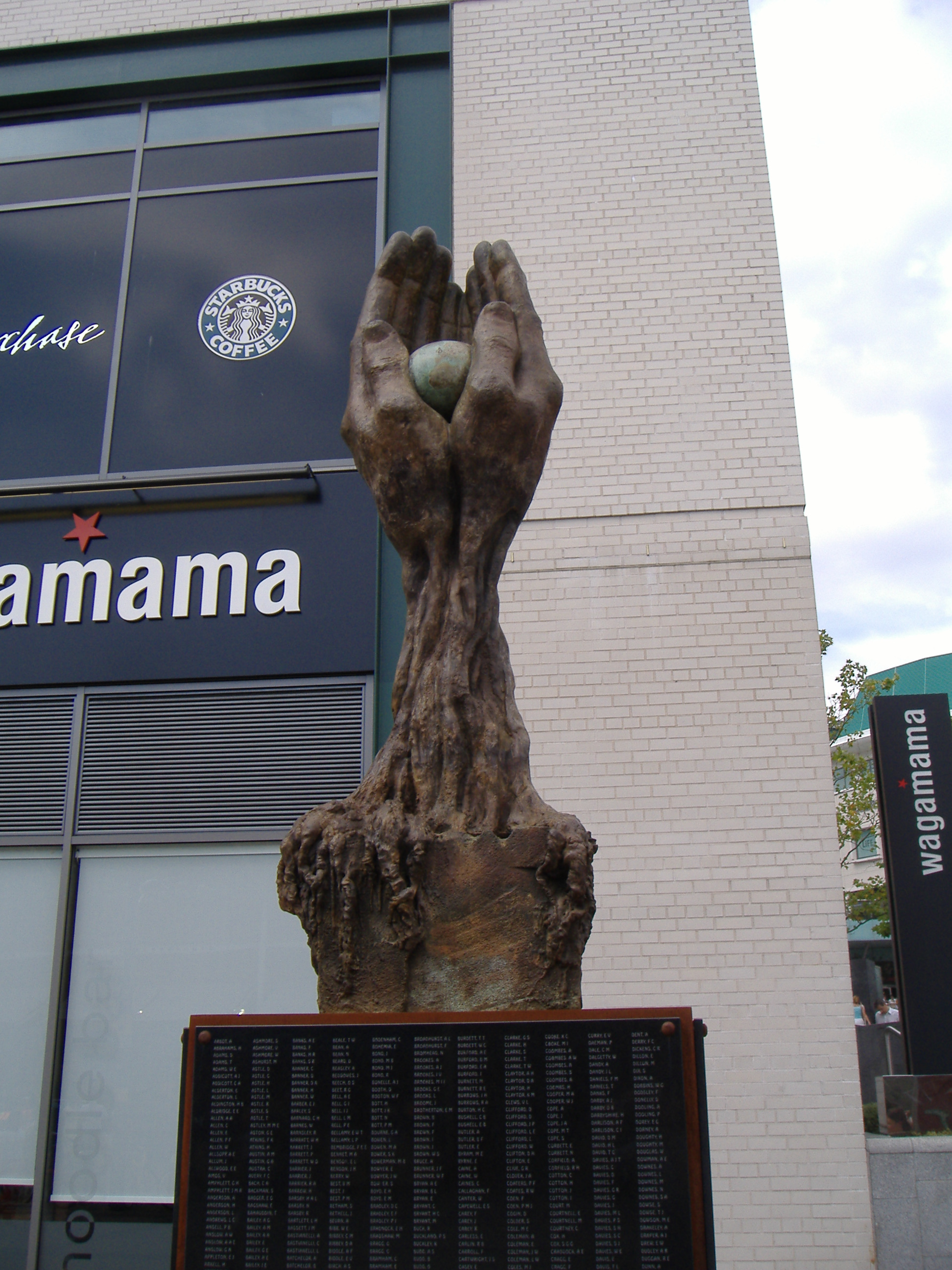
The surrounding Black Country towns suffered too. Smethwick lost 80 people across multiple raids. West Bromwich endured its heaviest attack on November 19, 1940, with more than 50 killed. In Dudley, a landmine tore into council houses in the Oakham area, killing ten. The human cost of the Birmingham Blitz extended far beyond the 2,241 official death toll: over 3,000 people were seriously injured, thousands more sustained lesser wounds, and entire neighborhoods were flattened. In 2005, a memorial sculpture called "The Tree of Life," created by Lorenzo Quinn, was unveiled near St Martin's Church to honor the victims. The massive destruction of civilian housing drove the postwar construction of council estates at Castle Vale and Chelmsley Wood -- neighborhoods that exist because bombs fell on the homes that preceded them. Birmingham's modern cityscape is, in significant part, the Blitz's legacy rebuilt in concrete and brick.
From the Air
Located at 52.48N, 1.90W. Birmingham's city center is visible as a large urban area in the West Midlands. Key Blitz-related sites include the Bull Ring area, St Thomas' Peace Garden on Bath Row, and the BSA factory site in Small Heath. Nearest airports: EGBB (Birmingham, 6nm E), EGBO (Wolverhampton Halfpenny Green, 15nm W). Best viewed at 3,000-5,000 ft AGL for the extent of the urban area.