Birr Castle
For seventy-two years, the largest telescope on Earth sat in the grounds of an Irish country estate. Not at a royal observatory. Not in a purpose-built facility. In the gardens of Birr Castle, County Offaly, surrounded by box hedges so ancient they hold a Guinness World Record for height, the 3rd Earl of Rosse built a 72-inch reflecting telescope in 1845 and called it the Leviathan. It could capture more light and resolve more detail than anything humanity had ever pointed at the sky. Charles Babbage came to see it. So did a French prince. For decades, the boggy midlands of Ireland were the unlikely center of world astronomy.
The Parsons and Their Castle
The castle's story begins in 1620, when Sir Lawrence Parsons was granted the land after the death of the O'Carroll chieftain. English masons built a new structure not on the site of the old Black Tower but at its gatehouse, adding diagonal flankers that give Birr Castle the distinctive plan it retains today. The Rebellion of 1641 tested the new owners early: Catholic forces besieged the Parsons family at what was then called Parsonstown for fifteen months. They held. Generations of Parsons refined and rebuilt the castle, with the 2nd Earl of Rosse heightening it and adding Gothic details in the early 19th century. But it was his son William, the 3rd Earl, who transformed Birr from an aristocratic residence into something altogether stranger and more wonderful.
The Leviathan Awakes
William Parsons was obsessed with the heavens. Between 1842 and 1845, he designed and built the Leviathan of Parsonstown, a reflecting telescope with a 183-centimeter mirror -- the largest in the world. No institution funded it. No government commissioned it. An Irish earl, working with local craftsmen on his own estate, simply decided to see further into space than anyone before him. The Leviathan held the record for the world's largest telescope until the 100-inch Hooker Telescope was completed at Mount Wilson Observatory in California in 1917. Through it, the spiral structure of nebulae was observed for the first time, a discovery that would eventually reshape humanity's understanding of the universe. After the 3rd Earl's death in 1867, the telescope fell into disrepair under the 4th Earl. Its mirror was carted off to the Science Museum in London. Around 1914, the metal support structure was melted down for the war effort. By the 1920s, the wooden housing had been demolished. The Leviathan went silent.
A Demesne of Wonders
Even without the telescope, Birr Castle's grounds hold surprises. The walled gardens shelter box hedges over 300 years old, recognized by the Guinness Book of Records as the tallest in the world. Ireland's oldest wrought-iron bridge, dating from 1820, crosses one of the estate's waterways. The River Camcor flows through the demesne, feeding into the Little Brosna, which marks the border between Counties Offaly and Tipperary before joining the Shannon. A grove of California sequoia redwoods called Giants' Grove rises incongruously from the Irish landscape. The castle also houses Ireland's Historic Science Centre, a museum celebrating the country's contributions to astronomy, engineering, and photography. Mary Parsons, Countess of Rosse and mother of the 4th Earl, was a pioneering photographer whose darkroom, preserved in the museum, is believed to be the oldest surviving example in the world.
Astronomy Returns
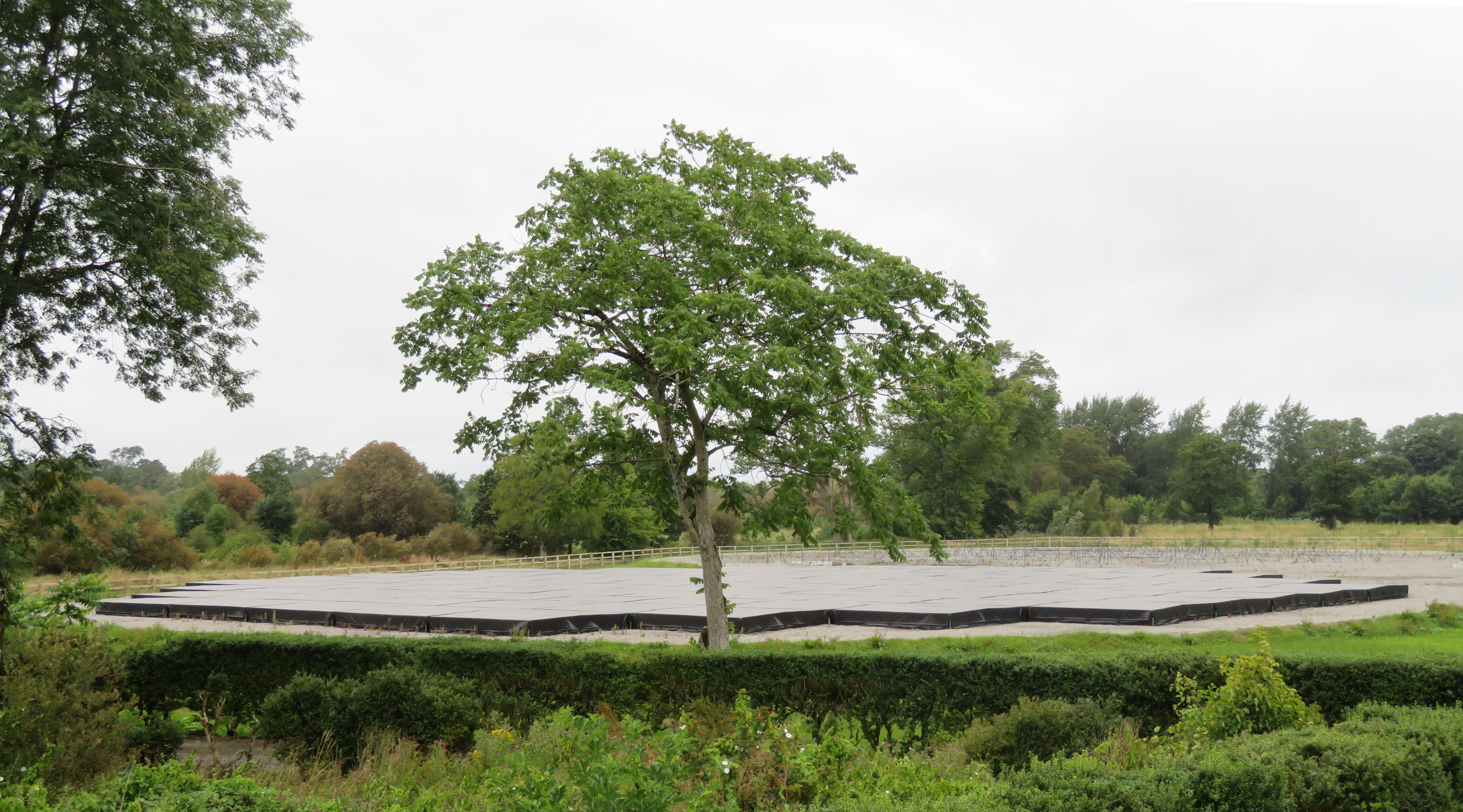
In the late 1990s, the Leviathan was restored and reopened to the public. But the truly unexpected chapter came in 2010, when astrophysicist Peter T. Gallagher of Trinity College Dublin visited the estate looking for a quiet site suitable for radio telescopes. He met Lord Rosse, and they agreed to repurpose an old sheep yard. What began as a solar observatory in a converted sheep pen has grown into Ireland's station of the LOFAR network, the I-LOFAR telescope -- 384 antennas spread across the fields between the Camcor and Little Brosna rivers. It is the westernmost station in the Europe-spanning network. In 2018, I-LOFAR observed a billion-year-old red dwarf flare star called CN Leo, roughly 75 trillion kilometers away. After a century of silence, Birr is listening to the cosmos again. In 2025, Birr Castle was placed on the UNESCO World Heritage Tentative List as part of Ireland's Historic Astronomical Observatories, alongside Dunsink and Armagh.
From the Air
Birr Castle is located at 53.095N, 7.916W in County Offaly, Ireland's midlands. From the air, the demesne stretches south and southeast of Birr town center. The restored Leviathan telescope and I-LOFAR antenna array are visible on the grounds near the Little Brosna River. Nearest airport: Birr Airfield (EIBI), roughly 3 km southeast. Shannon Airport (EINN) is about 90 km west. Recommended viewing altitude: 2,000-3,000 ft for best detail of the grounds and telescope structures.