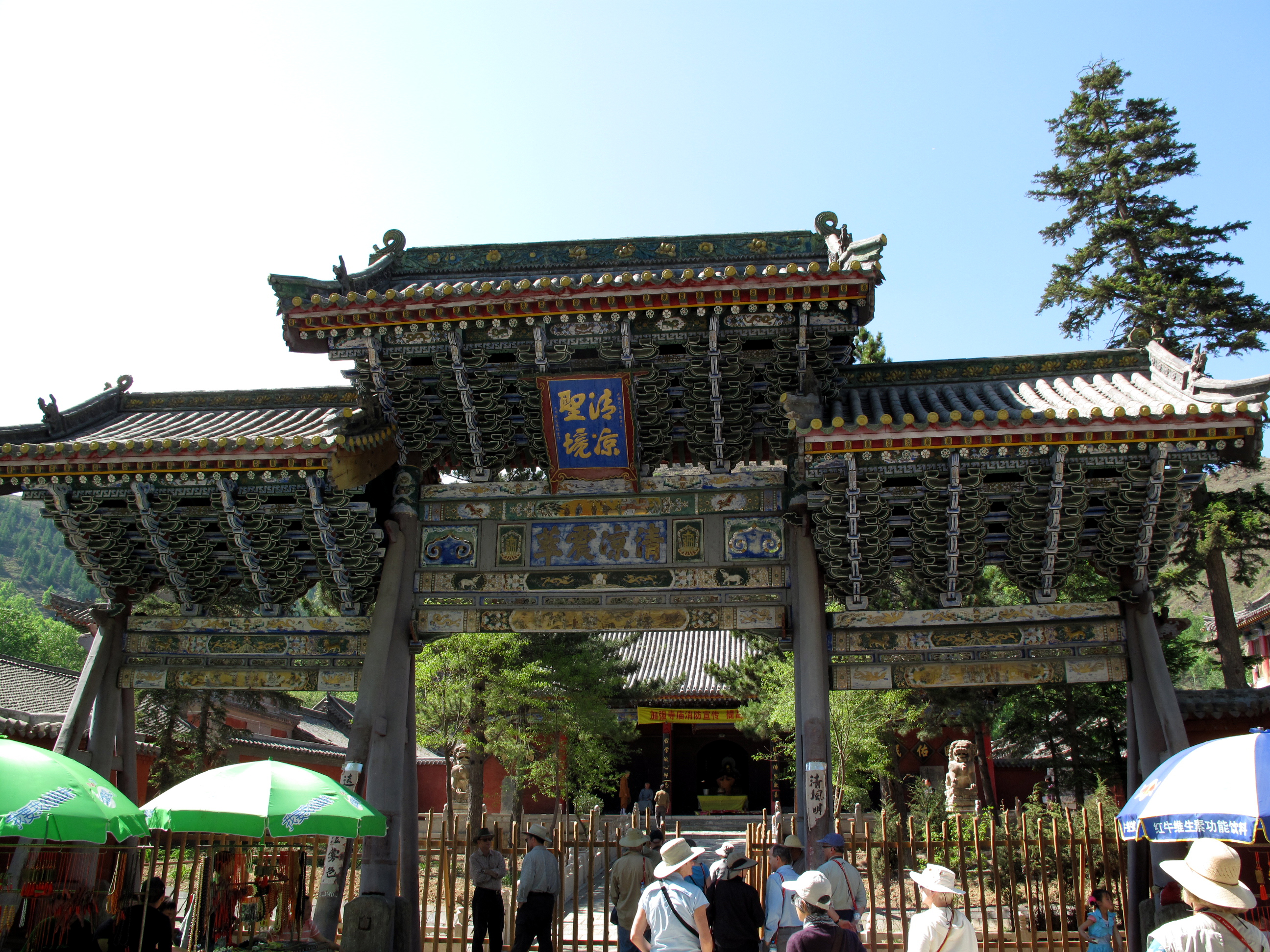
Bishan Temple
The ordination altar in Bishan Temple's Jietan Hall measures 5.1 meters long, 5 meters wide, and 1.2 meters high, carved from a single mass of bluestone during the Ming dynasty. For centuries, monks have knelt on this stone to take their vows -- a ritual that connects them, through the cold surface beneath their knees, to every generation of Buddhist practitioners who have done the same since the fifteenth century.
Fifteen Centuries of Names
Bishan Temple traces its origins to the reign of Emperor Xiaowen of the Northern Wei dynasty (467-499), making it one of the oldest surviving temples on Mount Wutai. It was initially called Beishan Temple. During the reign of Emperor Yingzong of the Ming dynasty (1435-1464), the name changed to Puji Temple. By the end of the Qing dynasty, under Emperor Xuantong (1908-1912), it acquired yet another name: Guangji Maopeng. Each renaming reflected a shift in patronage or theological emphasis, but the temple's essential purpose -- as a working monastery where monks practiced, studied, and took their vows -- remained constant across the centuries.
Stone, Jade, and Gilt
Bishan Temple's architecture unfolds along a central axis that moves visitors through progressively more sacred spaces. At the entrance, a decorative paifang arch frames the approach. The Tianwang Dian, or Hall of the Four Heavenly Kings, houses a statue of the bodhisattva Maitreya with a figure of the guardian deity Weituo behind it. Beyond stands the Pilu Hall, centered on a statue of Vairocana Buddha flanked by twelve bodhisattvas arranged along the gable walls. A sitting statue of the Buddha brought from Burma in 1928 occupies the ordination altar in the Jietan Hall. Flanking this figure, eighteen Arhat statues crafted during the Shunzhi period (1644-1661) of the Qing dynasty stand guard.
The Tower of Texts
At the rear of the complex rises the Zangjing Ge, the Tower of Buddhist Texts -- a two-story wooden structure that once held the temple's collection of sutras and scriptures. A seated statue of Maitreya, the future Buddha, presides over the space with a serene gaze. On the temple grounds, a stone zhaobi screen wall carries carved Chinese poetry, its characters weathered by centuries of mountain rain and wind. These inscriptions served both as artistic decoration and as teaching tools, offering arriving pilgrims a moment of literary contemplation before they entered the temple proper.
Among the Five Peaks
Bishan Temple sits in Taihuai Town at the heart of the Mount Wutai complex, surrounded by dozens of other temples scattered across the mountain's valleys and ridges. Mount Wutai -- the name means Five Terrace Mountain, for its five flat-topped peaks -- is one of the Four Sacred Mountains of Chinese Buddhism, sacred to the bodhisattva Manjushri. The concentration of religious architecture here spans more than fifteen centuries, from the Northern Wei through the present day. Bishan Temple's own history, stretching from the fifth century to the modern era, embodies that continuity. Pilgrims still come to take their vows on the ancient bluestone altar, adding their voices to a tradition that has persisted through the rise and fall of dynasties.
From the Air
Located at 39.02N, 113.60E in the Taihuai Town temple cluster on Mount Wutai, Shanxi Province, China. Elevation approximately 1,700 meters. The dense cluster of temple rooftops in the valley is visible from altitude. Nearest airports: Wutai Mountain Airport (ZBWT) at roughly 50 km and Taiyuan Wusu International Airport (ZBYN) at approximately 230 km southwest. Recommend 3,000-5,000 feet AGL for viewing the temple complex. The five distinctive flat peaks of Mount Wutai serve as clear navigational landmarks.