Bisho Massacre
Eighty thousand people walked toward a razor-wire fence on a September morning in 1992. They came from across the Eastern Cape to march on Bisho, capital of the Ciskei -- one of apartheid's nominally independent "homelands" created to strip Black South Africans of their citizenship while keeping their labor close. The fence marked a border that existed only because the architects of racial segregation had drawn it. Behind the wire stood soldiers of the Ciskei Defence Force. Within minutes, twenty-eight marchers would be dead and more than two hundred wounded, their blood soaking the ground outside Independence Stadium in one of apartheid's final and most bitter spasms of violence.
A Border Made of Ideology
Ciskei was a fiction built on force. The South African government established it in 1961 under the Bantu Authorities Act as a homeland for the Xhosa people, then spent two decades coercing Xhosa-speakers to relocate there. On 4 December 1982, Ciskei became an "independent republic" -- recognized by no country on Earth except South Africa and its other manufactured homelands. By 1992, the charade was crumbling. Negotiations between the ANC and the National Party government had raised the prospect of multiracial elections, and the ANC wanted to organize in the Eastern Cape, its traditional heartland. But Brigadier Oupa Gqozo, Ciskei's military ruler, blocked them at every turn. He formed his own party, the African Democratic Movement, to compete with the ANC, and in August 1992 he physically prevented ANC marchers from crossing into Ciskei from nearby King William's Town.
The March on Bisho
By September, South Africa's transition was stalling. The ANC had withdrawn from negotiations following the Boipatong massacre in June, accusing F. W. de Klerk's government of fomenting the violence that was tearing through Black communities. The ANC sent a memorandum demanding that De Klerk replace Gqozo with an interim administration; De Klerk refused, arguing that Ciskei lay outside his jurisdiction -- a legalistic dodge, since the homeland's very existence was a product of Pretoria's policies. So the ANC launched a campaign of mass action. On 7 September, a vast crowd gathered outside Bisho. Among the leaders were Chris Hani, secretary general of the South African Communist Party; Cyril Ramaphosa, who would one day become president; Steve Tshwete; and Ronnie Kasrils. A court order confined the march to Independence Stadium, outside the capital. The ANC refused to recognize the authority of a Ciskei court.
Gunfire at the Wire
What happened next unfolded with terrible speed. A group of marchers led by Ronnie Kasrils breached the razor-wire barrier. Colonel Vakele Archibald Mkosana radioed his commanders with a false report: his troops were under fire. He received permission to return fire. Soldiers opened up on the crowd. Rifleman Mzamile Thomas Gonya launched a grenade into the marchers. Twenty-eight ANC supporters died. A Ciskei soldier also fell -- shot, investigators later determined, by one of his own comrades. The Goldstone Commission, tasked with the inquiry, condemned Gqozo for suppressing political activity and found that the demonstrators had not fired first. Justice Richard Goldstone also criticized Kasrils for his role in leading the breach, calling his actions irresponsible. The truth, as always in apartheid South Africa, was tangled in complicity. Former Ciskei foreign affairs minister Mickey Webb later testified that South African Military Intelligence had fed Gqozo misinformation designed to provoke exactly this confrontation.
Reckoning and Memory
The massacre did not end the struggle -- it sharpened it. The ANC demanded Gqozo's removal, the repeal of laws banning political activity in Ciskei, and the withdrawal of South African military intelligence operatives. Gqozo clung to power until just before the April 1994 elections, then resigned. When the Truth and Reconciliation Commission convened, only two men applied for amnesty: Colonel Mkosana and Rifleman Gonya. Both were denied on the grounds that their actions were reckless, disproportionate, and not politically motivated. They were later charged with murder and culpable homicide but acquitted on claims of self-defense. Gqozo agreed to testify but never appeared, having been admitted to a psychiatric hospital. Justice, incomplete as it was, could not undo what had been done.
A Granite Witness
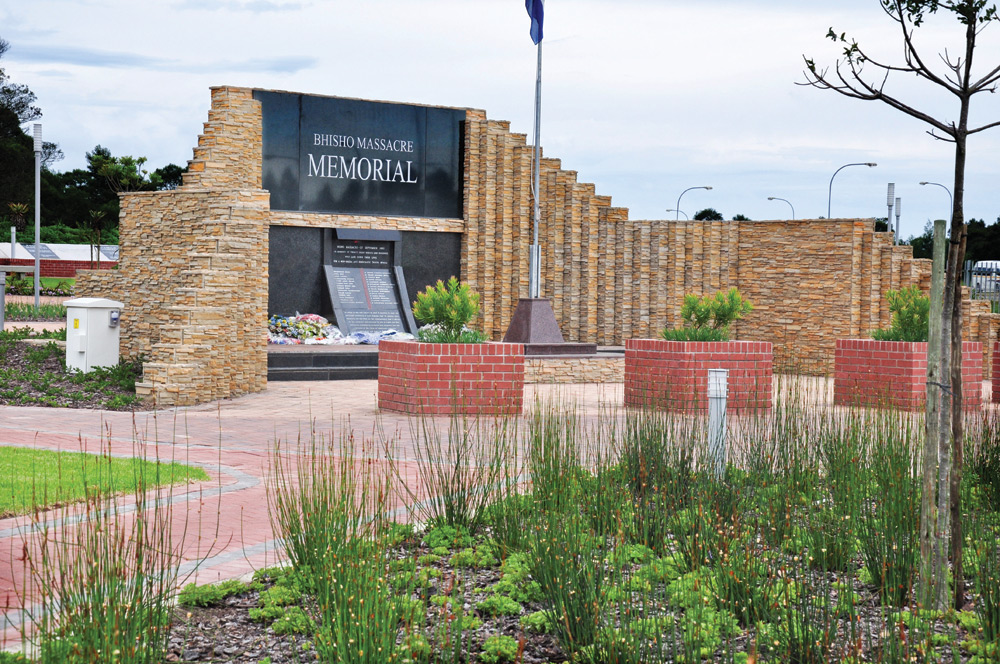
In 1997, Archbishop Desmond Tutu unveiled a granite monument on the site of the killings, outside Independence Stadium on Maitland Road between Bhisho and King William's Town. The victims were buried in nearby Ginsberg township. Each September, the Bisho Massacre Memorial Lecture draws leaders from across South Africa to honor the dead and reckon with what their sacrifice cost and what it achieved. The homeland of Ciskei no longer exists; the land is now part of the Eastern Cape province. Bhisho -- the town has reclaimed its original Xhosa spelling -- serves as the provincial capital. The razor wire is gone. The monument stands where it stood.
From the Air
The Bisho massacre site is located at approximately 32.86S, 27.43E in the Eastern Cape, South Africa, near the town of Bhisho (formerly Bisho). From the air, the area is characterized by the rolling green hills of the Eastern Cape interior, with the town visible as a cluster of government buildings and residential areas. The memorial is situated off Maitland Road between Bhisho and King William's Town, near Independence Stadium. The nearest major airport is East London Airport (FAEL), approximately 60 km to the south. King William's Town is visible to the northwest. Best viewed at 3,000-5,000 ft AGL for context of the town's layout and surrounding landscape.