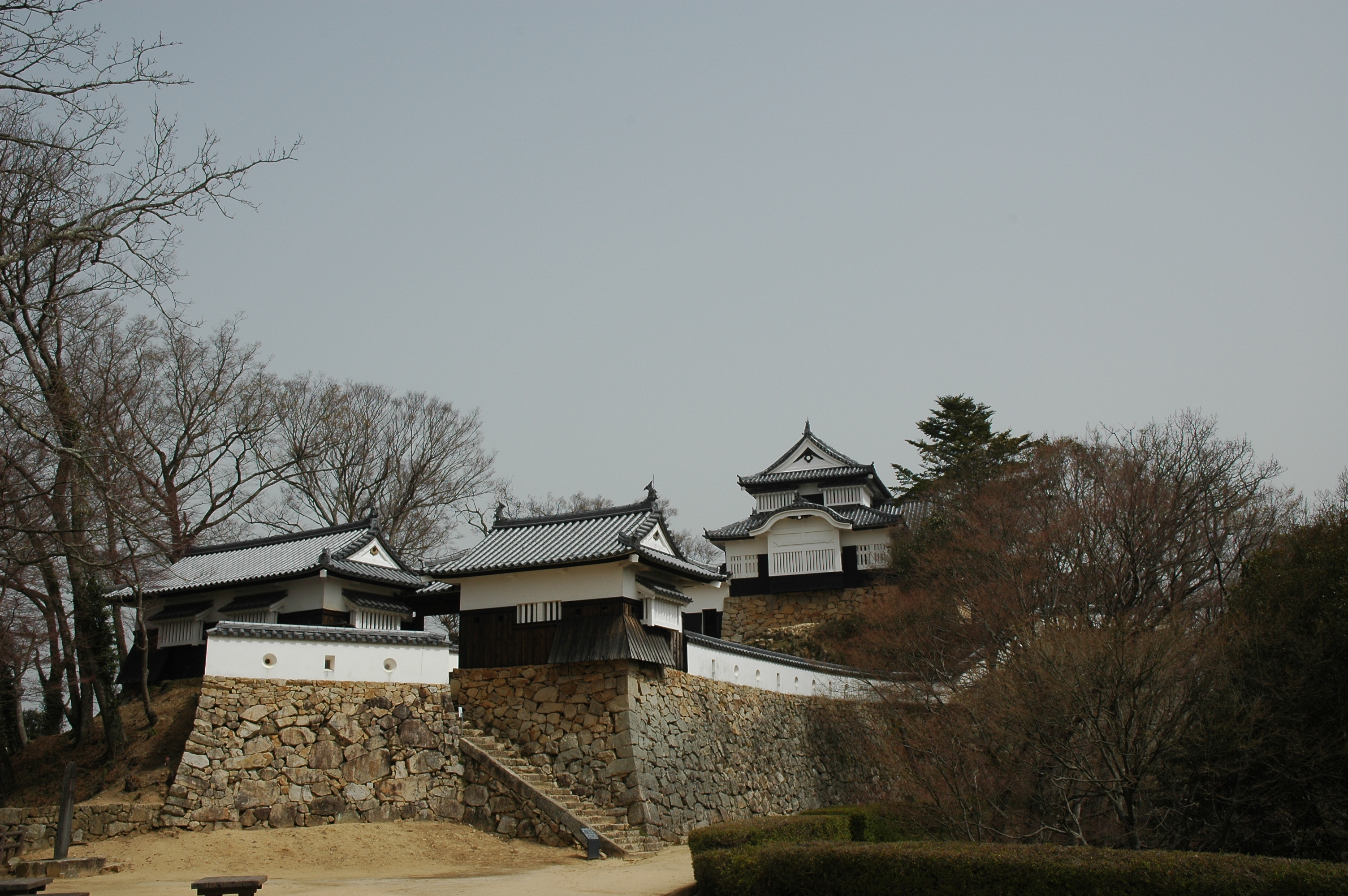
Bitchu Matsuyama Castle
On autumn mornings, when temperature inversions trap fog in the valleys below, Bitchu Matsuyama Castle appears to float on a sea of clouds. Photographers gather on the opposite mountainside before dawn, waiting for the moment when the stone walls and two-story keep emerge from the mist like a fortress suspended between earth and sky. At 430 meters above sea level, this is Japan's highest castle, and the only mountain fortress in the country that still has its original wooden keep.
A Fortress Between Two Seas
The castle's strategic value was always about geography. Mount Gagyu is a long ridge overlooking the Takahashi River, controlling the north-south transportation route between the Seto Inland Sea and the San'in coast on the Sea of Japan. The east-west route connecting Tsuyama to Miyoshi also passed through this corridor. Whoever held this mountain controlled the crossroads. A fortification first appeared on nearby Mount Omatsu in 1240, built by Akiba Shigenobu, though little is known about its form. Takahashi Muneyasu constructed the castle at its current location in 1331, beginning centuries of conflict over its possession. The Hosokawa, the Sho, the Mimura, the Mori, and eventually the Tokugawa all fought for or claimed these heights.
The Keep That Almost Wasn't
After the Battle of Sekigahara in 1600, Tokugawa Ieyasu seized the castle and the domain changed hands repeatedly. Mizunoya Katsutaka, arriving in 1641, rebuilt the keep, turrets, and gates that define the castle today. His tenshu was deliberately modest: only two stories tall, smaller than a typical corner turret at larger castles like Himeji. But on a mountaintop with commanding views in every direction, a towering keep would have been redundant. The Meiji government's modernization nearly finished what centuries of warfare could not. By 1875, most castle buildings across Japan were being demolished, and Bitchu Matsuyama was no exception. Only the tenshu, an attached turret called the Niju yagura, and a short section of wall survived, saved by local citizens who pressured authorities to spare them. The government funded restoration work between 1957 and 1960, and in 2006 the Japan Castle Foundation named it one of Japan's Top 100 Castles.
The Cat Lord of Takahashi
In July 2018, torrential rains brought devastating floods and mudslides to the region around Takahashi. A cat named Sanjuro, belonging to a local woman named Megumi Nanba, disappeared during the disaster. Weeks later, a castle worker discovered the cat living among the ancient stone walls and began feeding him. Sanjuro, named after the local samurai Tani Sanjuro, had apparently decided the highest castle in Japan was a fitting home. Officials first appointed the cat as a provisional mascot, then elevated him to the honorary title of castle lord in December 2018. The appointment was not merely whimsical. Sanjuro's presence drew visitors who might never have made the steep hike to a remote mountain castle, and tourism to Bitchu Matsuyama increased noticeably after his installation.
The Climb to the Clouds
Reaching the castle requires effort. The road from the city of Takahashi climbs partway up the mountain but does not reach the summit, leaving visitors to hike the remaining distance along a steep mountain path through forest. The difficulty is part of the appeal. Unlike flatland castles surrounded by parks and souvenir shops, Bitchu Matsuyama rewards physical commitment with solitude and sweeping views. The Itakura clan, who governed the domain for eight generations from 1744 until the Meiji Restoration in 1871, built their palace at the mountain's base rather than endure the daily climb. Standing at the top, looking out over the Takahashi River valley with the original wooden keep at your back, it becomes clear why warlords fought for these heights for six hundred years. The view is not just scenic. It is strategic, encompassing every approach, every road, every possible threat.
From the Air
Bitchu Matsuyama Castle sits at 34.81N, 133.62E atop Mount Gagyu near the city of Takahashi, Okayama Prefecture. From the air, look for stone walls and a compact keep on a forested mountain ridge north of the city center, overlooking the Takahashi River. The castle is especially dramatic from above when autumn fog fills the valley below. Nearest airports: Okayama (RJOB) approximately 35nm east, Hiroshima (RJOA) approximately 60nm west. Best viewed at 2,000-3,000 feet AGL.