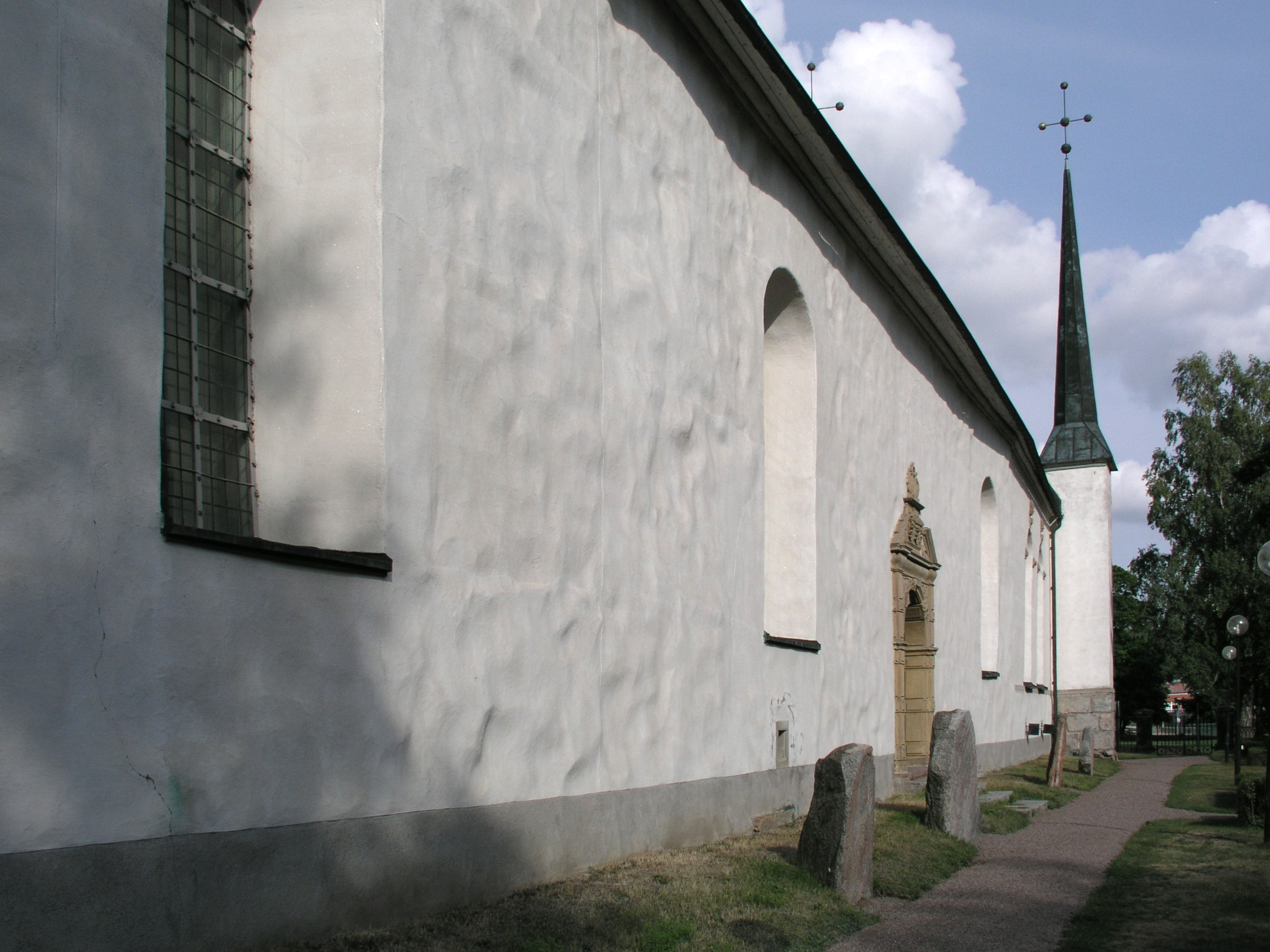
Bjorklinge Runestones
Gillaug had her stone carved for Jorund, her son, who died in Hedeby. In twelve Old Norse words, runestone U 1048 captures a mother's grief and points toward one of the Viking Age's most important trading centers. The Bjorklinge runestones, five granite monuments clustered at a church in Uppsala County, preserve intimate family stories carved in the Younger Futhark alphabet. Fathers memorialize sons who share their names. Four brothers honor their father with a single stone. And through these personal monuments, the broader world of 11th-century Scandinavia comes into focus: its trade networks stretching to Denmark, its Christian faith interweaving with older artistic traditions, its master runecarvers signing their work like Renaissance painters.
Death in a Distant Port
Hedeby was the crossroads of the Viking world. Located at the base of the Jutland peninsula in what is now northern Germany, this Danish emporium connected Scandinavian traders with the markets of continental Europe. Ships from Sweden, Norway, and the Baltic lands crowded its harbor. Merchants dealt in furs, enslaved people, amber, and Frankish swords. Jorund traveled there from Uppland, more than 500 kilometers across the Baltic Sea, seeking trade or opportunity. He never returned. His mother Gillaug commissioned a runestone in the late 11th or early 12th century, by which time Hedeby itself was dying. After repeated attacks by Slavic raiders, the population relocated across the Schlei inlet to Schleswig around 1050. Jorund may have witnessed Hedeby's final years.
Bears and Brothers
Runestone U 1047 tells a different kind of family story. Four brothers, Eygeirr, Ketilbjorn, Gisl, and Igull, raised the stone together to honor their father Eybjorn. The naming pattern reveals Viking Age family traditions: both Ketilbjorn and his father Eybjorn share the name element bjorn, meaning bear. Parents commonly repeated one element of their own names in their children's names to mark lineage. The practice created chains of connection across generations that could be traced through names alone. At 1.55 meters tall, the granite monument was discovered during the removal of a churchyard wall in 1865, having spent centuries incorporated into the church's foundations.
The Runemaster's Hand
Two master carvers left their marks at Bjorklinge. Scholars attribute U 1047 to a runemaster named Ingulv, based on stylistic comparison to his signed work at Uppsala Cathedral, Golvasta, Axlunda, and Balinge. Another candidate is Likbjorn, who signed three known inscriptions. These artisans were not anonymous laborers but skilled craftsmen whose individual styles scholars can identify across multiple monuments. An unsigned stone like U 1048 reveals its maker through characteristic letter forms, serpent designs, and decorative choices. The runemaster who carved it also created U 1050 at the same church and U 1060 in nearby Tibble, forming a traceable body of work.
Serpents and Crosses
The Bjorklinge stones showcase the Urnes style at its finest. Named for the ornate wooden carvings at Urnes stave church in Norway, this artistic tradition transformed runestone decoration in the late Viking Age. Slim, stylized animals weave through intricate patterns, their bodies forming ribbons that frame and encircle the runic text. On U 1047, an intertwined serpent circles three Christian crosses. The combination captures the moment when Scandinavia stood between two worlds. Pagan artistic traditions persisted in the serpent motifs, while the crosses proclaimed the new faith that was reshaping society. The carvers saw no contradiction in combining both.
Stones Scattered and Gathered
The Bjorklinge runestones have traveled over the centuries. U 1045 was moved to its current location on the church's south side in 1920, protecting it from weathering while keeping it accessible to visitors. A fragment designated U 1049 preserves only the partial phrase i lit rita, meaning had erected, the formula that began so many memorial inscriptions. The most poignant survival may be U 1113, found about one kilometer west near Haggeby. It preserves only a single name: Bjarnhofdi. That name also appears on U 1045, where a man named Bjarnhofdi commemorates his father, who bore the same name. The fragment may be all that remains of another memorial in this father-son chain.
From the Air
Located at 60.03N, 17.55E at the church in Bjorklinge, Uppsala County, Sweden, approximately 20 kilometers north of Uppsala. The runestones line the south wall of the medieval church, visible as a cluster of upright granite slabs. Uppsala Airport (ESKN) lies approximately 15 km to the southeast. Stockholm Arlanda Airport (ESSA) is approximately 45 km to the southeast. Best viewed at low altitude (1000-2000 feet) when approaching from the south in clear weather. The surrounding terrain consists of typical Uppland agricultural fields and scattered forests.