Black Dahlia
She was not the Black Dahlia when she was alive. Elizabeth Short was a twenty-two-year-old woman from Boston with chronic asthma, a dead fiance, and an uncertain foothold in postwar Los Angeles. The nickname came after January 15, 1947, when her body was found in a vacant lot in the Leimert Park neighborhood, mutilated and bisected at the waist. Newspapers of the era made a sport of naming lurid crimes, and someone -- possibly riffing on the 1946 film noir thriller The Blue Dahlia -- christened the case. The name stuck to Elizabeth Short in death in a way nothing had stuck to her in life, and nearly eight decades later, it still has not let go.
A Childhood in Fragments
Elizabeth Short was born on July 29, 1924, in Hyde Park, Boston, the third of five daughters. Her father, Cleo Short, built miniature golf courses until the 1929 crash wiped out his savings. In 1930, his car was found abandoned on the Charlestown Bridge, and the family assumed he had jumped into the Charles River. Phoebe Short, now a widow raising five girls alone, took work as a bookkeeper. Elizabeth's childhood was shaped by loss and illness: severe asthma and bronchitis led to lung surgery at fifteen. Doctors recommended she spend winters in warmer climates, so her mother sent her to stay with family friends in Miami. She dropped out of Medford High School during her sophomore year. Her life was already a series of dislocations -- Boston, Florida, back to Massachusetts -- before the strangest revelation arrived in late 1942: a letter from her father, very much alive, apologizing from California.
Drifting West
At eighteen, Elizabeth moved to Vallejo, California, to live with the father she hadn't seen since she was six. He was working at the Mare Island Naval Shipyard on San Francisco Bay. The reunion was brief and bitter; arguments drove her out within weeks. What followed was a nomadic stretch through wartime California. She worked at the Base Exchange at Camp Cooke, near Lompoc. She was arrested in Santa Barbara for underage drinking at nineteen. Juvenile authorities sent her back to Massachusetts, but she went to Florida instead. There she met Major Matthew Michael Gordon Jr., a decorated Army Air Force officer training for deployment to Southeast Asia. Gordon proposed by letter while recovering from a plane crash in India. Elizabeth accepted. He died in a second crash on August 10, 1945. In July 1946, she moved to Los Angeles, renting a room behind the Florentine Gardens nightclub on Hollywood Boulevard and working as a waitress. She has often been called an aspiring actress, though no acting credits or jobs have ever surfaced.
Six Days Missing
On January 9, 1947, Robert 'Red' Manley, a twenty-five-year-old married salesman she had been dating, dropped Elizabeth off at the Biltmore Hotel in downtown Los Angeles. She told him she was meeting one of her sisters, who was visiting from Boston. Hotel staff may have seen her using the lobby telephone. After that, six days of silence. What happened to Elizabeth Short between January 9 and January 15 has never been established. The gap is where the case turns from tragedy to obsession -- a void that has invited decades of speculation, confession, and theory, none of it conclusive. When she was found in the vacant lot on South Norton Avenue, the condition of her body spoke to a cruelty that investigators had rarely encountered. The LAPD launched one of the largest investigations in the city's history.
150 Suspects and No Answers
The investigation produced over 150 suspects. Dozens of people confessed falsely, a phenomenon that would become a defining feature of the case. The LAPD interviewed, investigated, and ultimately cleared every lead. No one was ever arrested. The Black Dahlia case has been called one of the first major crimes in postwar America to capture national attention, and the media frenzy that surrounded it helped establish the template for true-crime coverage that persists today. Over the decades, amateur detectives, retired officers, and authors have advanced theories implicating everyone from a prominent Los Angeles physician to Elizabeth's own acquaintances. Each new theory generates books, documentaries, and renewed public interest. None has produced evidence sufficient for prosecution. The case remains open with the LAPD, technically active, practically cold.
The Woman Behind the Name
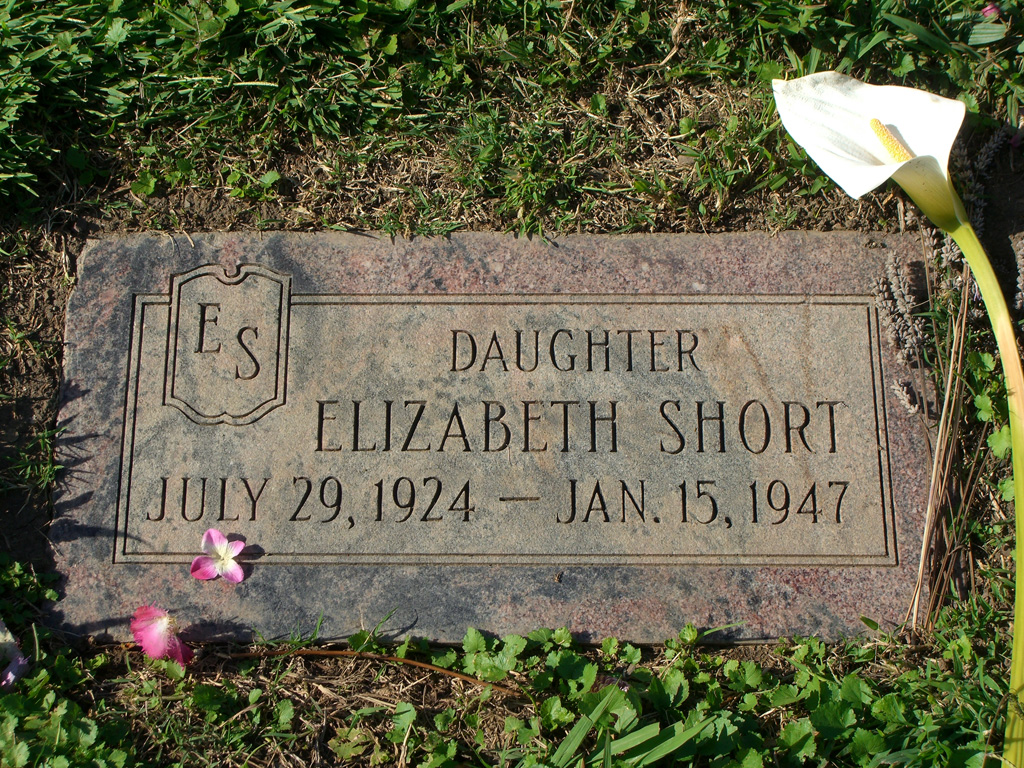
Elizabeth Short is buried at Mountain View Cemetery in Oakland, California -- far from Los Angeles, far from Boston, far from anywhere she lived for long. The cultural afterlife of her murder has been enormous: novels, films, television episodes, podcasts, and academic studies. James Ellroy's 1987 novel The Black Dahlia made her case the backbone of Los Angeles noir mythology. But the mythology has a cost. Elizabeth Short was a real person who lived through the Depression, lost her father to deception, lost her fiance to war, struggled with chronic illness, and was murdered at twenty-two. The fascination with her death has often eclipsed the fact of her life -- a life marked by resilience and displacement, not by the violence that ended it. She deserves to be remembered as more than a case file.
From the Air
Elizabeth Short is buried at Mountain View Cemetery in Oakland (37.8353N, 122.2369W), near the intersection of Piedmont Avenue and Pleasant Valley Road. From 3,000 feet AGL, the cemetery's winding paths and mature trees are visible against the urban grid. Oakland Metro (KOAK) lies approximately 3nm to the southwest. The murder itself occurred in the Leimert Park neighborhood of Los Angeles, far to the south, but the geographic connection to the Oakland area is through her final resting place.