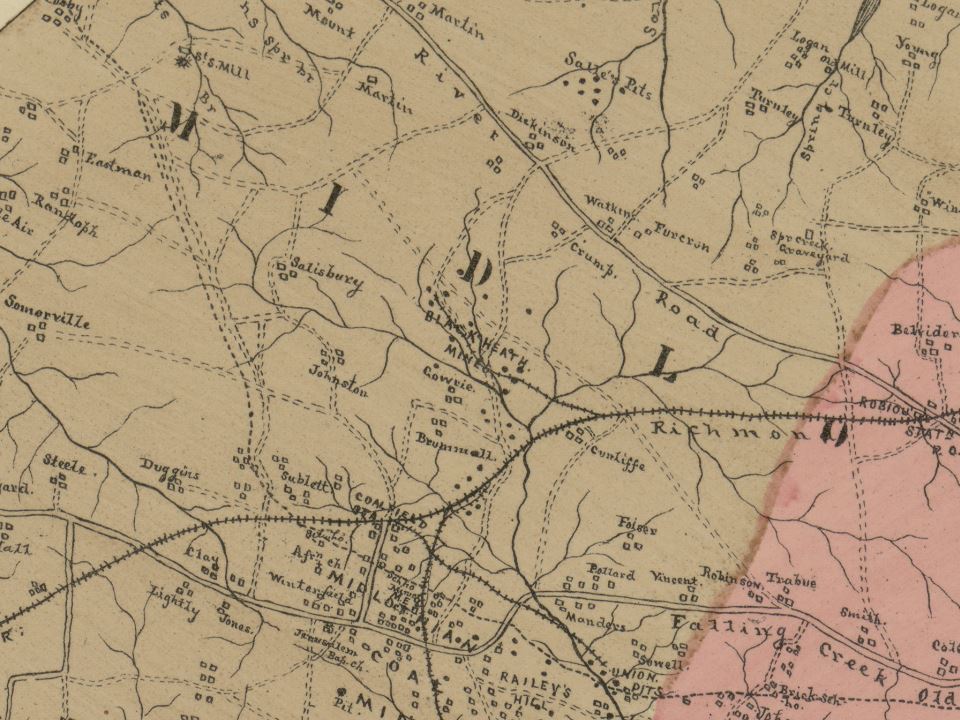
Black Heath
The coal that heated Thomas Jefferson's White House came from a 97-acre tract in Chesterfield County, Virginia, that would eventually consume itself. Black Heath was a mansion, a mine, and a cautionary tale all at once. The Heth family bought the land in 1795, dug shafts hundreds of feet deep, shipped high-quality coal down the James River, married into Virginia's most prominent dynasties, and built one of the first incorporated coal mining companies in the state. Then the tunnels they carved beneath their own home collapsed, and sometime in the late 1910s or 1920s, the grand house dropped into the earth it had profited from for over a century.
Coal Beneath the Colony
Long before the Heths arrived, French Huguenot refugees and Scottish miners had been pulling coal from the ground west of Richmond's fall line since around 1700. The mining community that grew up here was first called Coalfield, after a station on the Richmond and Danville Railroad, before Scottish immigrant miners renamed it Midlothian after their homeland county of East Lothian. The coal basin itself, oval-shaped and up to 40 feet thick in places, attracted a parade of owners. Colonel John Bolling held the land before 1749. A Huguenot named Andrew Ammonett divided it among his five sons in 1761. The tract that would become Black Heath passed through the hands of George Sowell and then William Ronald, who mined it for a decade before dying in debt. In 1795, Henry "Harry" Heth and his partner John Stewart purchased the 97 acres at auction for 3,150 pounds. Stewart left by 1797, and Heth had the land to himself.
The Heth Dynasty
Harry Heth grew spectacularly wealthy from coal. His children married Randolphs, Harrisons, and Picketts, the aristocratic surnames of old Virginia. He built the Black Heath mansion, an L-shaped house with four distinct sections mixing gable, hipped, and gambrel roofs in an eccentric arrangement that mirrored the eccentricity of its owner's ambition. When Heth died of consumption in Savannah in January 1821, he left the surface land to his eldest son Henry and the subsurface rights to a family partnership. Henry survived his father by only four years. His brother John took over the estate and in 1833 incorporated the Black Heath Company of Colliers, the first chartered coal mining corporation in Virginia. John traveled to England in 1840 to recruit investors, forming the Chesterfield Coal and Iron Mining Company. He died in 1842, leaving a widow and ten children. His eldest son, Henry Heth, reported to West Point that year describing the family as "badly off." That boy would later serve as a Confederate Major General.
The Price in Blood
The wealth of Black Heath was extracted at terrible human cost. On March 18, 1839, an explosion ripped through a shaft 700 feet deep, killing 53 men, most of them enslaved African Americans. Five years later, on June 15, 1844, another blast killed 11 more. The Maidenhead pits, which had become associated with the Black Heath operation, closed permanently in 1854 after yet another deadly explosion. Between the lethal blasts, shafts plunging as deep as 700 feet, and tunnels honeycombing the earth beneath homes and roads, the mining operation left a landscape riddled with danger. The coal seam was 36 feet thick and the Maidenhead mines alone produced an estimated 80,000 tons per year at their peak, but every ton came from darkness where one spark could end dozens of lives in an instant.
The Ground Gives Way
After the Civil War, Black Heath entered a long decline. A. F. D. Gifford, an English attorney for the mining company, had occupied the house, but he drowned in 1862 when his ship sank trying to run the Union blockade. Colonel William B. Ball, a Confederate cavalry officer turned country doctor, became the last known resident before his death in 1872. The land cycled through trustees, speculators, and failed mining ventures. The house sat empty, sinking. A WPA guidebook from 1940 described the site as lost in "dense undergrowth." The nearby Old Mount Pisgah Methodist Church had already been forced to relocate when its own foundation dropped into a collapsing mine tunnel. Black Heath suffered the same fate: the mansion that coal money built was swallowed by the coal shafts that made it possible.
Subdivisions Over Shafts
In 1957, Joseph Cogito sold the remnant tracts to Paul Duke, a Richmond journalist who went on to host Washington Week in Review on PBS for twenty years. By 1971, Duke began selling parcels for housing development. Today the subdivision named Black Heath sits on the old mine land, its streets carrying names that hint at what lies below: Heathmere Crescent, Black Heath Road, Olde Coalmine Road. Water-filled strip mining pits from later operations still dot the surrounding forest, a large swath of land with no foreseeable development future. The coal is gone, the mansion is gone, the Heths are scattered to history. But the voids they carved remain, hidden beneath the lawns of suburban Midlothian.
From the Air
Located at 37.520N, 77.632W in the Midlothian area of Chesterfield County, Virginia, approximately 12 miles west-southwest of downtown Richmond. Best viewed at 2,000-3,000 feet AGL. Look for the suburban developments off Huguenot Road (SR 147) north of Midlothian Turnpike (US 60). Water-filled mining pits are visible as dark ponds in forested areas. Nearest airports: Chesterfield County Airport (KFCI) 6 nm south, Richmond International (KRIC) 20 nm east. The Richmond and Danville Railroad line (now Norfolk Southern) cuts through the property and is visible from altitude.