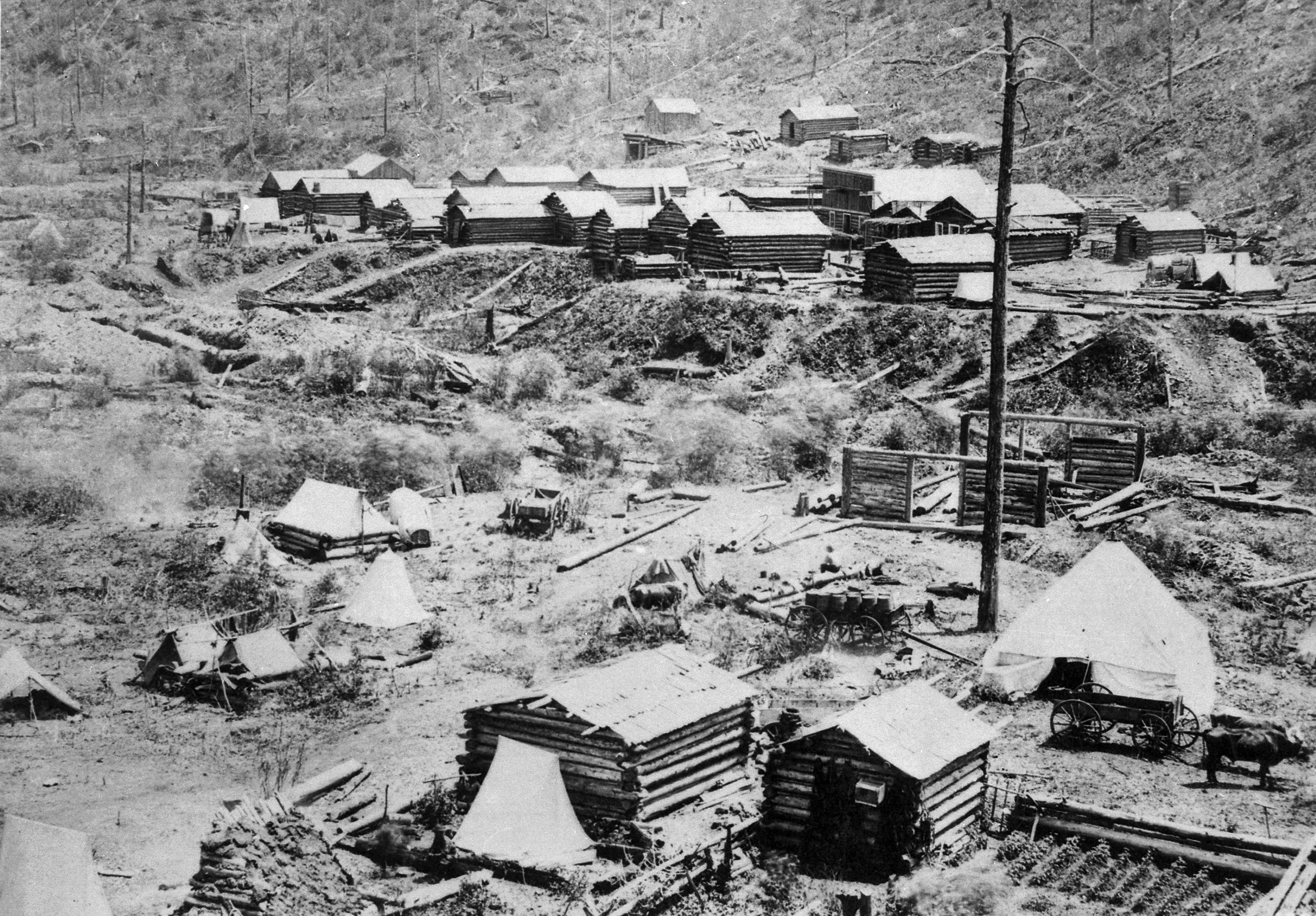
Black Hills Gold Rush
"Got all the gold we could carry." These words, carved into sandstone by a dying man named Ezra Kind in 1834, may represent the earliest documented gold discovery in the Black Hills. Kind and six companions had ventured illegally into Lakota territory, struck it rich, and then were hunted down beyond the high hill. His carved testament, the Thoen Stone, lay hidden on Lookout Mountain for fifty-three years before its discovery in 1887. By then, thousands of prospectors had already flooded these sacred lands, ignoring treaties, defying the U.S. Army, and transforming the Black Hills forever.
Forbidden Ground
The Black Hills held secrets the Lakota Sioux intended to keep. In the 1860s, Catholic missionary Father Pierre-Jean De Smet observed Sioux people carrying gold they said came from these forested mountains. The Lakota called them Paha Sapa, sacred ground central to their spiritual world. The Treaty of Fort Laramie in 1868 formally recognized the Black Hills as belonging to the Great Sioux Nation, explicitly barring white settlement. For six years, the treaty held. But rumors of gold spread through mining camps and frontier towns, each retelling growing richer. The government knew that keeping prospectors out of promised Native land would prove impossible once the word got out.
Custer's Gamble
In 1874, Lieutenant Colonel George Armstrong Custer led a military expedition of one thousand men into the Black Hills, ostensibly to survey potential fort locations. The expedition included miners and geologists whose true purpose was poorly disguised. Near present-day Custer, South Dakota, they found gold in French Creek. Custer's enthusiastic reports ignited a frenzy. Prospectors poured into treaty land despite army attempts to turn them back. The miners moved north through the hills, founding Hill City, Sheridan, and Pactola, finding gold flakes at each stop but never the bonanza they sought. Then in November 1875, someone struck the placer deposits of Deadwood Gulch.
Deadwood's Wild Fortune
By 1876, thousands of gold-seekers had descended on the new town of Deadwood, still technically on land belonging to the Sioux. The gulch yielded fortune from every shovelful of earth. Mining camps sprawled through the narrow canyon, lawless and wild. Wild Bill Hickok was shot dead at a poker table. Calamity Jane drove ox teams through muddy streets. Chinese workers built flumes and sluices. Many miners had traveled up the Missouri River from Kansas, following rumors of easy riches. The government eventually pressured the Sioux to cede the Black Hills in 1877, legalizing what had already been seized. The gold rush transformed an entire region from sacred wilderness into industrial mining district in just three years.
Legacy in Stone and Gold
The Black Hills gold rush peaked between 1876 and 1877, but its consequences still shape South Dakota today. The Homestake Mine at Lead, discovered during the rush, operated continuously until 2001 as one of the deepest gold mines in the Western Hemisphere. The town of Deadwood still trades on its Wild West heritage, its main street preserved beneath the shadow of surrounding hills. The Lakota Nation has never accepted payment for the stolen land; a Supreme Court settlement from 1980 remains unclaimed on principle, the fund now worth over a billion dollars. The HBO series Deadwood brought this lawless era to modern audiences, but the real story runs deeper than any dramatization. These hills, dark with ponderosa pine, witnessed the collision of sacred land, treaty promises, and the irresistible pull of gold.
From the Air
Located at 44.35N, 103.75W in the northern Black Hills of South Dakota. From the air, the dark pine forests contrast sharply with surrounding prairie. Look for the historic mining towns of Lead and Deadwood in narrow gulches, and the open pit of the Homestake Mine. Nearby airports include Deadwood Municipal (96D) and Rapid City Regional (KRAP). Best viewed at 5,000-8,000 feet AGL for perspective on the entire mining district.