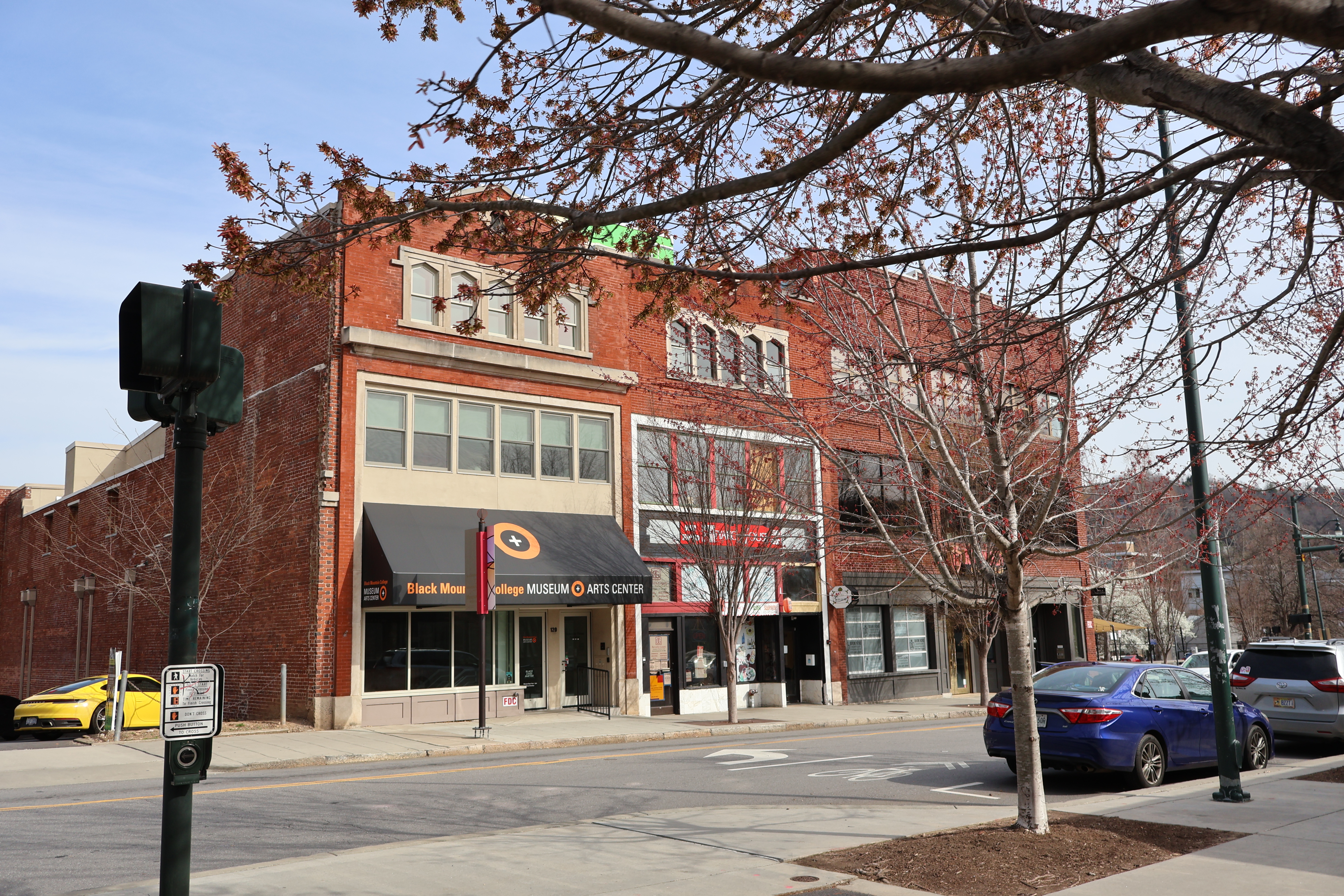
Black Mountain College Museum + Arts Center
In 1933, a group of dissident educators opened a tiny college in the Blue Ridge Mountains of North Carolina with an audacious premise: put art at the center of everything. No grades, no required courses beyond Josef Albers's materials workshop and a seminar on Plato, no separation between learning and living. Black Mountain College lasted only 24 years before financial troubles shuttered it in 1957, yet its influence on American culture proved seismic. Robert Rauschenberg, John Cage, Merce Cunningham, Ruth Asawa, Buckminster Fuller, Willem de Kooning -- the roster of faculty and students reads like a who's who of twentieth-century creative thought. Today, in a 6,000-square-foot space on Pack Square Park in downtown Asheville, the Black Mountain College Museum + Arts Center keeps that restless spirit alive.
Born in a Living Room
The museum began in 1993 not in a gallery but in the home of arts advocate Mary Holden Thompson in the town of Black Mountain itself. Thompson recognized that the college's extraordinary story -- how a handful of refugees from the Bauhaus and American experimentalists built something entirely new in the Appalachian foothills -- deserved a permanent keeper. For years, exhibitions happened through community partnerships and sheer determination. The museum hired its first employee, part-time office manager Alice Sebrell, in 1999. A small gallery opened on Broadway Street in Asheville in 2003, and by 2016 a second location followed at 69 Broadway. Finally, in September 2018, the museum consolidated into its permanent home at 120 College Street, doubling its footprint with 2,500 square feet of flexible exhibition space, a research library of over 1,500 texts, and climate-controlled storage for its permanent collection.
Artifacts of Radical Thought
The permanent collection spans creation dates from 1931 to 2004, every item bearing a direct connection to the college. Photographs, ceramics, weavings, furniture, paintings, and correspondence fill the archive. Two wooden benches from the Quiet House -- the contemplative retreat at Black Mountain's Lake Eden campus -- sit alongside a desk designed by Josef Albers himself. A complete set of The Black Mountain Review, the poetry journal that gave rise to the Black Mountain Poets, occupies a place of honor. In 2013, the museum acquired Robert Rauschenberg's 1971 work Opal Gospel, 10 American Indian Poems -- ten moveable silkscreened acrylic panels blending American Indian stories with Rauschenberg's signature layered imagery. Works by Ruth Asawa, Ray Johnson, Kenneth Noland, Charles Olson, and Dorothea Rockburne fill out a collection that traces the evolution of American modernism from a few mountain classrooms to the world stage.
Living Voices
Since 1999, the museum has recorded oral histories with Black Mountain College alumni, capturing 69 interviews as of 2019. These first-person accounts preserve the texture of daily life at the college -- the communal meals, the farm work that every student shared, the late-night arguments about form and function. The museum also publishes the Journal of Black Mountain College Studies, with 13 volumes issued between 2011 and 2023, and a chapbook series called Faith in Arts exploring figures like John Cage and M.C. Richards. An annual experimental art event called the {Re}HAPPENING, held on the former college grounds at Lake Eden, has brought more than 100 artists together each year since 2010 to channel the college's spirit of spontaneous creation.
Where the Avant-Garde Took Root
Black Mountain College occupies a singular place in American cultural history. When Josef Albers arrived from Germany in 1933, fleeing the Nazi closure of the Bauhaus, he carried with him an approach to art education that prized direct experimentation over theory. Students repeated simple exercises with materials and color until they genuinely changed how they saw the world. That philosophy -- learn by making, live by questioning -- attracted a constellation of artists, poets, and thinkers who would reshape dance, visual art, music, and literature in the decades to come. The college produced no accredited degrees, maintained no endowment, and occupied borrowed buildings, yet its students went on to transform the art world. The museum on Pack Square ensures their story does not vanish into the mist of the Blue Ridge.
From the Air
Located at 35.597N, 82.552W in downtown Asheville, North Carolina, on Pack Square Park. The museum building is not individually visible from altitude, but Pack Square sits at the heart of Asheville's compact downtown grid, identifiable from the air by the Vance Monument obelisk nearby. Asheville Regional Airport (KAVL) lies 9 miles south. The original Black Mountain College campus at Lake Eden is roughly 15 miles east, nestled in the Swannanoa Valley below the Blue Ridge Parkway. Best viewed at 3,000-5,000 feet AGL in clear conditions for context of the mountain setting.