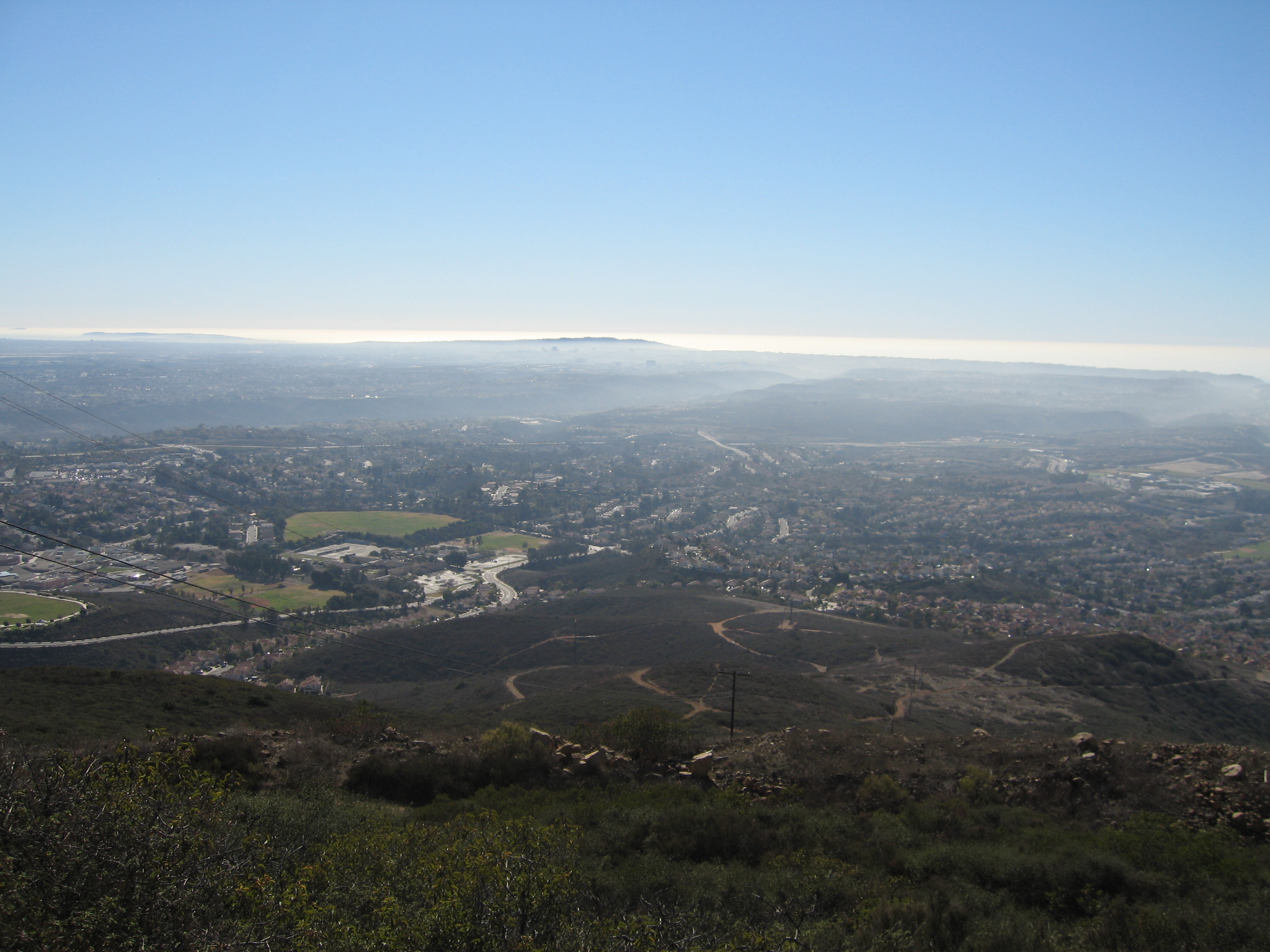
Black Mountain Open Space Park
The Kumeyaay called it 'Amat Kwanyil' long before suburban developments pressed against its flanks. Black Mountain last erupted 118 to 125 million years ago, when dinosaurs still walked the Earth and the peak stood among a chain of volcanic islands that would eventually become part of Southern California's coastal ranges. Today, this extinct volcano rises from northern San Diego's sprawl, its slopes preserving both the ancient geology of the Santiago Peak Volcanics and the living ecosystems that have adapted to California's Mediterranean climate.
Two Faces of the Mountain
Black Mountain wears its plant communities like a split cloak. The east and north sides host chaparral, that distinctive California ecosystem where manzanita, chamise, and toyon create dense evergreen thickets. These drought-adapted shrubs have thick, leathery leaves designed to conserve water through the long dry season. Walk around to the south and west faces, and the vegetation shifts to coastal sage scrub, a softer community dominated by the fragrant Californian white and black sage, California sagebrush, and California buckwheat. This division follows the sun: chaparral thrives where the slopes catch more moisture and less direct heat, while sage scrub endures on the drier, hotter exposures.
Creatures of the Chaparral
The park shelters a remarkable diversity of wildlife for a preserve surrounded by suburban development. Mule deer browse through the scrub at dawn and dusk. Bobcats hunt the desert woodrats and Pacific kangaroo rats that rustle through the undergrowth. More than 80 bird species have been documented here, including three that make birdwatchers travel considerable distances: the California gnatcatcher, with its rising, kitten-like mew; the rufous-crowned sparrow with its distinctive head markings; and the northern harrier, coursing low over the brush with its owl-like facial disk. On warmer days, the red diamond rattlesnake may sun itself on exposed rocks, while Pacific chorus frogs and slender salamanders hide in cooler, moister spots.
The Cowboy's Secret Mine
Tucked away in Black Mountain's canyon lies an abandoned mine with an unlikely history. In the 1920s, Frank Hopkins, an Escondido rancher, rodeo cowboy, and actor, established an arsenic mine here. His timing was excellent: white arsenic was in high demand as a key ingredient in pesticides used against the boll weevil, a beetle devastating cotton crops across the American South. But by 1927, as the boll weevil population declined and demand fell, Hopkins abandoned the operation. A 1939 article in the Vista Press noted he had also prospected for gold in the same tunnels. The mine remains accessible via trails branching from the Miner's Ridge Loop, though soil sampling by the University of San Diego in 2016 revealed elevated arsenic levels, prompting trail closures pending further study.
Trails Through Time
The park offers numerous trails of varying challenge across its terrain. The Miner's Ridge Loop covers 2.3 miles with 670 feet of elevation gain, passing near the historic mine site. The Nighthawk Trail, accessible from Hilltop Community Park, climbs the mountain's slopes. The Jas Arnold Trail for All People, a handicapped-accessible path named for the park's long-serving Citizens' Advisory Committee chair who passed in 2016, provides easier access from the Miner's Ridge Loop parking lot. The Lilac Canyon Trail connects to the Glider Port, where hang gliders and paragliders launch from the mountain's heights. Each trail offers different perspectives on the volcano's geology, from exposed rock faces to the deep shade of eucalyptus-filled canyons.
From the Air
Located in northern San Diego at 32.98N, 117.12W. Black Mountain is visible as a prominent peak rising from the suburban landscape of the Black Mountain Ranch and Rancho Penasquitos areas. The mountain's volcanic geology is apparent in its darker rock exposures. Look for hang gliders and paragliders launching from the Glider Port on clear days. Best viewed at 2,500-3,500 feet for the full topographic context. Nearby airports include Montgomery-Gibbs Executive (KMYF, 7nm south) and McClellan-Palomar (KCRQ, 15nm north). The mountain is part of the Santiago Peak Volcanics, which includes the more prominent Cowles Mountain visible to the southeast.