Black Pyramid
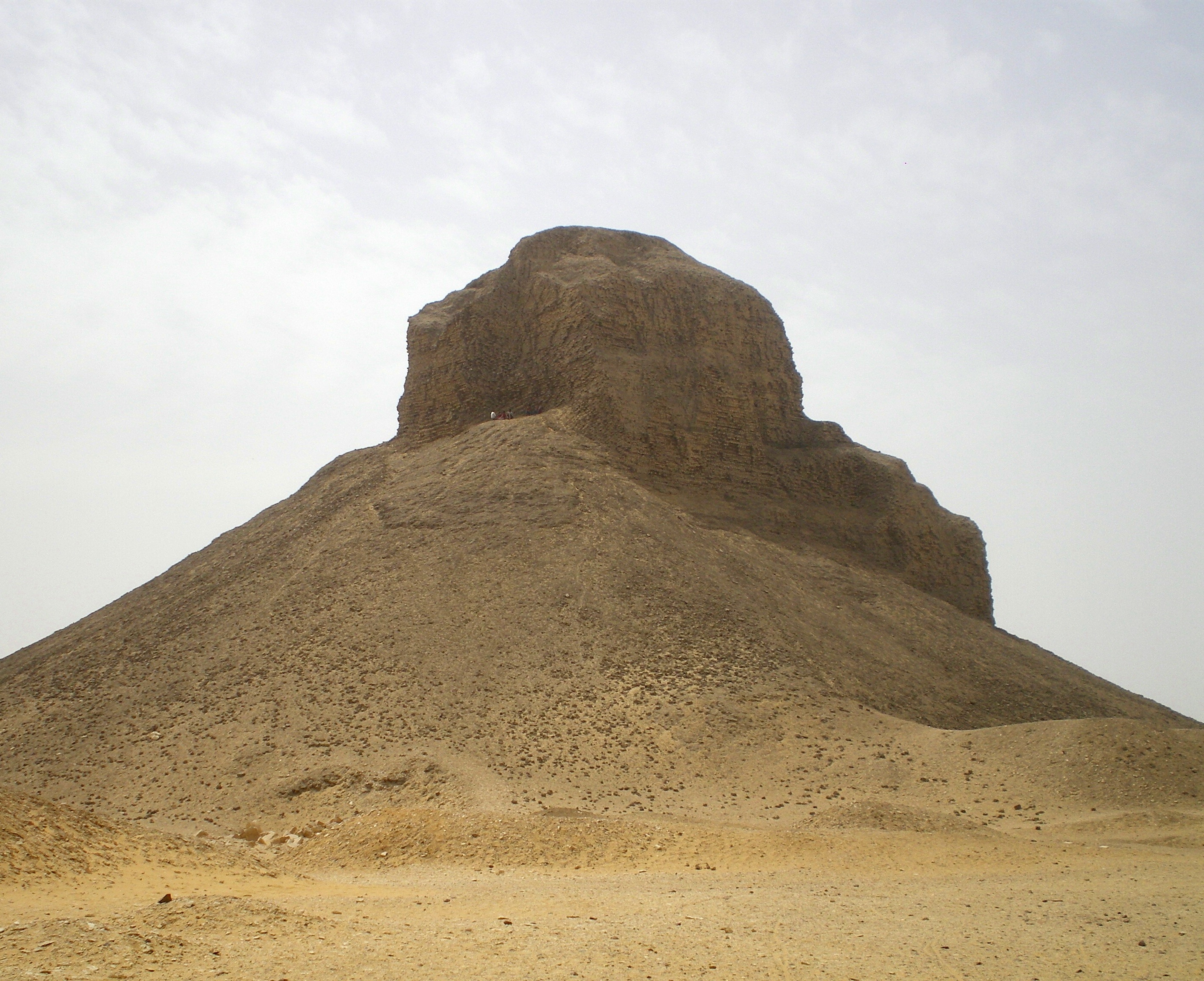
Its original name was "Amenemhet is Mighty." Today it is called the Black Pyramid, named for the dark rubble mound it has become after nearly four thousand years of decay. Built by King Amenemhat III during the Middle Kingdom, roughly 1860 to 1814 BC, at the necropolis of Dahshur in Egypt, this pyramid attempted something no predecessor had: housing both the king and his queens within a single structure. It was also, from a structural standpoint, a slow-motion disaster. Built of mud brick and clay on saturated lowland only 10 meters above sea level, the pyramid began sinking into the earth almost as soon as it rose above it.
Ambition in Mud Brick
The Black Pyramid originally stood about 75 meters tall on a 105-meter base, angled at 57 degrees. Where earlier pyramids used solid stone cores, Amenemhat III's builders encased a mud-brick structure in limestone, a cost-saving technique common in the Middle Kingdom but one that carried risks. The core had no internal support walls, possibly to reduce weight on the soft clay beneath. The outer casing was held together with dovetail pegs in the style of his father's tomb. But limestone veneer over mud brick is only as strong as its foundation allows, and the Nile's proximity guaranteed that groundwater would seep upward into the structure. The builders were, in effect, constructing a mountain on a sponge. Jacques de Morgan began excavation at Dahshur in 1892 on a French mission, and the German Archaeological Institute of Cairo completed the work in 1983.
A Labyrinth Below
Beneath the pyramid lies a network of passages more complex than the structure above suggests. The "King's section" remains largely intact, containing a sarcophagus carved to imitate the enclosure wall of Djoser's pyramid complex at Saqqara, perhaps a deliberate invocation of an older, more stable era of pyramid building. A canopic jar was also found, but the king was never buried here. The "Queen's section," located under the southwestern quadrant, was broken into and looted in antiquity. Two burial chambers were created for queens: one for Queen Aat, whose chamber contained a sarcophagus similar to the king's, and a second for an unnamed queen. Although looters had ransacked both chambers, archaeologists recovered items they overlooked, including one of Queen Aat's canopic jars. Two additional chambers may have belonged to King Amenemhet IV and Queen Sobekneferu, but this remains uncertain.
The Sinking
As the pyramid rose, it sank. The soft clay beneath the foundation could not support the mass above, and the underground chambers began to buckle under the weight pressing down on them. Builders attempted emergency measures: supporting beams were hastily installed and mud-brick walls erected inside the substructure to arrest the movement. These efforts failed. The pyramid was ultimately abandoned as a royal burial site, its chambers compromised and its structure visibly settling. Groundwater from the Nile continued to seep into the lower levels, softening the mud brick that formed the core beneath the limestone skin. Without enough stress relievers built into the upper structure to distribute loads over the underground voids, the weight of the pyramid slowly crushed what lay beneath it. Centuries later, the limestone casing was stripped away, exposing the mud-brick interior to wind and rain. What remains is the dark, crumbling mound that gave the pyramid its modern name.
Afterlife of a Failed Tomb
The Black Pyramid's story did not end with its abandonment by Amenemhat III. By the 13th Dynasty, roughly a century later, security had deteriorated to the point where local inhabitants were using the Valley Temple as a granary and the pyramid had been looted for the first time. But the site also saw reuse: King Auibre Hor and his princess Nubhetepti-khered were buried in two of the ten shaft tombs that lined the outer enclosure's northern side, suggesting the complex retained some ceremonial significance even in decline. The pyramidion, the capstone that would have crowned the structure, was recovered and is now in the Egyptian Museum in Cairo. Covered in inscriptions and religious symbols, some of which were later scratched off, possibly during Akhenaten's religious revolution, it remains one of the finest surviving examples of its kind. Since the Egyptian Revolution of 2011, rates of looting at Dahshur have increased, threatening what survives of the five remaining pyramids at the site.
From the Air
Located at 29.79N, 31.22E at the Dahshur necropolis, approximately 35 km south of Cairo. The dark rubble mound contrasts with the lighter desert sand. The Bent Pyramid and Red Pyramid are visible nearby to the northwest. Best viewed at 3,000-6,000 ft AGL. Nearest airport is Cairo International (HECA). The Giza pyramid complex lies approximately 15 km to the north.