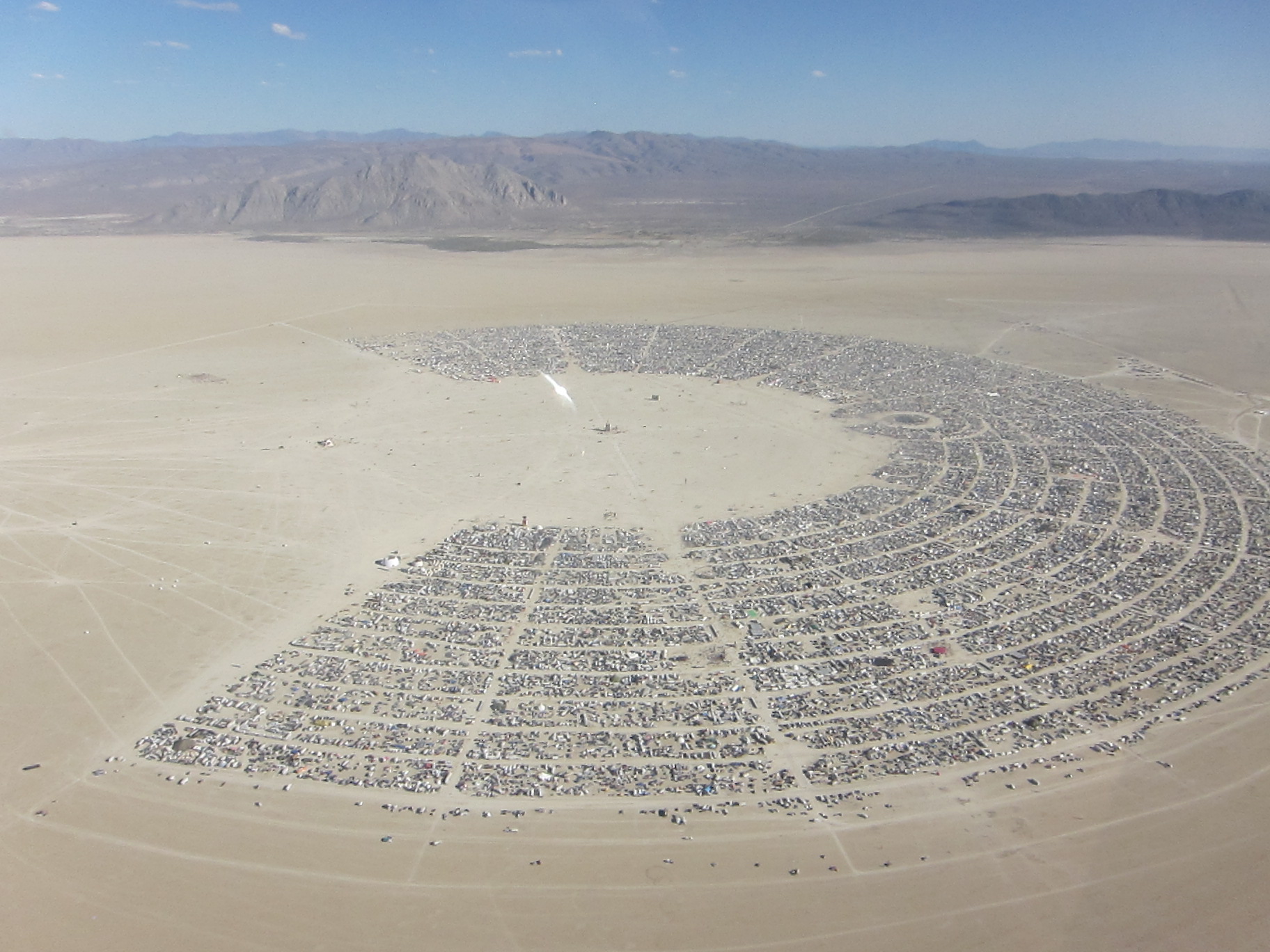
Black Rock City: The World's Most Temporary Metropolis
For one week every August, Black Rock Desert hosts America's third-largest city in Nevada. Then it vanishes. Black Rock City - home of the Burning Man festival - appears on the playa as a semicircular metropolis of theme camps, art installations, and 80,000 participants. There are no spectators, only contributors. Commerce is forbidden; only coffee and ice are sold. The city has streets, neighborhoods, emergency services, and its own culture. At the end, the Man burns. The Temple burns. Everything burns or gets packed out. Within two weeks, the desert shows no trace of the city that briefly existed. The whole point is impermanence.
The Origins
Burning Man began in 1986 on a San Francisco beach - Larry Harvey and friends built an eight-foot wooden figure and burned it on the summer solstice. The gathering grew, moved to Baker Beach, attracted police attention, and relocated to Nevada's Black Rock Desert in 1990. The empty playa offered space and isolation; the event evolved from beach bonfire to temporary city. By the 2000s, Burning Man had become a cultural phenomenon - criticized as both anarchist escapism and tech-bro playground. The tension between counterculture origins and mainstream infiltration remains unresolved. The Man still burns.
The Principles
Ten principles guide participation: Radical Inclusion, Gifting, Decommodification, Radical Self-reliance, Radical Self-expression, Communal Effort, Civic Responsibility, Leave No Trace, Participation, and Immediacy. In practice: no buying, selling, or advertising; you bring everything you need; you contribute rather than consume; you clean up completely. The principles are aspirational - their implementation is imperfect - but they create a framework for something genuinely different from normal society. For one week, participants experiment with alternative social structures. Then they return to the default world.
The City
Black Rock City is planned on a semicircular grid, streets named alphabetically and numerically. The Man stands at the center, visible from throughout the city. Theme camps cluster by neighborhood - some focused on music, others on art, others on specific communities. Art installations range from intimate sculptures to multi-story interactive structures. Mutant vehicles - modified art cars - are the only motorized transport on the playa. At night, the city transforms into a light-show; everything glows, blinks, flames. The population of 80,000 makes it Nevada's third-largest city, appearing for one week then vanishing completely.
The Burn
The Man burns Saturday night. Tens of thousands gather in a circle as the wooden structure ignites, collapses, is consumed. The Temple burns Sunday night - a quieter ceremony. Participants write messages to deceased loved ones on the Temple walls; the burning releases the grief. Both structures are designed to burn spectacularly. After the burns, the city dismantles. 'Leave No Trace' means exactly that: participants pack out everything, including gray water. A cleanup crew spends weeks removing even the smallest debris. The Bureau of Land Management inspects afterward; the goal is zero impact. The city vanishes as completely as if it never existed.
Visiting Burning Man
Burning Man occurs annually in late August, roughly 110 miles north of Reno on the Black Rock Desert playa. Tickets sell out quickly and are not available at the gate; purchase online months in advance. Participants must be entirely self-sufficient: bring all water, food, shelter, and supplies for the duration. Nothing is for sale except ice and coffee. The environment is harsh: daytime temperatures exceed 100°F, dust storms are common, nights are cold. The drive from Reno takes several hours plus entry queue time. First-timers should research extensively and ideally join an established camp. This is not a music festival; this is a participation-required social experiment in an extremely challenging environment.
From the Air
Located at 40.79°N, 119.20°W on the Black Rock Desert playa in northwestern Nevada. From altitude, the Black Rock Desert appears as a vast white alkali flat - one of the largest and flattest surfaces on Earth. During Burning Man (late August), Black Rock City is visible as a semicircular development on the playa - streets, structures, and the central Man figure identifiable from altitude. The temporary city appears surreal against the empty desert. Before and after the event, the playa shows no trace of human activity. The contrast is the point: a city of 80,000 that appears, burns, and vanishes, leaving the prehistoric lakebed exactly as it was.