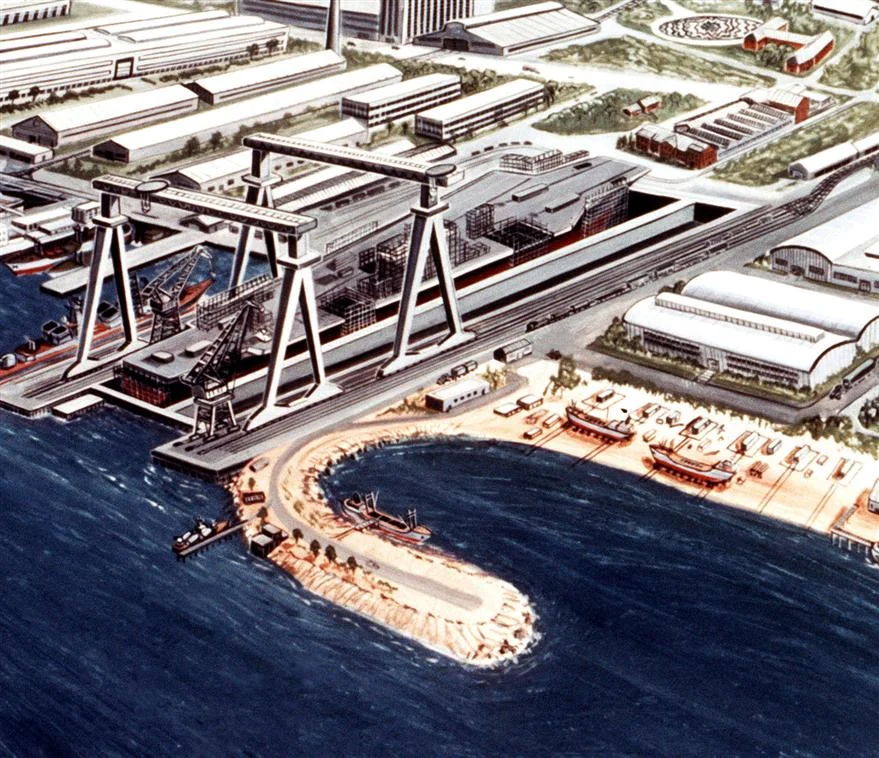

Black Sea Shipyard
Every aircraft carrier the Soviet Union and Russia ever put to sea was born in the same place: a sprawling shipyard on the southern tip of the Mykolaiv peninsula, where the Southern Bug runs down toward the Black Sea. That is a remarkable claim for a facility founded in 1895 by Belgian investors, and it captures the strange arc of the Black Sea Shipyard, an enterprise that began as foreign capital chasing profit in the Russian Empire and ended, in 2021, liquidated by an economic court, its slipways silent. For most of the twentieth century, though, this was one of the great shipbuilding yards of the world, and the giants it launched shaped fleets and cold wars alike.
Belgian Money, Russian Steel
The yard opened in 1895 as a Belgian-owned venture, began building warships in 1901, and grew fast. British armaments know-how from Vickers Limited flowed in, mergers and renamings followed, and by 1914 the works employed some 10,400 people, making it one of the largest industrial firms in the whole Russian Empire. Then came revolution. After the First World War the Bolsheviks took control and renamed it the Black Sea Shipbuilding Works, and after a moribund early Soviet decade the yard roared back to life in the 1930s as Stalin's regime launched an ambitious naval buildup. It began turning out surface warships and submarines, and was formally redesignated Shipyard No. 198, a numbered cog in a vast state war machine.
The Carriers of a Superpower
It was after the Second World War, which badly damaged the yard and left it years of rebuilding, that the Black Sea Shipyard became legendary. Here the Soviet navy built its Moskva-class helicopter carriers in the 1960s, then the Kiev-class ships that carried vertical-takeoff aircraft, and eventually the great carrier Admiral Kuznetsov. The scale of the work was so significant that in 1984 American KH-11 spy-satellite photographs of the Kuznetsov under construction were leaked to Jane's Defence Weekly by Samuel Loring Morison, a U.S. naval intelligence analyst, in one of the era's notable espionage cases. These were among the largest warships ever built anywhere, and they took shape on the banks of a river most of the world could not find on a map.
The Silence After
Alongside the warships, the yard built the workaday vessels of a maritime economy, dry-cargo ships, floating fish factories, and large trawlers, and it anchored a whole ecosystem of Ukrainian shipbuilding, including the design firm Chernomorsudoproekt founded in 1956. When the Soviet Union dissolved, the enormous facility found itself in an independent Ukraine with no superpower navy to build for, and no economy of the same scale to sustain it. The great slipways that had launched carriers grew quiet, orders dwindled, and on 25 June 2021 the economic court of Mykolaiv Oblast formally liquidated the company. After 126 years, the yard that had built every carrier of two states passed into history, its story a reminder of how completely the industries that define an age can vanish when that age ends.
From the Air
The Black Sea Shipyard occupies the southern tip of the Mykolaiv peninsula at about 46.95 degrees north, 31.98 degrees east, on the Southern Bug where it widens toward the estuary. From the air the long slipways, cranes, and fitting-out basins along the riverbank mark the site. Nearest airport is Mykolaiv International (UKON) just north of the city; Kherson (UKOH) lies to the southeast and Odesa International (UKOO) to the west.
Nearby Stories
- Pontic Olbia 9.1 km away
- Yelanets Steppe Nature Reserve 40 km away
- Kuialnyk Estuary 45 km away
- Granite-Steppe Lands of Buh 70 km away
- Vorontsov Lighthouse 71 km away
- Skadovsk 84 km away
- Church of the Nativity of the Theotokos 102 km away
- Dzharylhach 115 km away