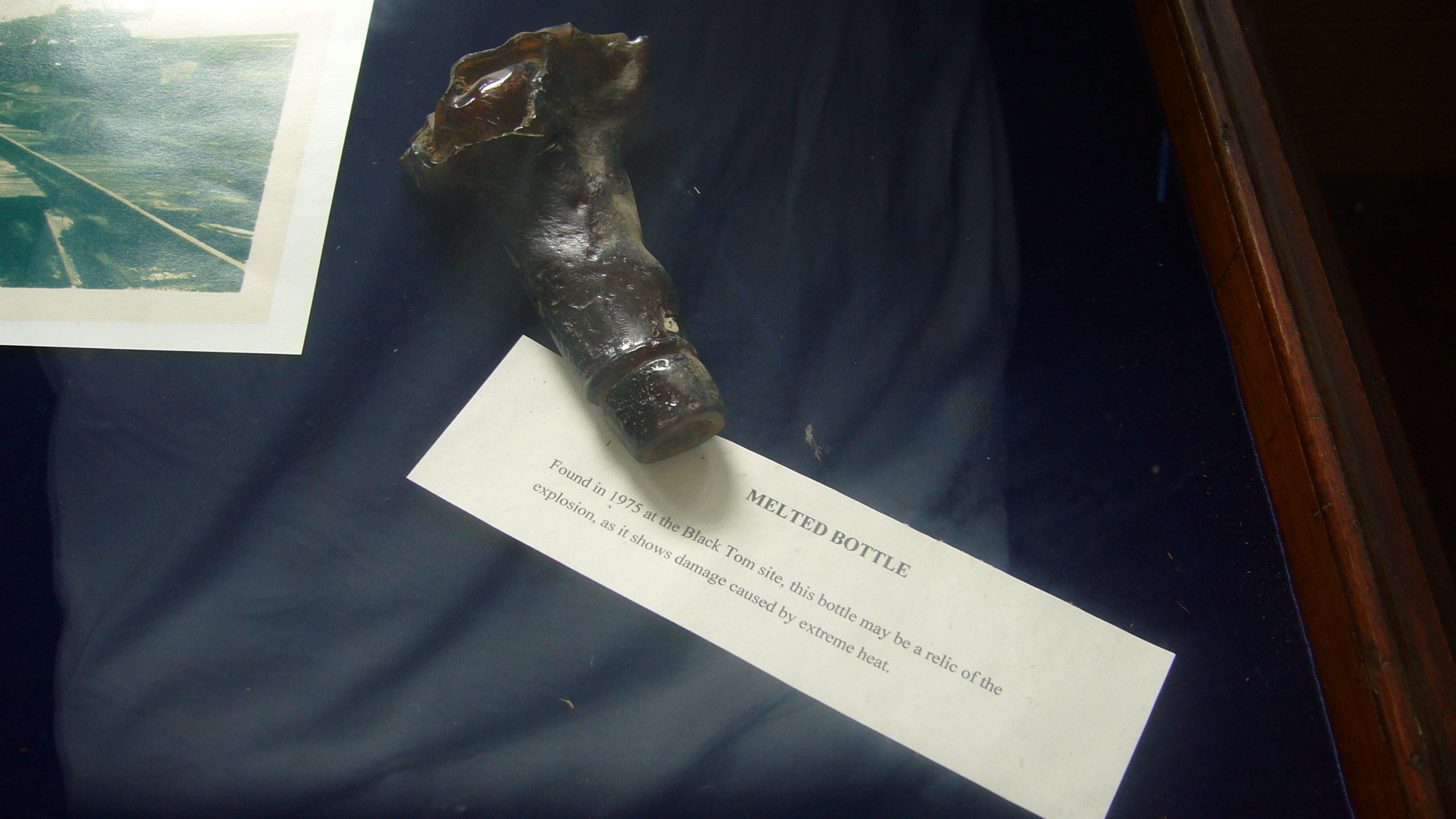
Black Tom: The Night German Spies Blew Up New York Harbor
At 2:08 on the morning of July 30, 1916, the clock tower of The Jersey Journal building in Journal Square stopped. Fragments from an explosion that registered between 5.0 and 5.5 on the Richter scale had lodged in the tower and frozen its hands at 2:12 a.m. Across the harbor, thousands of windows shattered in Lower Manhattan. Panes cracked in Times Square. The outer wall of Jersey City's City Hall split open. The Brooklyn Bridge shook. People as far away as Maryland woke up convinced an earthquake had struck. What had actually happened was an act of war on American soil, carried out seventeen months before the United States would enter World War I: German agents had set fire to Black Tom Island, a munitions depot in New York Harbor loaded with small arms, artillery ammunition, and fifty tons of TNT, all bound for Allied forces in Russia.
An Island Built from Garbage
Black Tom was named for a dark-skinned fisherman who had lived on a rocky outcrop in New York Harbor for years. By the 1880s, the rock had been expanded with city refuse into a promontory connected to the New Jersey mainland by a causeway and railroad tracks. The Lehigh Valley Railroad owned the island and continued to fill it with landfill between 1905 and 1916, annexing the entire area to Jersey City. A long pier housed a depot and warehouses for the National Dock and Storage Company. The location made Black Tom the major munitions shipping point for the northeastern United States. While America remained officially neutral in World War I, its munitions companies could sell to any buyer. In practice, the Royal Navy's blockade of Germany meant only the Allied governments could purchase American arms. Mountains of shells, bullets, and explosives piled up on Black Tom Island, waiting for ships to carry them to the war. Germany, watching millions of dollars' worth of munitions flow to its enemies from an island it could almost see from the Statue of Liberty, decided the shipments had to stop.
Two Hours After Midnight
On the night of the explosion, about two million pounds of small arms and artillery ammunition sat in freight cars and on barges at the depot. Johnson Barge No. 17 alone carried fifty tons of TNT and 417 cases of detonating fuses. Jersey City's Commissioner of Public Safety, Frank Hague, later said the barge had been tied up at Black Tom to avoid a twenty-five-dollar docking fee elsewhere. When the incendiary devices ignited, the result was one of the largest artificial non-nuclear explosions in history. Shrapnel flew for miles. Fragments embedded themselves in the Statue of Liberty, causing one hundred thousand dollars in damage and structural harm that would permanently close the torch to visitors. The explosion destroyed more than one hundred railroad cars and thirteen warehouses, and carved a crater at the blast's source. At least seven people died, including Lehigh Valley Railroad chief of police Joseph Leyden and ten-week-old Arthur Tosson. Immigrants being processed at nearby Ellis Island had to be evacuated to Manhattan.
Smudge Pots and Spymasters
The investigation began with a plausible alibi. Two night watchmen had lit smudge pots to ward off mosquitoes, and for a time the fires were blamed on their carelessness. President Woodrow Wilson dismissed the blast as "a regrettable incident at a private railroad terminal." But evidence of sabotage accumulated. A Slovak immigrant named Michael Kristoff admitted to transporting suitcases for German agents in 1915 and 1916, and claimed that two of the guards at Black Tom were themselves German operatives. The conspiracy reached high into the Kaiser's diplomatic apparatus. Ambassador Count Johann Heinrich von Bernstorff acted as a covert spymaster while maintaining his diplomatic cover, and Captain Franz von Rintelen of German naval intelligence employed cigar bombs designed to ignite hours after being planted. The United States had no formal intelligence service, no federal laws against peacetime espionage or sabotage, and only rudimentary communications security, which made the investigation agonizingly slow.
Decades of Reckoning
The legal and diplomatic aftermath stretched for decades. Germany's liability for the Black Tom explosion was finally settled in 1953, when the Federal Republic of Germany agreed to pay ninety-five million dollars, including accumulated interest. The last payment was not made until 1979, sixty-three years after the explosion. The fates of the saboteurs varied wildly. Lothar Witzke was arrested at the Mexican border in 1918, convicted of espionage, and sentenced to death, but the November Armistice saved him from hanging. President Wilson commuted his sentence to life, and President Coolidge pardoned him in 1923 and deported him to Germany, where the Reichswehr awarded him the Iron Cross. He later joined the Abwehr, served in the Hamburg Parliament after World War II, and died in 1961. Kurt Jahnke escaped capture entirely, resurfaced as an Abwehr intelligence advisor during World War II, was captured by Soviet SMERSH agents in 1945, and was executed in 1950. Kristoff drifted through prison on various charges and died of tuberculosis in 1928.
The Torch That Never Reopened
The Black Tom explosion reshaped American national security. New York Police Commissioner Arthur Woods argued afterward: "The lessons to America are clear as day. We must not again be caught napping with no adequate national intelligence organization." The attack contributed directly to the establishment of domestic intelligence agencies. President Franklin Roosevelt later cited Black Tom as part of his rationale for the internment of Japanese Americans after Pearl Harbor, a grim reminder of how the fear of sabotage could be weaponized against the innocent. Black Tom Island itself is now part of Liberty State Park in Jersey City. A commemorative plaque marks the site, and stained-glass windows in Our Lady of Czestochowa Catholic Church memorialize the victims with inscriptions in Polish. The Statue of Liberty's torch, damaged by the blast, was closed to visitors and never reopened, even after the 1984 to 1986 restoration that replaced the original copper torch with a new gold-plated one. Every visitor who looks up at Lady Liberty and wonders why they cannot climb to the torch is looking at the legacy of a night when German spies turned an island made of garbage into one of the most consequential explosions of the twentieth century.
From the Air
The site of the Black Tom explosion (40.6922N, 74.0556W) is now part of Liberty State Park in Jersey City, New Jersey, directly adjacent to Liberty Island and the Statue of Liberty. From the air, the site is identifiable along the Jersey City waterfront, with the distinctive green of Liberty State Park and the Statue of Liberty immediately to the east across the harbor. Ellis Island sits between the explosion site and Lower Manhattan. The Central Railroad of New Jersey Terminal, now a ferry terminal, is nearby on the waterfront. Nearby airports: KEWR (Newark Liberty, 10km W), KJFK (John F. Kennedy, 26km SE), KLGA (LaGuardia, 18km NE). Best viewed at 2,000-4,000 feet AGL approaching from the west over Jersey City or from the east across New York Harbor. The Statue of Liberty serves as the primary visual reference.