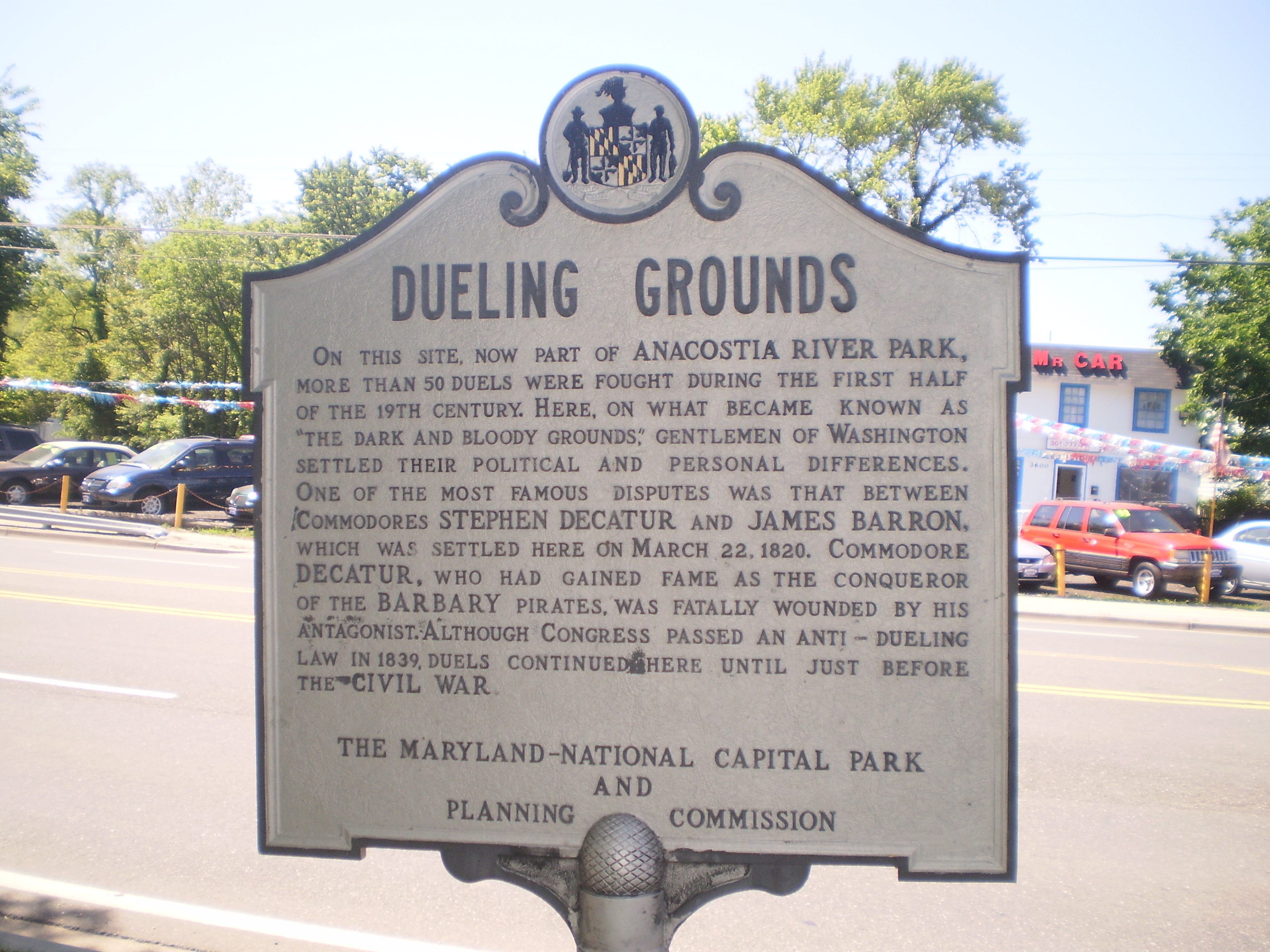
Bladensburg Dueling Grounds
The argument was about steamboat speed. In June 1836, twenty-two-year-old Daniel Key -- the son of Francis Scott Key, author of "The Star-Spangled Banner" -- met fellow Naval Academy midshipman John Sherbourne in a shaded grove along a creek just northeast of Washington, D.C. They faced each other with pistols drawn, following the formal rituals of the code duello. Key did not survive. His death was just one of roughly fifty duels fought at this small spit of land along what locals came to call "Blood Run" -- officially Dueling Creek, a tributary of the Anacostia River. Today the site sits within the town of Colmar Manor, Maryland, a fraction of its original size, quiet and unremarkable. But for six decades, this was the deadliest patch of ground in American politics.
An Affair of Honor
The Bladensburg Dueling Grounds opened for business, so to speak, in 1808, when U.S. Representative Barent Gardenier of New York challenged U.S. Representative George W. Campbell of Tennessee. The quarrel grew from Gardenier's opposition to President Thomas Jefferson's trade embargo with Great Britain and France. Gardenier was wounded but recovered and won reelection. That first contest established the site's reputation. Situated just across the D.C. border in Maryland -- where enforcement of anti-dueling laws was lax -- the grove became the preferred venue for gentlemen, military officers, and politicians to settle what they called "affairs of honor." Each duel followed the code duello, a formalized set of rules governing weapons, distance, seconds, and protocol. The exact number of duels fought at Bladensburg may never be known. Dueling was illegal, records were deliberately obscured, and many encounters went undocumented.
The Commodore Falls
The most famous duel at Bladensburg ended the life of one of America's greatest naval heroes. In 1820, Commodore Stephen Decatur -- celebrated for his daring exploits against the Barbary pirates and in the War of 1812 -- was mortally wounded by Commodore James Barron in a dispute that had festered for years. Decatur was carried from the field and died later at his home in Washington, D.C. His death shocked the nation and became the most widely publicized duel of the nineteenth century. The spot where Decatur and Barron faced each other is no longer within the boundaries of the current Dueling Creek Park. A year before Decatur's death, Colonel John Mason McCarty had killed his own second cousin, General Armistead Thomson Mason, in a musket duel at the same grounds. McCarty survived but was haunted by the killing for the rest of his life.
Death in Ninety Seconds
The duel that finally forced Congress to act was fought on February 24, 1838. Congressman Jonathan Cilley of Maine, a reluctant participant, faced Congressman William J. Graves of Kentucky. Graves was serving as a stand-in for New York newspaper editor James Webb, whom Cilley had publicly called corrupt. The weapon choice was rifles at 80 yards -- Cilley selected rifles specifically to negate Graves' reputation as an expert pistol shot. A single shot severed an artery in Cilley's leg. He bled to death in ninety seconds. The killing of a sitting congressman by another sitting congressman was too much even for an era accustomed to political violence. Less than a year later, on February 20, 1839, Congress passed an act prohibiting the giving or accepting of duel challenges within the District of Columbia. The law did not end dueling at Bladensburg -- it simply made participants more discreet.
The Last Shots on Blood Run
Dueling's decline tracked the arc of the Civil War. The wholesale slaughter of organized battle made the ritualized killing of individuals seem less romantic and more absurd. The last recorded duel at Bladensburg was fought in 1868 between General A. Galletin Lawrence, the U.S. Minister to Costa Rica, and Baron Kusserow, Secretary of the German Legation. It was a bloodless affair -- both men fired and missed, or perhaps deliberately aimed wide, and honor was declared satisfied. After that, the grounds fell silent. Bladensburg's reputation as a place of violence gradually softened into something more like dark tourism. The site became a popular attraction, visitors drawn by the romanticized stories of honor and pistols at dawn. Today, only a small remnant of the original grounds survives as Dueling Creek Park, a modest green space that gives little hint of the blood once spilled beneath its trees. The creek still flows into the Anacostia, carrying its old nickname -- Blood Run -- like a whisper from a more dangerous time.
From the Air
Located at 38.925N, 76.940W in Colmar Manor, Maryland, just northeast of Washington, D.C., along Dueling Creek, a tributary of the Anacostia River. The site is a small park within a densely developed suburban area. Recommended viewing altitude: 2,000-3,000 feet AGL. Nearby landmarks include the Anacostia River and Bladensburg Waterfront Park. Nearest airports: KDCA (Ronald Reagan National), approximately 6 nm southwest; KADW (Joint Base Andrews), approximately 9 nm southeast. This area falls within the Washington D.C. Special Flight Rules Area (SFRA).