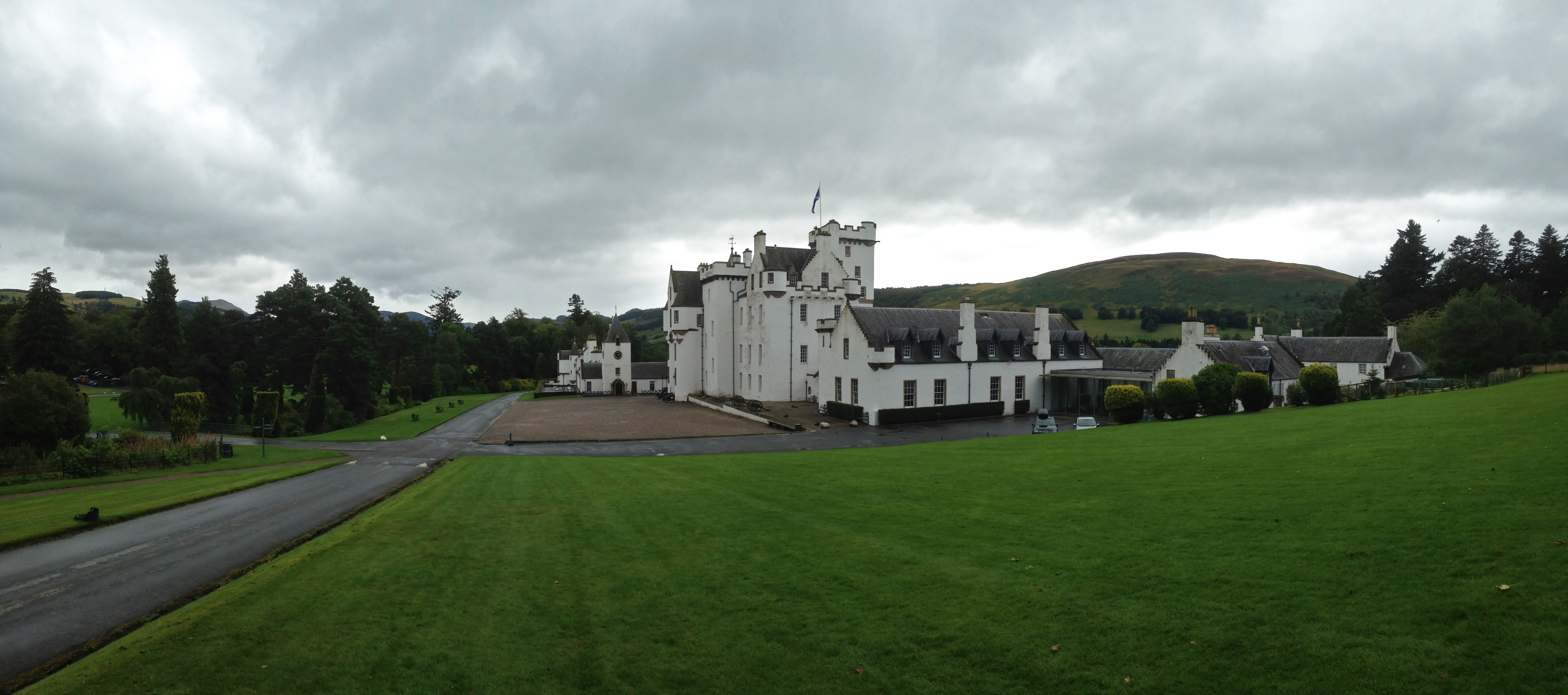
Blair Castle
Every year, the Atholl Highlanders parade in the grounds of Blair Castle in Perthshire, wearing kilts and carrying rifles. They are the only legal private army in Europe, and their existence is owed to an afternoon in 1844 when Queen Victoria, visiting the castle with Prince Albert, was so impressed by the men who escorted her that she granted them the right to bear arms. It is a peculiar distinction -- a ceremonial relic from a castle whose history is anything but ceremonial. Blair Castle has stood at the strategic gateway to the central Scottish Highlands for over seven hundred years, and the story of who held it, who besieged it, and who was besieging whom is one of the most tangled in Scottish military history.
Built by an Interloper
The castle's origin story involves a dispute between neighbors. In 1269, while David Strathbogie, Earl of Atholl, was away on crusade, John Comyn, Lord of Badenoch, began building a tower on the Earl's land. When Strathbogie returned and discovered the intrusion, he complained to King Alexander III, who ruled in the Earl's favor. Strathbogie reclaimed his land and incorporated Comyn's tower into his own castle. That tower -- known as Comyn's Tower or Cummings' Tower -- is the oldest surviving part of Blair Castle, and though it was largely rebuilt in the fifteenth century, its six storeys still anchor the structure. The castle stands in Glen Garry on what is now the A9 road, the main route through the central Highlands, and its strategic position has made it a prize worth fighting over in every major conflict to touch this part of Scotland.
A Family Divided
Blair Castle's most dramatic episode came during the first Jacobite rising in 1689, and it turned on the divided loyalties of a single family. The Marquess of Atholl, head of Clan Murray, chose to support the new government of William and Mary -- but his factor, Patrick Stewart of Ballechin, held the castle for the exiled King James. When Atholl's eldest son, Lord John Murray, arrived to take possession, Ballechin refused him entry. Murray laid siege to his own family's castle while General Mackay marched north to support him. Viscount Dundee, the Jacobite commander, saw an opportunity and moved to intercept. The result was the Battle of Killiecrankie, fought just three miles from Blair Castle on July 27, 1689. Dundee and his officers had held their council of war in the castle the night before. He won the battle but died in the fighting, and Blair Castle remained in Jacobite hands for months afterward, with Highland chiefs swearing a bond of allegiance within its walls.
Besieged Again -- and Again
The castle's strategic importance drew conflict like a magnet. During the English Civil War, the Murrays supported the Royalist cause, and Cromwell's army seized Blair Castle after his invasion of Scotland in 1650. In the Forty-Five -- the final Jacobite rising of 1745 -- Blair Castle was occupied twice by Prince Charles Edward Stuart's army. When the Jacobites abandoned it, government forces moved in and held it against a Jacobite siege in March 1746. The garrison was nearly starved out before the Jacobite forces withdrew to fight at Culloden, the battle that ended the Stuart cause for good. It was the last castle in Britain to be besieged -- a distinction that belongs to the fabric of the building as much as to the events themselves. The walls of Blair Castle bear the marks of every conflict from the Wars of Scottish Independence to the last gasp of Jacobitism, each generation of Murrays navigating the shifting loyalties of Scottish politics while trying to hold onto the castle that defined their family.
Victorian Transformation
The castle that visitors see today is largely a Victorian creation. In the 1870s, the architect David Bryce remodeled the entire building for the seventh Duke of Atholl in the Scots Baronial style, adding the ballroom and unifying the sprawling complex of medieval towers and eighteenth-century additions into a single coherent facade. The interior houses generations of Murray family collections: weapons, paintings, furniture, hunting trophies, and needlework accumulated over seven centuries. Diana's Grove, in the castle grounds, contains specimen trees that include one of the tallest in Britain -- a Grand Fir measured at nearly sixty-three metres in 2009. The family burial ground lies beside the ruins of St Bride's Kirk, the old village church that fell into disuse when the estate village was relocated in 1823. The tenth Duke placed the castle and most of the estate in a charitable trust before his death in 1996, ensuring it would remain in Scotland even though the eleventh Duke lived in South Africa. The castle has been open to the public since 1936, and the Atholl Highlanders still parade each spring -- a private army with no enemies, in a castle that has known too many.
From the Air
Blair Castle stands at 56.77°N, 3.86°W near the village of Blair Atholl in Perthshire. The white-walled castle and its extensive grounds are visible from the air in Glen Garry, with the A9 road running nearby. The Pass of Killiecrankie lies approximately 3 nm to the southeast. Nearest airport: Perth (EGPT) approximately 28 nm to the south.