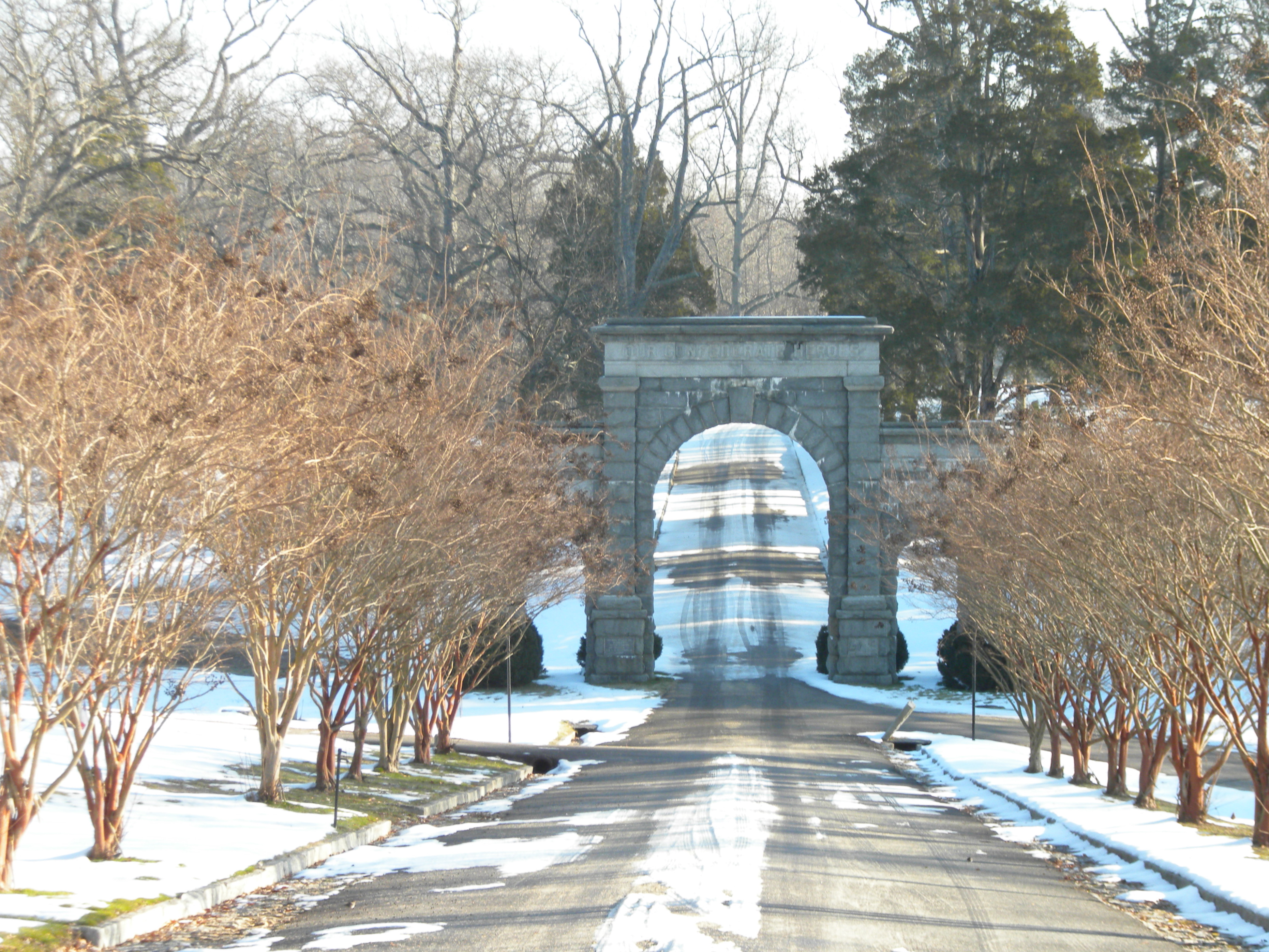
Blandford Cemetery
Of the 30,000 Confederate soldiers buried at Blandford Cemetery, only 3,700 names are known. The rest lie beneath the soil of Petersburg, Virginia, in a mass grave that speaks to the staggering scale of the Civil War's longest sustained campaign. But Blandford is far more than a military burial ground. Since a brick church rose on Well's Hill above the Appomattox River in 1737, this ground has served as Petersburg's most intimate record of life and death, holding people of all classes and races, from colonial merchants to Civil War generals to the city's first Black female mayor.
A Church on the Hill
The story begins in 1735, when Bristol Parish split and the vestry acquired a scenic overlook above the Appomattox River. Colonel Robert Bolling, Major William Poythress, and Captain William Starke contracted with Colonel Thomas Ravenscroft to build a brick church, which opened on August 13, 1737. The settlement of Blandford grew nearby on Poythress's lands, chartered alongside Petersburg by the Virginia General Assembly in 1748. After the Revolutionary War, both towns merged into the borough of Petersburg. By 1799, the church saw services only a half dozen times per year, and the cemetery fell into ruin. The City of Petersburg acquired it in 1819, transforming an abandoned churchyard into a municipal cemetery that would become a showplace for the city's ornamental ironwork and elaborate mourning customs.
Where Every War Left Its Mark
Between 1820 and 1865, Petersburg prospered as a manufacturing center with six tobacco factories by 1835, becoming Virginia's third-largest city by 1850. The cemetery grew with it. Robert Buckner Bolling constructed a granite and marble mausoleum that aspired to be one of the finest in the Southern states. Then the Civil War arrived, and Petersburg's railroads made it a crucial supply line for the Confederate capital at Richmond. The Siege of Petersburg lasted from June 15, 1864, to April 3, 1865, and the cemetery hill itself became a strategic target for its commanding view of the city and the railroad bridge over the Appomattox. The cemetery sat directly behind Confederate siege lines at Gracie's, Colquitt's, and Elliott's salients. When the fighting ended, thousands of dead from the battlefields of Fredericksburg, Manassas, the Wilderness, Spotsylvania, and Sharpsburg were reinterred here, with further reburials occurring as late as 1992.
The Flowers That Started a Holiday
Blandford Cemetery holds a contested but compelling connection to Memorial Day. Shortly after the war, schoolteacher Nora Fontaine Maury Davidson became a passionate advocate for honoring the Confederate dead. In her 1903 memoir, she recounted taking 80 pupils on May 26, 1866, to decorate the graves of soldiers killed during Petersburg's evacuation. The Memorial Society of the Ladies of the City of Petersburg, formed on May 20 of that year with 200 members, laid decorations on June 9, 1866, the anniversary of the Battle of Old Men and Boys. In March 1868, the wife of Union General John A. Logan visited Blandford Church and noticed flowers and tiny Confederate flags on the graves. On May 5, 1868, General Logan issued General Order No. 11, naming May 30 as a day for decorating the graves of Union dead. While historians Thomas Bellware and Richard Gardiner noted in 2014 that Logan was already aware of Southern memorial observances before his wife's visit, Blandford remains one of the earliest documented sites of Decoration Day ceremonies.
Lives Carved in Stone
Walk the grounds and the headstones read like a cross-section of American history. Colonel Robert Bolling, the English-born merchant and planter who arrived in 1646, rests here alongside Confederate Major General William Mahone, the railroad engineer turned soldier whose tactical brilliance shaped the Siege of Petersburg. Hollywood comes calling too: Joseph Cotten, the film and stage actor known for Citizen Kane and The Third Man, was born in Petersburg in 1905 and returned here in death in 1994. Florence Saunders Farley, Petersburg's first Black female mayor, lies here as well, a testament to the city's long and complex racial history. Adjacent to Blandford stands People's Memorial Cemetery, established in 1840 when a group of African American men acquired an acre of land across the road, making it one of Virginia's largest African American cemeteries.
Weathering the Centuries
A Gothic iron arch erected in 1884 by the Ladies Memorial Association still marks the entrance to Memorial Hill, inscribed with the words "Our Confederate Dead" on one side and "Waiting for Reveille" on the back. In 1889, a granite monument crowned by a bronze Confederate soldier was laid atop the hill. In 1900, the Ladies Memorial Association began converting Blandford Church into a memorial chapel. The cemetery has endured its share of hardship: vandalism in 1986 and 1987 forced the Historic Blandford Cemetery Foundation to reconstruct the entrances, and Hurricane Isabel in 2003 uprooted trees and crushed ironwork and table tombs. Listed on the National Register of Historic Places in 1992, Blandford endures as one of the South's most layered and significant burial grounds, a place where colonial ambition, Civil War devastation, racial history, and the origins of a national holiday all converge on a single Virginia hillside.
From the Air
Blandford Cemetery sits at 37.226°N, 77.381°W on a prominent hill overlooking the Appomattox River in Petersburg, Virginia. Best viewed at 2,000-3,000 feet AGL. The cemetery's tree-lined layout and adjacent Blandford Church are visible from the air. Petersburg Municipal Airport (KPTB) lies approximately 3 miles to the southeast. Richmond International Airport (KRIC) is about 25 miles north. The Appomattox River winding through the city provides a strong visual reference for navigation.