Blantyre
The city borrowed its name from a small town in Scotland, birthplace of the missionary David Livingstone, and the borrowing tells you everything about how Blantyre began. Scottish missionaries arrived in the Shire Highlands in the 1870s, drawn by Livingstone's reports of fertile land and the horrors of the slave trade he had witnessed along Lake Malawi. They built a mission, a church, and eventually an entire settlement at roughly 1,000 metres elevation, where the air was cooler and the ground held enough moisture for tea and tobacco. The city that grew from that mission is now Malawi's largest, its commercial engine, and the place where the country's colonial past, its trading present, and its cultural identity collide most visibly.
A Market City at the Crossroads
Blantyre is where Malawi does its business. Traders from across the region, including neighbouring Mozambique, converge on the downtown commercial district to stock up on food, construction materials, and electronics. The streets are lined with Indian-run shops, a legacy of the South Asian trading communities that arrived during the colonial era, and nearby Limbe -- once a separate town, now effectively a twin city -- mirrors the pattern. A sprawling open-air market offers fruits, vegetables, used clothing, and building supplies at prices that reward the patient haggler. Western-style supermarkets like Game and Shoprite coexist with family-run stores catering to expats with hard-to-find imports, bakeries, and ice cream counters. Counterfeit goods are everywhere, and prices for the same item can vary wildly from one shop to the next. Blantyre rewards those who shop around.
The Missionary Imprint
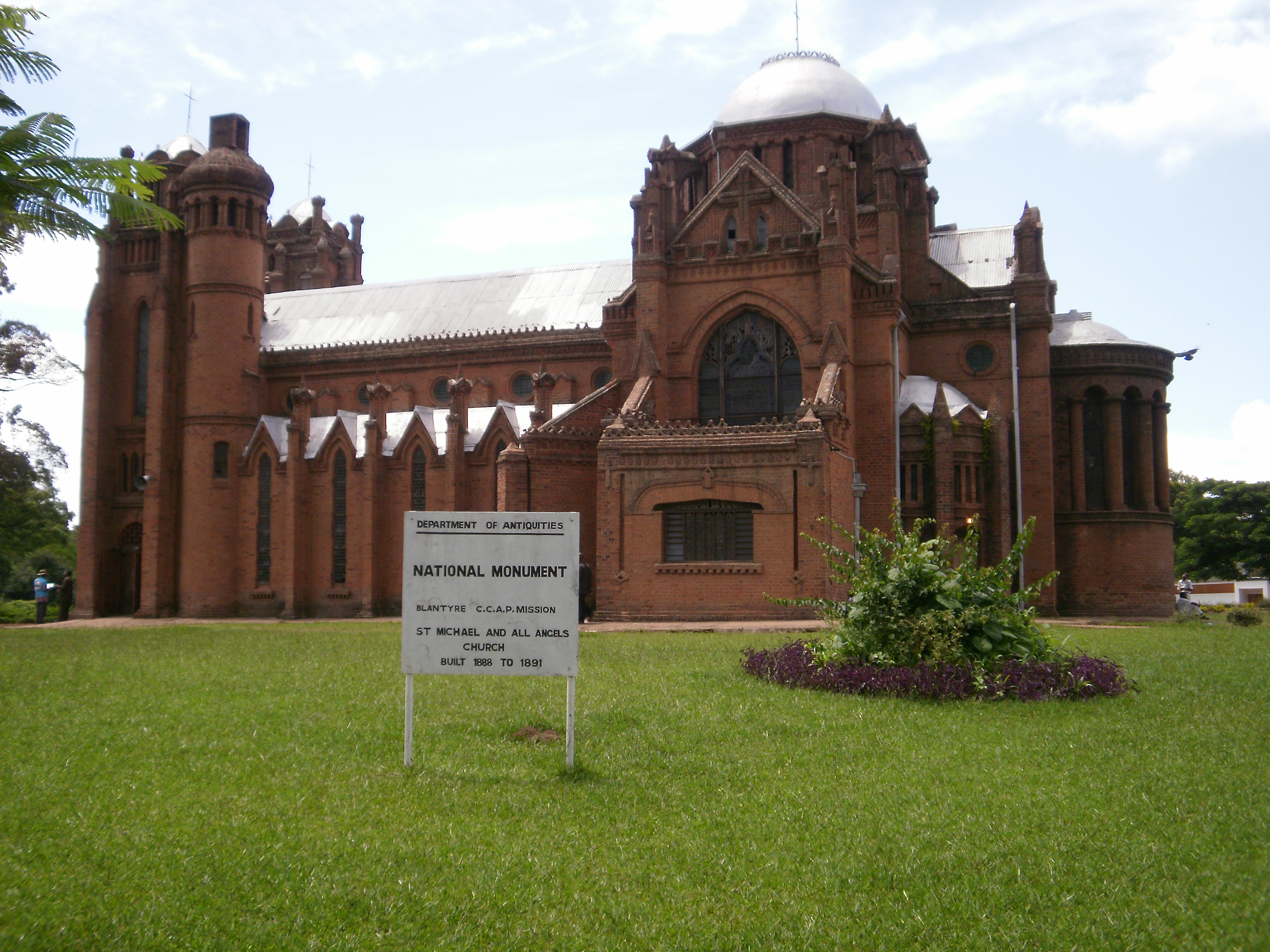
The most striking physical reminder of the city's origins is St. Michael and All Angels Church, a brick masterpiece built between 1888 and 1891 on the original mission site off Chileka Road. Designed by Reverend David Clement Scott -- who had no formal architectural training -- the church used eighty-one different forms of brick, each detail tested with dry bricks before final assembly. It has been described as the first permanent Christian church erected between the Zambezi and the Nile. Nearby, the Society of Malawi, housed above the historic Mandala House, preserves archives and scholarly papers that trace the country's transformation from mission territory to protectorate to nation. For anyone curious about Malawi's layered past, the reading room is open weekday mornings.
Getting There the Hard Way
Reaching Blantyre is an exercise in patience that says as much about Malawi's infrastructure as anything in a guidebook. Flights connect the city to Johannesburg, Dar es Salaam, Harare, Lusaka, Nairobi, and Addis Ababa. The M1 highway from the capital, Lilongwe, is the main overland route. An Intercape bus from Johannesburg takes up to thirty-five hours. And then there is the railway. Central Eastern African Railways theoretically operates a service from the Mozambican border at Nayuchi, involving a change at Balaka and a journey of approximately twenty-two hours -- once a week. There are no trains from Lilongwe at all. The intrepid traveller arrives at Blantyre station to find it mostly quiet, a relic of ambitions that the country's difficult terrain and limited budgets never quite fulfilled.
Street Life After Dark
By day, Blantyre is walkable and approachable. The city centre is compact enough to explore on foot in a couple of days, and minibuses connect Blantyre to Limbe for a few hundred kwacha. But after sunset, the calculus changes. Night-time muggings occur, and the standard advice is to have the phone number of a reliable taxi driver before darkness falls. Taxis congregate at the Mount Soche Hotel, the city's de facto transport hub, and negotiation is expected. For visitors who stay out for dinner, the rewards include Chez Maky, a Cameroonian-owned restaurant on a multi-level wooden deck on Kabula Hill Road, known for grilled meat and real coffee, and the 21 Grill at Ryalls Hotel, where the service alone is worth the visit in a country where attentive hospitality remains a work in progress.
From the Air
Located at 15.79S, 35.01E in the Shire Highlands of southern Malawi, at approximately 1,000 metres elevation. Chileka International Airport (FWCL) serves the city, located about 16 km to the south. From altitude, Blantyre appears as a sprawling urban area in a landscape of tea estates and rolling green hills. The Mulanje Massif is visible to the east on clear days, and the Shire River valley lies to the west. Limbe is distinguishable as a connected urban area to the east of the main city centre.