The Dome They Named a Church For
In Javanese, mblenduk means dome. It is such a simple, satisfying word that it became the name the people of Semarang gave their oldest church, never mind that its formal title runs to eleven syllables: the Protestant Church in Western Indonesia Immanuel Semarang. Nobody calls it that. They call it Gereja Blenduk, the dome church, and when you see its copper-clad crown rising above the colonial shopfronts of Letjen Suprapto Street, you understand why. The dome is the building's argument, its identity, the feature that makes it unmistakable from the ground or from the air. Established in 1753, Blenduk is the oldest church in Central Java, and the dome that gave it its name has watched over nearly three centuries of worship, war, independence, and quiet Sunday mornings.
Before the Dome
The original Blenduk looked nothing like the building that stands today. When Dutch colonists established the congregation in 1753, they built in the joglo style, the traditional Javanese form with a steeply pitched pyramidal roof supported by central pillars. It was a Protestant church, but Catholics worshipped here too, since Semarang had no Catholic church of its own until St. Joseph's was built in the Gedangan neighborhood. The joglo structure served for thirty-four years before it was rebuilt in 1787. But the transformation that created the Blenduk people recognize today came in 1894, when architects H.P.A. de Wilde and W. Westmas spearheaded a renovation that added the copper dome and flanking towers. The church shifted from Javanese vernacular to something far more European in its ambitions, yet it never lost its local nickname.
An Octagon in Copper and Teak
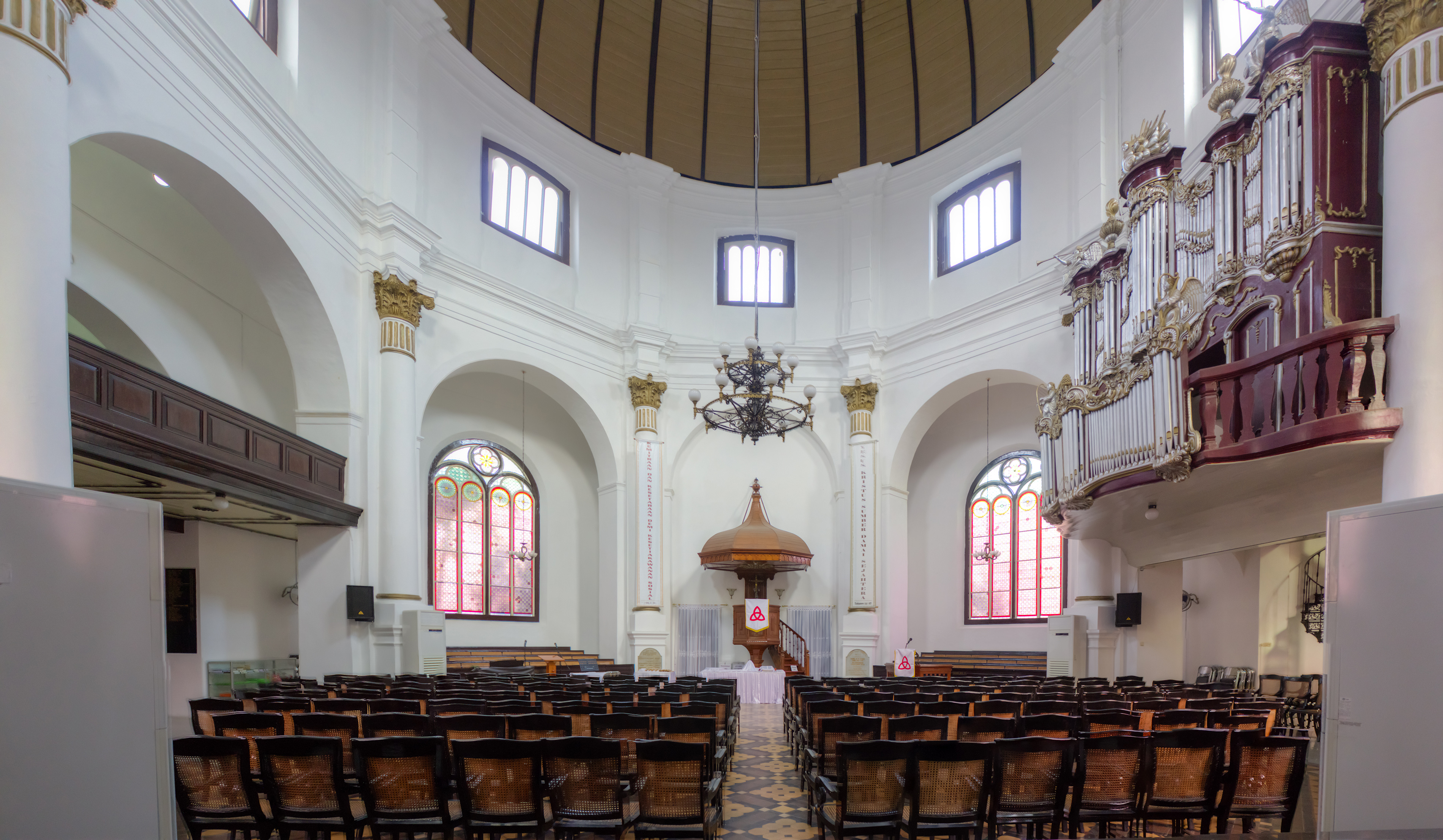
Blenduk sits in a small courtyard between former colonial office buildings, the Jiwasraya building across the street to the south and the Kerta Niaga offices to the west. The church itself is octagonal, built on a stone foundation with single-layer brick walls. Its dome rides on thirty-two steel beams, eight large and twenty-four small, and is clad in copper that has weathered to a patina visible blocks away. Twin towers flank the main entrance, square at their bases and gradually rounding as they rise to their own smaller domes. Roman-style porticoes with saddle-shaped roofs extend from the eastern, southern, and western faces, while a cornice of horizontal lines traces the building's perimeter. The south-facing entrance features wood-panel double doors, and the windows are etched and stained glass, filtering equatorial light into the interior.
Where Rattan Meets Baroque
Step inside and the cultural layering becomes tangible. Wooden pews have rattan seats, a material as Javanese as the teak platform beneath the octagonal pulpit. The floor is covered in black, yellow, and white tiles arranged in geometric patterns. Against this tropical interior sits a Baroque pipe organ from the 1700s, now nonfunctional but still present, its pipes silent witnesses to the church's Dutch colonial origins. In the northern corner, a spiral staircase leads to the second floor, its metalwork etched with the name of its manufacturer: Pletterij den Haag, the rolling mill in The Hague. It is a small detail, easily missed, but it traces a direct line from this equatorial city to a factory floor in the Netherlands, a reminder of the colonial infrastructure that built this place and the distances it spanned.
Still Standing, Still Singing
Blenduk has survived more than most buildings are asked to endure. It outlasted the Dutch colonial era, the Japanese occupation, and the turbulence of Indonesian independence. Another series of renovations began in the early 2000s, careful work to preserve what time and the tropical climate had worn. In 2003, the congregation celebrated the church's 250th anniversary. As of 2004, roughly 200 families belonged to the congregation, holding regular Sunday services in a building that doubles as one of Semarang's most visited tourist attractions. In February 2009, the Central Java branch of the Architects' Society of Indonesia awarded Blenduk the prize for Best Maintained Old Place of Worship, an acknowledgment that preservation requires as much devotion as the services held within.
The Old Town Anchor
Semarang's Kota Lama, the old town district, is a neighborhood of Dutch colonial architecture slowly being restored and reimagined. Blenduk anchors this quarter. Its copper dome is a fixed point among the warehouses, banks, and trading offices that once served the Dutch East Indies' commerce. The church does not stand alone in its significance, but it stands longest. Other colonial buildings in Kota Lama have been repurposed or left to decay, but Blenduk continues to serve its original function, a Protestant congregation worshipping in the same space where their predecessors gathered in 1753. The Javanese word mblenduk may just mean dome, but in Semarang, it has come to mean persistence.
From the Air
Located at 6.97S, 110.43E in Semarang's Kota Lama (old town) district on Java's north coast. Ahmad Yani International Airport (ICAO: WARS) is approximately 6 km to the west. The copper dome is a distinctive feature in the old town grid, best spotted at 2,000-3,000 feet when approaching from the Java Sea to the north. The surrounding area is dense urban fabric with colonial-era buildings along the waterfront.