Bletchley Park
"Do not talk at meals. Do not talk in the transport. Do not talk travelling. Do not talk in the billet. Do not talk by your own fireside. Be careful even in your Hut." The 1942 security warning issued to staff at Bletchley Park was not paranoia -- it was survival. If Germany had discovered that the Allies were reading its encrypted communications, the entire advantage would have been lost. So nearly 9,000 people, at the peak of operations in January 1945, came to work at a Victorian country estate in Buckinghamshire, broke some of the most sophisticated ciphers ever devised, and told nobody. Churchill called them "the geese that laid the golden eggs and never cackled."
Captain Ridley's Shooting Party
The estate was purchased in 1938 by Admiral Sir Hugh Sinclair, head of the Secret Intelligence Service, using 6,000 pounds of his own money because the government said it lacked the budget. Sinclair and his colleagues inspected the site under the cover of "Captain Ridley's shooting party," and what they found was geographically ideal: Bletchley sat on the railway junction where the Varsity Line between Oxford and Cambridge met the main West Coast line from London to the north. The universities were expected to supply the codebreakers, the railway would bring them, and the telegraph station at nearby Fenny Stratford provided the communication links. The mansion itself -- a hybrid of Victorian Gothic, Tudor, and Dutch Baroque that one architect called "a maudlin and monstrous pile" -- became the headquarters of the Government Code and Cypher School when its staff relocated from London on 15 August 1939, two weeks before war began.
Breaking Enigma
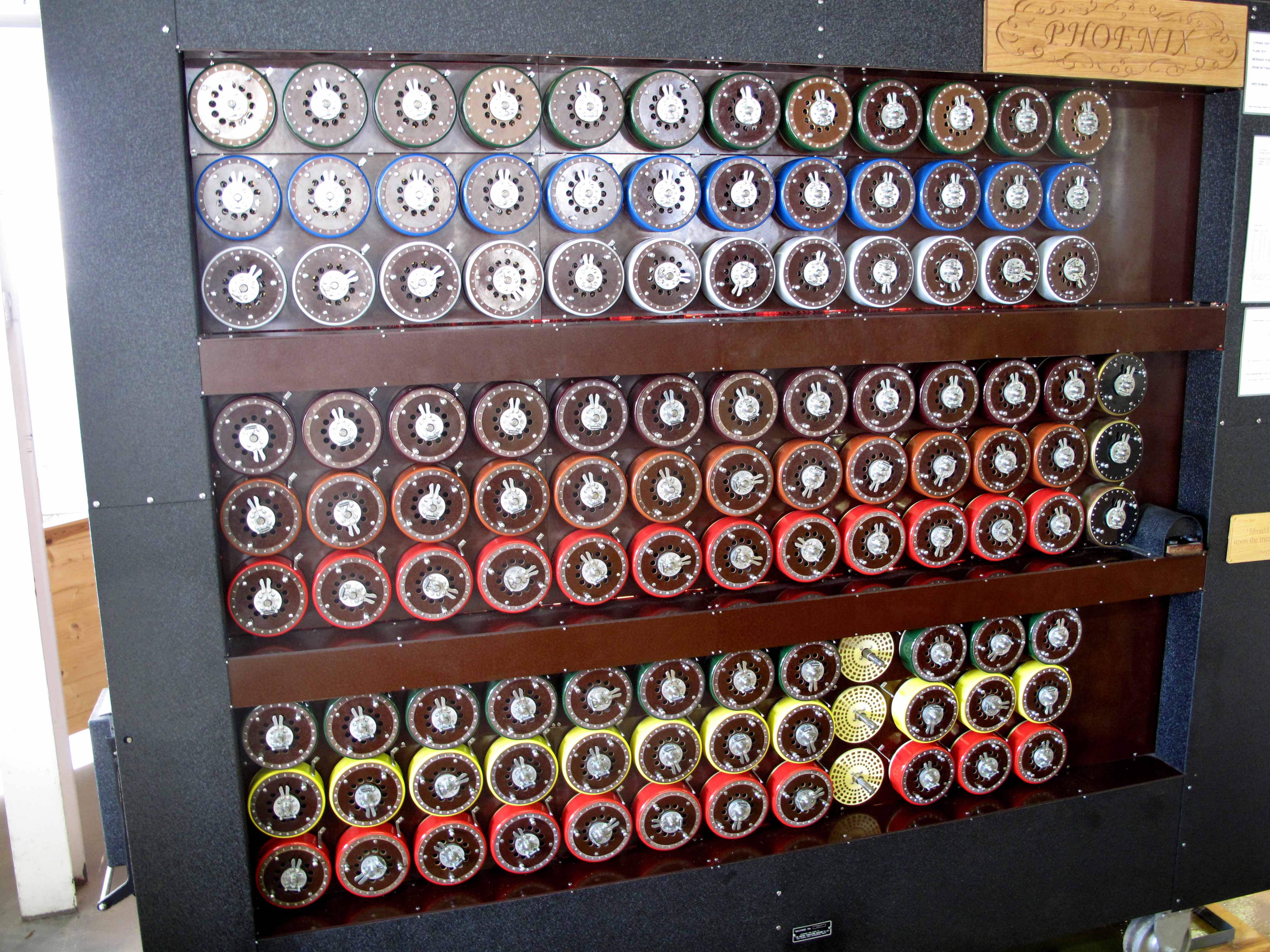
The German Enigma machine produced encrypted messages of extraordinary complexity, but it was not invulnerable. Polish mathematicians Marian Rejewski, Jerzy Rozycki, and Henryk Zygalski had broken earlier versions of Enigma before the war, and their work provided a crucial foundation. At Bletchley, Alan Turing and Gordon Welchman designed the bombe, an electromechanical device that could determine the daily settings of the Enigma machines across German military networks. Each bombe was seven feet high and wide, two feet deep, and weighed about a ton. At its peak, Bletchley was reading approximately 4,000 messages per day. The intelligence derived from decrypted signals, designated "Ultra," was classified above the highest normal security level. Prior to the Normandy landings on D-Day, the Allies knew the locations of all but two of Germany's fifty-eight Western-front divisions.
Colossus and the Birth of Computing
The Lorenz SZ42 cipher machine, used for high-level German military communications, was even more complex than Enigma -- a twelve-rotor system that Bletchley codenamed "Tunny." The cryptanalysts in the Testery worked out the machine's logical structure without ever seeing one, and their work culminated in something unprecedented: Colossus, the world's first programmable digital electronic computer. Designed and built by Tommy Flowers and his team at the Post Office Research Station at Dollis Hill, the prototype first worked in November 1943, was delivered to Bletchley in January 1944, and became operational on 5 February. An enhanced Mark 2 Colossus was running by 1 June 1944, just in time for D-Day. Flowers produced one Colossus per month for the rest of the war, totalling ten machines with an eleventh partially built. They were operated primarily by women of the Women's Royal Naval Service in a section named the Newmanry, after its head, Max Newman.
The Geese That Never Cackled
Three-quarters of Bletchley Park's staff were women, drawn from middle-class backgrounds, many holding degrees in mathematics, physics, and engineering. They performed the calculations, operated the machines, and decoded the signals. Joan Clarke was one of the few employed as a full cryptanalyst. Mavis Lever, working in Dilwyn Knox's section, broke the Italian naval Enigma that enabled the British victory at the Battle of Cape Matapan in 1941. Recruitment was inventive: in 1941, The Daily Telegraph was asked to organise a crossword competition, after which promising solvers were quietly approached. The secrecy held for thirty years after the war. Not until F. W. Winterbotham published The Ultra Secret in 1974 did the public learn what had happened at Bletchley. The site nearly became a housing estate before a trust was established in 1991. Today it is a museum, restored with help from an eight-million-pound Heritage Lottery Fund grant. The Duchess of Cambridge visited in 2014 -- her grandmother Valerie and great-aunt Mary Glassborow had both worked as codebreakers in Hut 6.
From the Air
Located at 51.998N, 0.741W in Bletchley, now part of Milton Keynes, Buckinghamshire. The estate is identifiable from the air as a cluster of low buildings and huts amid green grounds, adjacent to Bletchley railway station. The Victorian mansion is visible at the centre. Milton Keynes's distinctive grid road pattern extends to the north. Nearest airports: EGMC (Cranfield, 8nm north), EGTK (Oxford Kidlington, 30nm west). The West Coast Main Line runs along the eastern edge of the site.