The Hill That a Billion Screens Made Famous
You have almost certainly seen this hill. It sat behind every email you wrote, every spreadsheet you cursed, every game of Minesweeper you pretended was work. For more than a decade, a single photograph of a green slope under a blue sky greeted over a billion Windows XP users every time they powered on their computers. The hill is real. It sits along the Sonoma Highway in California wine country, a few miles from the Napa-Sonoma county line, and the photographer who shot it swears he never touched it up -- not even a little.
A Photographer Pulls Over
In January 1996, Charles O'Rear was driving along California State Route 121 where it intersects Route 12 in southern Sonoma County. O'Rear was a veteran National Geographic photographer with decades of editorial work behind him, and he was alert that day -- a winter storm had just passed, and the rains had turned the hills an almost absurd shade of green. Then he saw it: a rolling hill, bare of the grapevines that normally covered it, glowing under a clearing sky. "There it was! My God, the grass is perfect!" he remembered thinking. He pulled over, loaded his Mamiya RZ67 medium-format camera with Fujifilm Velvia slide film, and shot the image. No filters. No digital enhancement. No Photoshop -- a claim that even Microsoft's own developers would later struggle to believe.
Why the Hill Was Bare
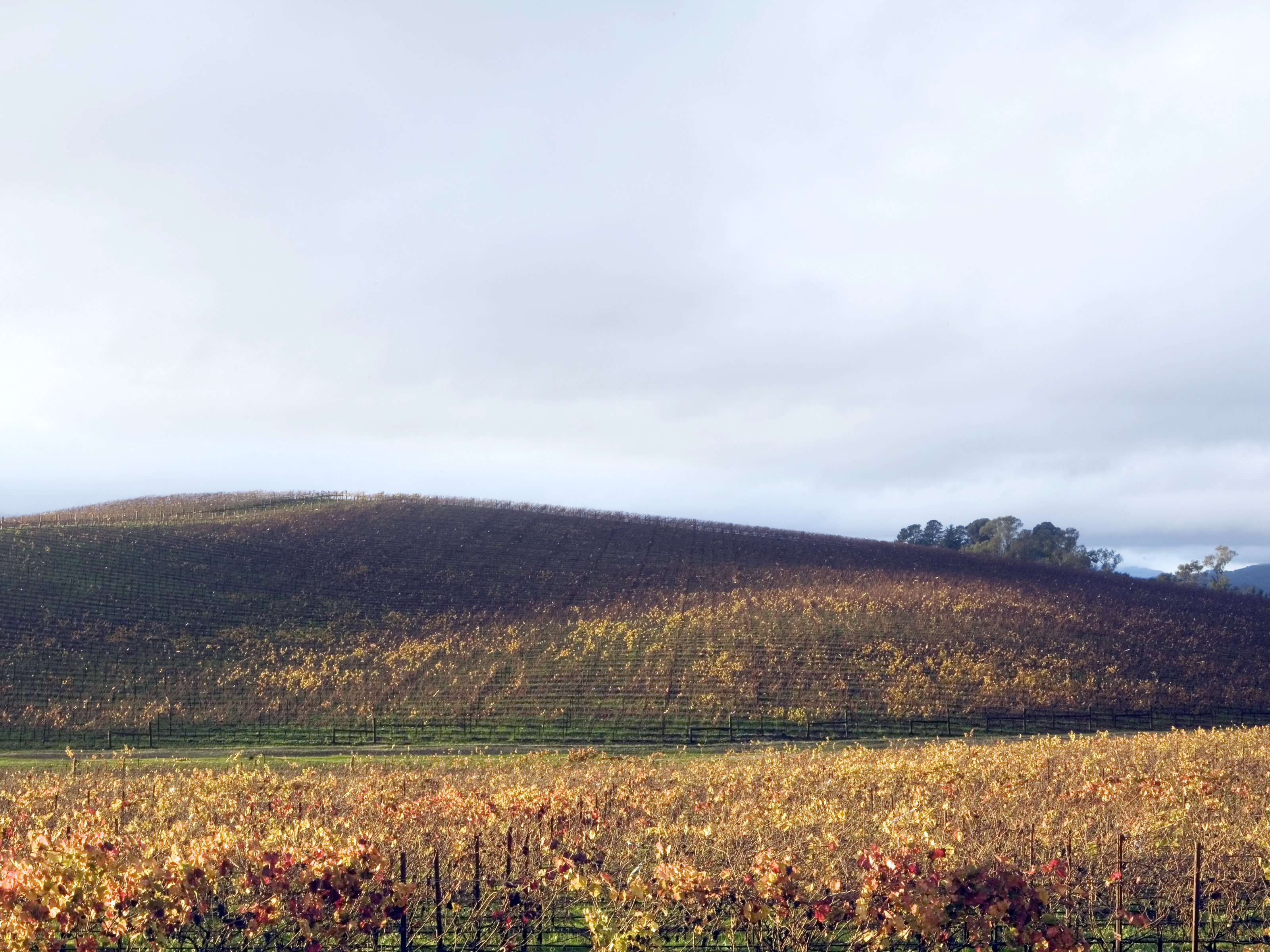
The green perfection O'Rear captured was an accident of agricultural disaster. Years before he arrived, a phylloxera infestation had ravaged the vineyards that covered the hillside. Phylloxera, a microscopic insect that feeds on grapevine roots, had devastated Sonoma and Napa counties in the late 1980s and early 1990s, forcing growers to rip out entire vineyards and replant with resistant rootstock. The process took years. In the interim, the bare hill returned to grass -- thick, rain-fed, impossibly green winter grass that looked more like Ireland than California. It was a narrow window. Within a few years, new vines would cover the slope again, and the view O'Rear captured would vanish under orderly rows of trellised grapevines.
From Stock Photo to Global Icon
O'Rear titled the image Bucolic Green Hills and filed it with Westlight, the stock photo agency he had co-founded. When Bill Gates' company Corbis acquired Westlight in 1998, the image entered a vast digital archive. Two years later, Microsoft's Windows XP development team came browsing. They wanted something grounded -- the cloud-and-sky imagery of Windows 95 had felt too abstract. Green grass and blue sky matched the XP branding palette perfectly. Microsoft did not simply license the photograph; they bought all rights to it outright, paying O'Rear what he has described as the second-largest sum ever given to a photographer for a single image. A confidentiality agreement prevents him from revealing the exact figure, though it has been reported in the low six figures. The image, renamed Bliss, shipped as the default wallpaper on every copy of Windows XP and appeared across a $200 million advertising campaign.
The Most Viewed Photograph Nobody Could Place
Despite being seen by an estimated billion-plus people, the origins of Bliss remained obscure for years. Speculation placed the hill in France, Ireland, Switzerland, New Zealand, even southeastern Washington. Dutch users were certain it was Ireland because Microsoft had filed the image under the name "Ireland" in the Dutch version of XP. Academics called it one of the most recognizable contemporary landscape photographs. A cult following developed. When Microsoft finally retired Windows XP in April 2014, a wave of nostalgic media coverage drew pilgrims to the site -- only to find a vineyard. The Goldin+Senneby art duo had visited as early as 2006, re-photographing the view and finding grapevines where grass had been. Art historian Julian Myers-Szupinska observed that the re-creation "loses its shine." The magic, it turned out, depended on a pest, a rainstorm, and a photographer who happened to be driving by.
Bliss After Bliss
O'Rear has conceded, with good humor, that despite a long career shooting for National Geographic -- covering Napa Valley wines, Egyptian archaeology, and stories across dozens of countries -- he will probably be remembered for one roadside photograph on a winter afternoon. Microsoft has continued to mine the image's cultural capital: a modified version appeared as a Microsoft Teams background in 2021, a 4K rendering was released in 2023, and a limited-edition holiday sweater featuring Bliss raised money for The Nature Conservancy. The hill itself remains in Sonoma County, privately owned, planted in vines, producing wine instead of wallpaper. From the air, it is an unremarkable slope in a landscape full of them. But on the ground, standing where O'Rear stood, you can still see the composition -- the curve of the hill, the depth of the valley beyond, the particular way the sky opens above the ridgeline. The grass just is not green anymore.
From the Air
Located at 38.25N, 122.41W along the Sonoma Highway (CA Route 121/12) near the Napa-Sonoma county line. The hill is privately owned vineyard land and not visually distinctive from the air -- it blends into the surrounding Sonoma Valley wine country terrain. Look for the junction of Routes 121 and 12 south of Sonoma. Nearest airports: Sonoma Skypark (0Q9) approximately 4 nm northwest, Napa County Airport (KAPC) approximately 8 nm northeast. San Francisco International (KSFO) is 40 nm south. Best viewed at 1,500-2,500 ft AGL.